



Oklahoma gets a larger share of the take than most states do, but its net revenue lags
Oklahoma squeezes a better return from its lottery than most states do from theirs, but it might get more if it loosened some rules, U.S. Census Bureau data suggest.
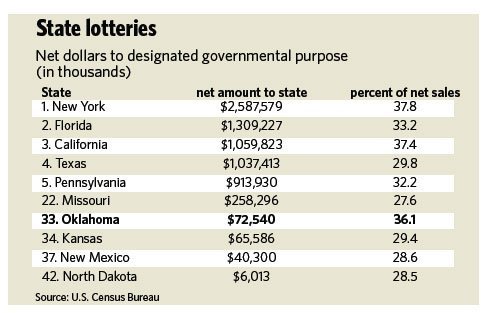
Oklahoma ranks high in the percentage of lottery proceeds netted for government use, but it's low in actual lottery sales and dollars netted, according to information gathered by the Census Bureau as part of its annual survey of state government finances.
Rollo Redburn, the Oklahoma Lottery Commission's director of administration, said the statistics are not particularly surprising.
"We've tried to tell the Legislature that if we lift the revenue restrictions, as sales go up, some of the costs will go down," he said, referring to a legal requirement that at least 35 percent of net sales must go to the Oklahoma Education Lottery Fund, which benefits education.
But Redburn also cautioned against reading too much into the Census Bureau figures.
Variations in state lotteries and their governance make strict comparisons difficult, he said.
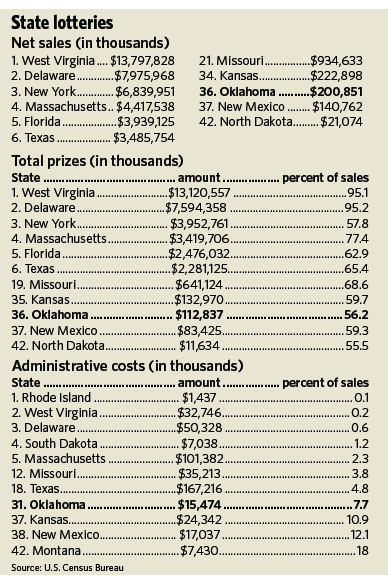
The bureau lists West Virginia and Delaware as the top two states for lottery sales in 2008, with $13.8 billion and $8 billion, respectively.
Most of that came from video gambling, however. Most states, including Oklahoma, count video gambling separately from traditional lottery games.
All told, the 41 states with lottery commissions in 2008, plus the District of Columbia, reported $77.4 billion in net revenues. Of that, $56.7 billion — about three-fourths — went to players as prizes.
Administrative costs accounted for $2.4 billion, or about 3 percent, for a net to state governments of $18.2 billion, or slightly less than 25 percent.
Oklahoma's net sales for 2008 totaled $200.8 million, 36th among the 42 lotteries. The Oklahoma Lottery returned $112.8 million in prizes for a 56.2 percent payoff percentage — the fourth-lowest in the country.
The Oklahoma Lottery's "profit margin" — the state's share, in other words — of 36.1 percent was the eighth-best of the lotteries, but its $72.5 million in net proceeds ranked only 33rd.
Oklahoma Lottery officials have argued that the state would wind up with more actual dollars if it reduced or eliminated the 35 percent earmark to offer bigger prizes.
They say other states, including Texas and North Carolina, have improved their bottom lines by doing so.
Two extreme cases — West Virginia and Delaware — net less than 5 percent each from their combined lottery and video casino games but still collect $644.5 million and $331.3 million, respectively.
That's four to eight times more than Oklahoma's net.
Oregon, Kentucky, Louisiana and Iowa — the four lottery states closest to Oklahoma in population and demographics — have greater net sales, and three of the four make more total dollars from the lottery.
Of the four, only Louisiana has a larger profit margin.
 (Click to display full-size in gallery)
 (Click to display full-size in gallery)

It seems OK Lottery officials are even having a hard time explaining the concept that less means more sometimes to politicians with their hands in the Lottery's pocket.
It's like the monkey trapped with his hand in the jug grabbing the peanut. He can't get his hand out of the jug with his fist clenched around the peanut. If he released the peanut his hand would fit through the narrow opening on the jug and he could get it out. But he won't let go of the peanut. So there he sits. You can offer him a handful of peanuts to release the one in his hand but he just can't seem to make himself let go.
That's how government is once their hand is around money in someone's pocket, they just can't seem to let go.
Parallels can be drawn on a larger scale with the federal government. Ronald Reagan proved that you can expand the economy and thereby increase government revenue by cutting taxes but that philosophy has been cast aside by the old-style, big-government crowd running things now. They ain't lettin' go of that money in our pockets, no matter what.
Oklahoma might want to consider players like viewing Live Real Ball Drawings. Otherwise computerized draw results are what someone says happened behind closed doors.
True Drawings: Powerball
Computerized: Cash 5, Hot Lotto, Pick 3
https://www.lotterypost.com/lottery-report-card.asp
Oklahoma has always had a knack for screwing everything it gets its hands on. GM closed because they bent them over one too many times. Oklahoma cannot get any new corporations to come into this hillbilly state because they know from the past, those old gray headed law-makers at the state capital will figure out a way to screw em.
So, when Oklahoma finally passed a lottery, I knew it would be a cluster-feck from the get-go!