Buddy Roogow, president of Mega Millions and Maryland Lottery director, offers no detail of changes
The California Lottery Commission voted unanimously Tuesday to join the multistate lottery Mega Millions in a drive to pump up annual ticket sales by $500 million.
Joining Mega Millions gives Californians the first significant new choice in lottery games since the California Lottery began 20 years ago - and more chances per year of winning jackpots of $100 million or more.
The state will continue to offer its signature SuperLotto game, which holds drawings twice a week.
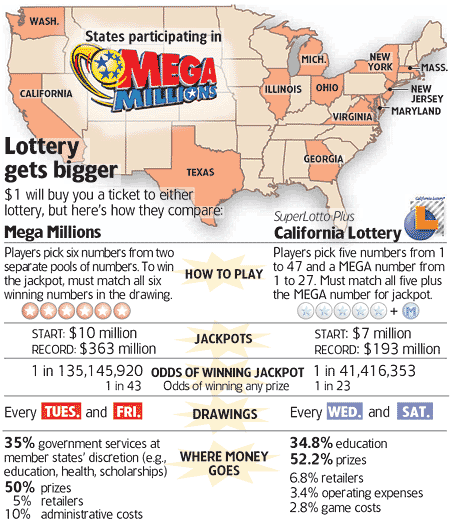
California is the 12th and largest state to join Mega Millions, a lottery that has a minimum $10 million jackpot and held a drawing for $40 million Tuesday night. The top Mega Millions jackpot was $363 million about five years ago.
Lottery representatives from each of the 11 Mega Millions states voted to invite California into their ranks, said Buddy Roogow, president of Mega Millions and Maryland Lottery director.
"We're so excited California is going to join, because it's going to mean higher jackpots and faster-growing jackpots," Roogow said after hearing about the vote.
With California stepping in, Mega Millions will undergo some changes, he said. "But we're not ready to announce what those will be."
Dylan Lane, 25, of Sacramento, said he occasionally buys a scratch-off lottery ticket but would not be likely to spring for many Mega Millions tickets.
"Chances are pretty slim," he said at the Bonfare Market in midtown. "I haven't won the lotto thus far. So given the odds, (my chances) are probably not much more impressive."
Inside the store, clerks were more optimistic at the prospect of selling a winning ticket and getting a cut of the jackpot. Plus, more lottery sales mean more sales storewide, clerk Minto Singh said.
"It's a good idea," he said. "People come in for a lottery ticket, they usually buy something else."
Mega Millions began as the Big Game in 1996 with six states. It was renamed in 2002.
No date has been set for the sale of $1 Mega Millions tickets in California, but representatives from the California Lottery and Mega Millions expected sales to begin this year.
"We are moving aggressively to implement the game," said Chon Gutierrez, the interim California Lottery director. "We are going to put together a plan and a timetable, but it's premature to pick a time."
Besides signing a contract with the multistate consortium, the commission will embark on an advertising campaign for the new game, printing new tickets, creating a new logo and installing new software, Gutierrez said.
He had no dollar amount for the game's launch in California, but every step will have to be approved by the commission, he said.
The commission considered offers from Mega Millions and Powerball, a 29-state lottery.
The commission went with Mega Millions because it racks up $100 million-plus jackpots nearly 20 times a year and the largest, urban states - those with demographics similar to California's - belong to it, Gutierrez said.
Another key was drawing dates: Mega Millions drawings are on Tuesday and Friday, which won't compete with California's SuperLotto drawings on Wednesday and Saturday, Gutierrez said.
As a heavyweight moving into the multistate consortium, California was able to bring its own rules - mainly that all nine prizes awarded in each drawing will be parimutuel payoffs for California players.
Parimutuel prizes are determined by the number of tickets sold.
In Mega Millions, the top prize is a parimutuel payoff, but the other eight prizes are fixed in the other states, starting at $175,000.
California law reserves at least 34 percent of lottery sales for public schools. If Mega Millions brings in the anticipated $500 million in new ticket sales, the state's public `schools would realize a $170 million windfall.
Annual lottery sales in California - almost $3 billion last year - have lagged at fifth in the nation.
The top seller, New York, generated nearly $6 billion in sales.
The homegrown lottery, first offered in 1984, has "matured," and players seem to rally most for the $100million-plus jackpots, having grown complacent about anything less, Gutierrez said.
Joining a multistate lottery has been part of the lottery's long-term plan and was suggested by Gov. Arnold Schwarzenegger's California Performance Review task force, which noted that state public schools' share of lottery money has stagnated at about $1 billion annually.
The amount is about 1.8 percent of all state funds earmarked for public schools.
Legislation that would have increased the share of prize money to boost sales never gathered steam last year.
Now, California is betting that Mega Millions will be the ticket to surging sales, much as it was in Texas.
Texas joined ranks with Mega Millions in 2003, after 13 years of running its own lottery, said Robert Elrod, a spokesman for the Texas Lottery Commission. The first Texas winner took home $101 million in October.
"It took us a while to get a winner, but it got popular a lot faster than we thought," Elrod said.
In the first calendar year, which ended in December, Texans bought $234 million in Mega Millions tickets, he said.
Total sales, including the Texas games, hit $3.5 billion for the last full fiscal year, second highest in Texas gaming history, he said.
Texas also joined Mega Millions to jump-start waning interest in gaming and to gain more school revenue, Elrod said.
Another Texas spokesman said fears that interest in the state game would dwindle even more after Mega Millions debuted proved unfounded.
"It just didn't have that cannibalization effect," said Bobby Heith, the spokesman.
Any sales the state lottery lost seemed to rebound when the commission moved its drawings to Monday and Thursday nights so it wouldn't compete with Mega Millions, he said.
Wonder if they're going to expand the playing field to 5 out of 80, and for the mega ball 1 out of 80or something equally lame?????
Sure it drives the jackpots up, but discourages small players like myself who don't win anything small to take my few $$$$ elsewhere to other states lotteries.
Payouts will differ in CA than in the rest of the country. CA law requires that all lottery payouts be pari-mutuel. It may be that either MegaMillions simply changes their payout format to all pari-mutuel or that CA piggybacks MegaMillions numbers to operate an independent lottery with a pari-mutuel payout.
I think CA demanded some changes to insure big jackpots - since New York and Texas have come on board we have not seen very many really big ones. I think it will be a matrix change to make the odds longer.
I will wait until I see what changes are made however if they raise the odds I think for myself I will stop playing. I win little as it is and do not play when it gets high because of the feeding frenzy and media coverage so a change in that direction will save me a few dollars. good luck to all
I saw the same report as Cashonly. http://www.lottoreport.com/2updates.htm
I have no idea how accurate it is though. I personally am not holding my breath that they will have the foresight to change the game until at least a year of poor sales due to low jackpots.
Quote:Originally posted by mrmst on February 10, 2005
I think CA demanded some changes to insure big jackpots - since New York and Texas have come on board we have not seen very many really big ones. I think it will be a matrix change to make the odds longer.
when new york joined was when it went from the big game to mega millions.






Wonder if they're going to expand the playing field to 5 out of 80, and for the mega ball 1 out of 80 or something equally lame?????
Sure it drives the jackpots up, but discourages small players like myself who don't win anything small to take my few $$$$ elsewhere to other states lotteries.
I heard proposals for 5/63+1/24 (1:~169 million) and 5/71+1/17 (1:~221 million).
Where did you hear those proposals?
Todd:
Somebody else said Dawn Nettles provided them.
5/63 + 1/24 seems fair
I predict "no" to those changes, but we'll see. I've been wrong before.
Payouts will differ in CA than in the rest of the country. CA law requires that all lottery payouts be pari-mutuel. It may be that either MegaMillions simply changes their payout format to all pari-mutuel or that CA piggybacks MegaMillions numbers to operate an independent lottery with a pari-mutuel payout.
I think CA demanded some changes to insure big jackpots - since New York and Texas have come on board we have not seen very many really big ones. I think it will be a matrix change to make the odds longer.
mst:
And fewer Mega Balls (plus maybe a 2+0 prize) to increase the OVERALL odds.
I will wait until I see what changes are made however if they raise the odds I think for myself I will stop playing. I win little as it is and do not play when it gets high because of the feeding frenzy and media coverage so a change in that direction will save me a few dollars. good luck to all
did anyone notice under the page showing comparisions that they put the "mega" where the super lotto is, and vice-versa..
i honestly don't think they'll change anything major in the structure..!
Doesn't the European lottery have two powerballs? That might be the solution.
Orangeman
I saw the same report as Cashonly. http://www.lottoreport.com/2updates.htm
I have no idea how accurate it is though. I personally am not holding my breath that they will have the foresight to change the game until at least a year of poor sales due to low jackpots.
when new york joined was when it went from the big game to mega millions.