An analysis of 55 million tickets played in the Cash 3 and Cash 4 lottery games shows that in August, more people started playing the numbers most likely to come up.
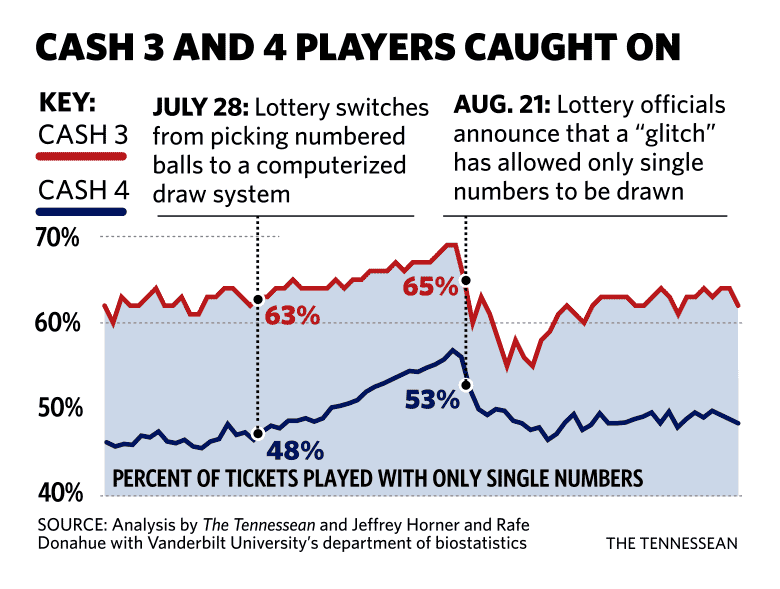
That is the time period when a "glitch" in a new computerized system of picking numbers prevented duplicating combinations such as 1-1-2 or 3-3-3-3 from being drawn.
A Tennessean computer analysis indicates that players either knew or figured out that duplicate numbers weren't coming up, because many stopped playing them. An outside auditor hired by the lottery to examine the glitch isn't investigating whether fraud was involved in such purchases, however.
Todd Northrop, creator of the Web site Lotterypost.com, where lottery enthusiasts trade their betting strategies, said it was essential that the lottery look back at what happened to ensure fraud was not a factor.
"In order to run a lottery, I think you have to be so far above board," Northrop said. "You have to demonstrate that there is no way something is happening behind the scenes."
Lottery CEO Rebecca Paul Hargrove said lottery officials did look into the questions of fraud. They looked at the 15 numbers that paid out the most money during the time the computers were drawing only singles, and at other time periods, and the payouts were similar.
"If you are going to do fraud, you would put a lot of money on specific numbers," she said. "That just didn't occur."
Coding error ran 3 weeks
On July 28, the lottery switched from little white balls to computers to pick random numbers for Cash 3 and Cash 4.
Unbeknownst to the lottery, the computers were blocked from picking repeat numbers because of a computer coding error.
The lottery didn't discover the problem until Aug 20, and announced it on Aug. 21.
"In order to run a lottery, I think you have to be so far above board. You have to demonstrate that there is no way something is happening behind the scenes."-Todd Northrop, CEO, Lottery Post
The Tennessean requested a database of tickets played throughout 2007, for the purpose of scrutinizing betting practices during the malfunction. The analysis was conducted by The Tennessean and two members of Vanderbilt University's Biostatistics Department, Rafe Donahue and Jeffrey Horner.
The analysis shows — within a week or so — a rise in the percentage of non-repeating numbers, such as 3-4-7, compared to repeating numbers such as 4-4-2.
Among the 5.6 million numbers played during the time when the computers weren't able to pick all numbers, roughly 190,000 more single numbers were played than would have been expected based on prior betting patterns.
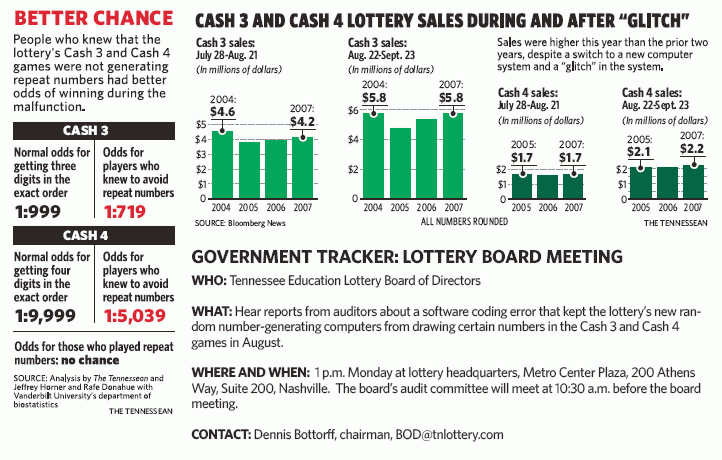
More than 2 million numbers were played that had no chance of winning because of the glitch.
"Even without the lottery announcing there had been an issue, people were changing their strategy based upon what they saw," said Donahue, a research associate professor.
"It's very obvious that the people playing the games were detecting something was amiss," Donahue said. "At least they believed it was amiss, because they changed their betting habits."
Maybe, as Donahue said, players just figured it out over time.
Or maybe someone actually knew about the glitch and took advantage of it to buy more non-repeating number combinations while the odds were more favorable for those who knew.
Donahue said he discounts fraud based on the gradual rise in single numbers being played after the computer system took over Aug. 28.
"It wasn't like there was a spike that occurred right after they switched," he said.
"I generally don't attribute to malice what can be adequately explained by incompetence," he said. "I just think a bunch of administrative bureaucrats didn't really know what they were doing. But lottery players started adjusting their strategy. That's pretty obvious."
Hargrove disagreed the analysis showed any such trend. She said the increase in single numbers being played could have been the result of other factors, not any observation by players that only singles could win.
"The Cash 3 player and Cash 4 players tend to be very, very superstitious," Hargrove said. "They tend to play numbers for a whole wide variety of reasons."
A number of players did realize something was amiss, however.
They began contacting the lottery about the lack of duplicating numbers being drawn as early as a weekafter the computers took over picking the numbers. They said they received boilerplate replies with assurances that the computers had been checked and were running properly.
Others simply quit playing. A number of them told The Tennessean they stopped or cut back severely because they weren't winning anymore, didn't trust the system and didn't like the change to computers picking the numbers.
"I have definitely stopped buying them," said Bertha Pinkerton of Nashville. "The way they have got the drawing now, you just don't know what is coming out of there. When we had the balls, you could see them coming out. I felt safe, even though that could be rigged, too."
Reports due Monday
The lottery has hired an outside auditor, KPMG, to make sure the number-generating computers are working properly. But KPMG's $90,000 contract does not ask for a review of possible fraud.
The lottery board's internal auditor has considered fraud, at the request of the lottery board's audit chairman.
But after The Tennessean reported that fraud would not be investigated by KPMG, Sen. Bill Ketron, R-Murfreesboro, co-chairman of the legislature's lottery oversight committee, asked the state Comptroller's Office to do so.
Lottery and KPMG auditors are expected to report their results at a lottery board meeting Monday.
On Nov. 26, legislators will also discuss the issue.
Legislators fear the glitch incident will undermine player confidence and lead to lower sales. That would affect how much money the lottery raises for scholarships and other educational programs.
"Numerous people have come up and told me they are not buying them anymore," Ketron said.
Lottery sales did drop off in August, the analysis shows. However, sales figures for prior years show similar August dropoffs, and both the Cash 3 and Cash 4 games pulled in more money during and after the glitch than in either of the prior two years, lottery figures show.
"That's very encouraging," Ketron said.
If anything, news stories about the glitch improved sales, Hargrove said. She added that the $67.7 million returned to the state for the quarter ending Sept. 30 was almost 9 percent higher than in the same quarter a year ago.
When things like this happen we all throw our hands up in the air. But if you really think about it, if you figured it out your odds were actually better at winning. This seems to be the case if the players stopped playing those numbers. In daily 3 that takes out 280 possible combinations out of 1000 which isn't bad. The 50% payout ratio of the game still wouldn't allow you to make money buying all the tickets but definetly cut the odds down. It is kind of funny. All the mistakes in drawings lately seem to have been in the favor of the players.
8-8-07 Bobby, Thank you. Dawn At 10:05 AM 8/8/2007 -0500, Heith, Robert wrote:
The answer to your original question is no, you would not receive a ticket containing three of the same numbers.
Robert E. (Bobby) Heith Media Relations Director 512/344-5210 --------------------------------------------------------------------- From: Dawn Nettles [mailto:lottoreport@tx.rr.com] Sent: Wednesday, August 08, 2007 9:56 AM To: Heith, Robert; Elrod, Robert; Vasquez, Leticia; Smith, Robyn Cc: Tirloni, Robert; Anger, Michael; Sadberry, Anthony Subject: RE: P3 Question
Bobby,
Thanks for your reply but you didn't answer my question. Let me re-word it - If a player tells a clerk he want a $5 P3 QP - Any Order - Could he get a "triple digit" number on his ticket?
It seems to me that your answer addressed "repeating" numbers - and the info was new to me - but still doesn't answer the specific question about triple digit numbers.
I know triple digits can only be bet exact - that's why I'm curious about them coming out on a QP with an "any" bet.
I think "ANY QP's" would exclude the 10 triple digit combinations if a player specifies "any" order on a QP. Is this right?
Dawn
At 09:12 AM 8/8/2007 -0500, Heith, Robert wrote:
Ms. Nettles,
The following is the response lottery staff received from GTECH addressing your Pick 3 question:
For Pick 3 we restrict repeating numbers for an ANY or EXACT/ANY bet. You can have 2 repeating numbers for these bet types (112,121,211) and so on but not 3 repeating numbers (111). That is because of the definition on an ANY wager and how much it wins. If someone is going to play 3 repeating numbers, the only way they can match is exactly.
If you have any further questions, please contact a staff member of the Media Relations Division at your convenience.
Robert E. (Bobby) Heith Media Relations Director 512/344-5210 ------------------------------------------------------------------------ From: Dawn Nettles [mailto:lottoreport@tx.rr.com] Sent: Tuesday, August 07, 2007 1:48 PM To: Elrod, Robert; Heith, Robert; Vasquez, Leticia; Smith, Robyn Subject: P3 Question
8-7-07
Would one of you please tell me ... if I buy a Pick3 QP "ANY" order, would I ever get a ticket that contains three of the same numbers? ie ... 111, 222, 333, 444, 555 etc?
I wonder if they pulled ticket history in the game since R N G started wether quick picks are hitting at a higher or lower ratio or wether pick your own is doing better or worse.
Only experienced lottery players who track numbers and play accordingly would have picked up on this and a majority of all players might have started playing doubles thinking they would have to come out sooner or later.
There is no way of knowing without seeing the actual drawing betting statistics. And that information could have been doctored to show that many people didn't play doubles during that time. There is no way a lottery could convince me otherwise that people dropped doubles in favor of single digit numbers. Since everyone knows doubles pay more on a box more people probably play doubles counting on a win.
Hargrove can say whatever she wants she knows they made a error in judgment and didn't follow any protocols regarding testing of the product before implementing it. Moreover she should have know people favor ball drawings. She implemented computer drawings under pretences the general public weren't aware of, no one outside of the lottery organization were privileged to the changes being made for their drawings.
With the exception of a few sentences buried in a news release on their web site. Who else knew Tennessee was going to use computers to draw numbers. The mere fact that the people of tennessee weren't involved in the process is an outrage. Apparently Hargrove and here employees could care less what the people want.
As an experienced lottery director she should have taken the peoples point of view into consideration before switching drawing types. If anyone should be looking at anything they should be looking into why she did what she did. And review there charter processes to see if she broke any of the rules regarding changing lottery drawings.
"As an experienced lottery director she should have taken the peoples point of view into consideration before switching drawing types. If anyone should be looking at anything they should be looking into why she did what she did. And review there charter processes to see if she broke any of the rules regarding changing lottery drawings."
I agree totally. She should NOT have been able to change the types of draws without input from SOMEONE! If she did make the judgement call without any input from any officials, she should lose her job..period. The people who play Pick 3 and Pick 4 should have had a chance to give some input on this as it is a major decision. They are the ones spending the money. As far as more sales on Pic 3 and Pick 4, how many of these sales are from their online games such as Hot Trax which runs every 5 minutes.
How do you go from an action where someone from the Tennesee Lottery selects a "U" for "Unique" or an "R" for repeat... To a "Glitch" in the program that results all these story changes?
The claim was the "U" or the "R" ...Somebody my have been preparing to steal lots of money from the players.
Also, what are the changes that have been made that would be noticeable in the future as, it has more than been proven that you can attach electronic-magnectic stickers encoded, on the balls?
lottoscorp wrote: Also, what are the changes that have been made that would be noticeable in the future as, it has more than been proven that you can attach electronic-magnectic stickers encoded, on the balls?
when and where was this done.
the ping pong type lottery balls they use these days have the numerals silk screened on and have seven or more coats of hard lacquer on them. Any type of magnetic stickers would be easily seen and felt. Every lottery that uses balls goes through strict procedures checking these balls before a drawing. Every set of balls is weighed measured and calibrated for that particular drawing wouldn't you think it would be impossible to rig said drawing if that many people are involved who would take that risk and how could they benefit from it outside of doing jail time.
This thread is about Tennessee lottery switching drawings and not listening to it's players when they came forward with the fact that no doubles were drawn. It's not about conspiracy theory's concerning ball drawings. .
You're right, lottoscorp; they're doing some major damage control. I'm afraid most of it is geared toward the fraud issue, though. If fraud is discovered to be the cause behind the "glitch" in the Tennessee Lottery, the resulting reverberations would cast suspicion on all remaining RNG states, and the players in those states would begin demanding investigations of their own lotteries when their tickets missed by one digit.
Whether or not they're run in an honest and forthright manner, state lotteries should be banned from using computers to draw their numbers. The potential for fraud is simply too great, and if someone can figure out how to compromise the code, the chances of being caught are very, very small. It's infinitely more likely that the offending party would simply be fired without a public comment, since going public with such a revelation would further compromise the integrity of the games. Players would think, "Well, if that guy could do it, what's to keep his replacement from pulling the same trick?"
I think this would be the perfect opportunity to ask Senator Kyle to sponsor federal legislation to outlaw RNG's in ALL state lotteries.
From the graph provided, I estimated the point shown on the graph in green. It shows the point I have brought up in a Blog I made back in August.
From my Blog from 2007 Aug 29:
"Boy I tell ya, there are some people who think everyone is stupid and will believe anything you say without question. Like these statements from Lottery Post News, Official wants fraud probe of Tennessee Lottery: "Hargrove said she did not believe fraud was involved. She said a player would have had to spend $720 to win $500 in the Cash 3 game and $5,040 to win $5,000 in Cash 4, making it unlikely anyone would purposely rig the games." The part of the statements "...a player would have had to spend $720 to win $500 in the Cash 3..." and "...making it unlikely anyone would purposely rig the games." are not true; the math is wrong.
I had to sit and think about how could someone rig, rip-off the lottery and not get caught. First, the rigging and not get caught part. Rigging is so easy now that computers are picking the numbers, just set up some code in the thing to restrict or eliminate some combinations so you know what you are working with. You don't want to eliminate all the combinations just enough to give the appearance of randomness for a period of time before the lottery officials and the public notice. Also, the game would have to be one where the top prize is lager enough to make money, but you would not have to fill out any paper work to hide your tracks. Pick 4 is no good, it's top prizes is $5,000.00, most state lotteries require you to pick up your prizes through the lottery office for prizes above a certain amount, like $599.00 here in Wisconsin. Hmm, what online game has a top prize just under $599.00 and can have the money redeemed at most local online sellers??? Pick 3! It's top prize is $500.00.
Now the rip-off part. I began looking at the Pick 3 midday and evening numbers for the Tennessee Lottery during the computer mess period from 2007-07-28 to 2007-08-19. I noticed there is an unusually large number of picks for a certain type of Permutational Form, C A B. The C A B form is one of six different permutational forms that can occur when all the numbers are different. The six forms are A B C, A C B, B A C, B C A, C A B and C B A. The 5th permutational form C A B occurred twice as much as the reset of the numbers, 15 times during the computer draw mess. For a truly random setting, the draws for any permutational form should have been closer to 7. You can identify these numbers in the draws easily. The first number is the largest and the second number is the smallest. Below is a table with the highlighted numbers. Well, you might say, "What good is that?" Knowing this, you can now reduce the numbers you have to play from 720 all of the permutational forms, to just 120 for the permutational form of C A B. These would be, 2 0 1, 3 0 1, 3 0 2, 3 1 2, 4 0 1, 4 0 2, 4 0 3, 4 1 2, 4 1 3, 4 2 3, 5 0 1, 5 0 2, 5 0 3, 5 0 4, 5 1 2, 5 1 3, 5 1 4, 5 2 3, 5 2 4, 5 3 4, 6 0 1, 6 0 2, 6 0 3, 6 0 4, 6 0 5, 6 1 2, 6 1 3, 6 1 4, 6 1 5, 6 2 3, 6 2 4, 6 2 5, 6 3 4, 6 3 5, 6 4 5, 7 0 1, 7 0 2, 7 0 3, 7 0 4, 7 0 5, 7 0 6, 7 1 2, 7 1 3, 7 1 4, 7 1 5, 7 1 6, 7 2 3, 7 2 4, 7 2 5, 7 2 6, 7 3 4, 7 3 5, 7 3 6, 7 4 5, 7 4 6, 7 5 6, 8 0 1, 8 0 2, 8 0 3, 8 0 4, 8 0 5, 8 0 6, 8 0 7, 8 1 2, 8 1 3, 8 1 4, 8 1 5, 8 1 6, 8 1 7, 8 2 3, 8 2 4, 8 2 5, 8 2 6, 8 2 7, 8 3 4, 8 3 5, 8 3 6, 8 3 7, 8 4 5, 8 4 6, 8 4 7, 8 5 6, 8 5 7, 8 6 7, 9 0 1, 9 0 2, 9 0 3, 9 0 4, 9 0 5, 9 0 6, 9 0 7, 9 0 8, 9 1 2, 9 1 3, 9 1 4, 9 1 5, 9 1 6, 9 1 7, 9 1 8, 9 2 3, 9 2 4, 9 2 5, 9 2 6, 9 2 7, 9 2 8, 9 3 4, 9 3 5, 9 3 6, 9 3 7, 9 3 8, 9 4 5, 9 4 6, 9 4 7, 9 4 8, 9 5 6, 9 5 7, 9 5 8, 9 6 7, 9 6 8 and 9 7 8. That would be only 24 play slips to hand in at one time, assuming there are 5 plays per slip; simple and fairly quick.
Tennessee Lottery
Date
Pick 3
Year
Month
Day
Midday
Evening
2007
7
28
5
7
8
9
0
3
2007
7
29
5
4
9
2007
7
30
4
3
8
2
1
9
2007
7
31
5
4
1
7
6
0
2007
8
1
5
7
6
8
2
4
2007
8
2
0
3
6
6
1
8
2007
8
3
9
5
3
4
0
6
2007
8
4
7
4
6
4
6
8
2007
8
5
6
3
8
2007
8
6
7
8
0
5
0
2
2007
8
7
1
2
9
8
6
7
2007
8
8
9
1
3
7
0
6
2007
8
9
0
2
8
5
1
3
2007
8
10
5
3
6
0
8
5
2007
8
11
9
3
8
5
9
8
2007
8
12
6
3
7
2007
8
13
0
2
1
5
3
6
2007
8
14
8
1
2
8
0
2
2007
8
15
0
1
7
2
9
4
2007
8
16
9
1
2
1
7
5
2007
8
17
3
7
5
5
1
2
2007
8
18
6
0
2
4
3
6
2007
8
19
8
1
3
Now the math behind it. Would there be a profit during this period? Also, your winnings would have to go into the plays once you got by the startup cost. To play all the 120 permutational forms during this period would be, $5,040.00, that's $120.00 x 42 draws. Playing only Straight to get $500.00 dollar return, the winnings would be, $7,500.00, that's $500.00 x 15 wins. Profit, $7,500.00 - $5,040.00 = $2,460.00, and that's just one person playing one run of their slips. Now imagine 10 runs of the same slips at 10 different locations, the profit would be $24,600.00. Get 10 a of your buddies in on this and the profit jumps to $246,000.00. Not very hard. Not very hard at all.
Look at this a little more closely. I think you'll find more interesting things."
Personally, I think there is more that is not being told and needs to be told.
Quote: Originally posted by lottoscorp on Oct 28, 2007
I just have a couple of questions:
How do you go from an action where someone from the Tennesee Lottery selects a "U" for "Unique" or an "R" for repeat... To a "Glitch" in the program that results all these story changes?
The claim was the "U" or the "R" ...Somebody my have been preparing to steal lots of money from the players.
Also, what are the changes that have been made that would be noticeable in the future as, it has more than been proven that you can attach electronic-magnectic stickers encoded, on the balls?
Lots of damage-control going on here...
lottoscorp-NY$
yes balls can be manipulated but were talking computers here and a manmade program ...software......
I dont trust lotterys to give out money ...I belive they do a lot of collecting and cashing in on peoples wishes ...and putng the cash-money in their pockets ;
I just read that mutual funds are gonna go bust before 2009 and people already are loosing their homes because they " betted " to lease their morgage now the lenders want more money through interest and the amounts are like double ....its a head game and its all about our pocket books ...no one cares if we die brooke and take our children down with us ...its about them and their dollars ..we cannot aford to sleep or be lead like sheep ; when we see the system ain't working don't wait attack and be heard ...fix Tenns. problem with complaits everyday untill they switch back to the balls and be aggressive and persistiant ,that gets things done; Public out -cry is an American right ,
only a under Martial Law will our rights be silienced , so dont wait till next year , that will be too late by fall of 2008 we'll be under PD 51 OR PRESIDENTIAL DIRECTIVE 51;
Quote: Originally posted by four4me on Oct 28, 2007
Only experienced lottery players who track numbers and play accordingly would have picked up on this and a majority of all players might have started playing doubles thinking they would have to come out sooner or later.
There is no way of knowing without seeing the actual drawing betting statistics. And that information could have been doctored to show that many people didn't play doubles during that time. There is no way a lottery could convince me otherwise that people dropped doubles in favor of single digit numbers. Since everyone knows doubles pay more on a box more people probably play doubles counting on a win.
Hargrove can say whatever she wants she knows they made a error in judgment and didn't follow any protocols regarding testing of the product before implementing it. Moreover she should have know people favor ball drawings. She implemented computer drawings under pretences the general public weren't aware of, no one outside of the lottery organization were privileged to the changes being made for their drawings.
With the exception of a few sentences buried in a news release on their web site. Who else knew Tennessee was going to use computers to draw numbers. The mere fact that the people of tennessee weren't involved in the process is an outrage. Apparently Hargrove and here employees could care less what the people want.
As an experienced lottery director she should have taken the peoples point of view into consideration before switching drawing types. If anyone should be looking at anything they should be looking into why she did what she did. And review there charter processes to see if she broke any of the rules regarding changing lottery drawings.
four4me said " As an experienced lottery director she should have taken the peoples point of view into consideration before switching drawing types. If anyone should be looking at anything they should be looking into why she did what she did. And review there charter processes to see if she broke any of the rules regarding changing lottery drawings. "
In Georgia she proved over and over she never caredwhat players wanted so long as they did what ads told them and kept buying tickets. All we got were canned replies if any, no changes .... just her bulldozing her vision through until she ran our lottery into the ground then left for Tennessee.
""Hargrove disagreed the analysis showed any such trend. She said the increase in single numbers being played could have been the result of other factors, not any observation by players that only singles could win.
"The Cash 3 player and Cash 4 players tend to be very, very superstitious," Hargrove said. "They tend to play numbers for a whole wide variety of reasons."
Same old arrogant 80's out of touch retread mindset ..... players aren't smart ... enough to figure out what's being done to them .... and things will die down quickly if she does enough damage control ... they'll shut up and go back buying tickets.
Quote: Originally posted by konane on Oct 28, 2007
four4me said " As an experienced lottery director she should have taken the peoples point of view into consideration before switching drawing types. If anyone should be looking at anything they should be looking into why she did what she did. And review there charter processes to see if she broke any of the rules regarding changing lottery drawings. "
In Georgia she proved over and over she never caredwhat players wanted so long as they did what ads told them and kept buying tickets. All we got were canned replies if any, no changes .... just her bulldozing her vision through until she ran our lottery into the ground then left for Tennessee.
""Hargrove disagreed the analysis showed any such trend. She said the increase in single numbers being played could have been the result of other factors, not any observation by players that only singles could win.
"The Cash 3 player and Cash 4 players tend to be very, very superstitious," Hargrove said. "They tend to play numbers for a whole wide variety of reasons."
Same old arrogant 80's out of touch retread mindset ..... players aren't smart ... enough to figure out what's being done to them .... and things will die down quickly if she does enough damage control ... they'll shut up and go back buying tickets.
Blowback from this has been well earned.
Konane you said it! I am so sick of know-it-alls who constantly categorize people, especially daily players. She has gotten too big for her britches, methinks.






When things like this happen we all throw our hands up in the air. But if you really think about it, if you figured it out your odds were actually better at winning. This seems to be the case if the players stopped playing those numbers. In daily 3 that takes out 280 possible combinations out of 1000 which isn't bad. The 50% payout ratio of the game still wouldn't allow you to make money buying all the tickets but definetly cut the odds down. It is kind of funny. All the mistakes in drawings lately seem to have been in the favor of the players.
Brad
Texas Lottery
8-8-07
Bobby,
Thank you.
Dawn
At 10:05 AM 8/8/2007 -0500, Heith, Robert wrote:
The answer to your original question is no, you would not receive a ticket containing three of the same numbers.
Robert E. (Bobby) Heith
Media Relations Director
512/344-5210
---------------------------------------------------------------------
From: Dawn Nettles [mailto:lottoreport@tx.rr.com]
Sent: Wednesday, August 08, 2007 9:56 AM
To: Heith, Robert; Elrod, Robert; Vasquez, Leticia; Smith, Robyn
Cc: Tirloni, Robert; Anger, Michael; Sadberry, Anthony
Subject: RE: P3 Question
Bobby,
Thanks for your reply but you didn't answer my question. Let me re-word it - If a player tells a clerk he want a $5 P3 QP - Any Order - Could he get a "triple digit" number on his ticket?
It seems to me that your answer addressed "repeating" numbers - and the info was new to me - but still doesn't answer the specific question about triple digit numbers.
I know triple digits can only be bet exact - that's why I'm curious about them coming out on a QP with an "any" bet.
I think "ANY QP's" would exclude the 10 triple digit combinations if a player specifies "any" order on a QP. Is this right?
Dawn
At 09:12 AM 8/8/2007 -0500, Heith, Robert wrote:
Ms. Nettles,
The following is the response lottery staff received from GTECH addressing your Pick 3 question:
For Pick 3 we restrict repeating numbers for an ANY or EXACT/ANY bet. You can have 2 repeating numbers for these bet types (112,121,211) and so on but not 3 repeating numbers (111). That is because of the definition on an ANY wager and how much it wins. If someone is going to play 3 repeating numbers, the only way they can match is exactly.
If you have any further questions, please contact a staff member of the Media Relations Division at your convenience.
Robert E. (Bobby) Heith
Media Relations Director
512/344-5210
------------------------------------------------------------------------
From: Dawn Nettles [mailto:lottoreport@tx.rr.com]
Sent: Tuesday, August 07, 2007 1:48 PM
To: Elrod, Robert; Heith, Robert; Vasquez, Leticia; Smith, Robyn
Subject: P3 Question
8-7-07
Would one of you please tell me ... if I buy a Pick3 QP "ANY" order, would I ever get a ticket that contains three of the same numbers? ie ... 111, 222, 333, 444, 555 etc?
Thanks.
Dawn Nettles
/results.htm
From: Dawn Nettles <lottoreport@tx.rr.com>
To: "Heith, Robert" <Robert.Heith@lottery.state.tx.us>, "Elrod,
Robert" <Robert.Elrod@lottery.state.tx.us>, "Vasquez,
Leticia" <Leticia.Vasquez@lottery.state.tx.us>, "Smith,
Robyn" <Robyn.Smith@lottery.state.tx.us>
Cc: "Tirloni, Robert" <Robert.Tirloni@lottery.state.tx.us>, "Anger,
Michael" <Michael.Anger@lottery.state.tx.us>, "Sadberry,
Anthony" <Anthony.Sadberry@lottery.state.tx.us>
Date: Wed, 08 Aug 2007 10:22:34 -0500
I wonder if they pulled ticket history in the game since R N G started wether quick picks are hitting at a higher or lower ratio or wether pick your own is doing better or worse.
That would be a nice stat to see.
Only experienced lottery players who track numbers and play accordingly would have picked up on this and a majority of all players might have started playing doubles thinking they would have to come out sooner or later.
There is no way of knowing without seeing the actual drawing betting statistics. And that information could have been doctored to show that many people didn't play doubles during that time. There is no way a lottery could convince me otherwise that people dropped doubles in favor of single digit numbers. Since everyone knows doubles pay more on a box more people probably play doubles counting on a win.
Hargrove can say whatever she wants she knows they made a error in judgment and didn't follow any protocols regarding testing of the product before implementing it. Moreover she should have know people favor ball drawings. She implemented computer drawings under pretences the general public weren't aware of, no one outside of the lottery organization were privileged to the changes being made for their drawings.
With the exception of a few sentences buried in a news release on their web site. Who else knew Tennessee was going to use computers to draw numbers. The mere fact that the people of tennessee weren't involved in the process is an outrage. Apparently Hargrove and here employees could care less what the people want.
As an experienced lottery director she should have taken the peoples point of view into consideration before switching drawing types. If anyone should be looking at anything they should be looking into why she did what she did. And review there charter processes to see if she broke any of the rules regarding changing lottery drawings.
"As an experienced lottery director she should have taken the peoples point of view into consideration before switching drawing types. If anyone should be looking at anything they should be looking into why she did what she did. And review there charter processes to see if she broke any of the rules regarding changing lottery drawings."
I agree totally. She should NOT have been able to change the types of draws without input from SOMEONE! If she did make the judgement call without any input from any officials, she should lose her job..period. The people who play Pick 3 and Pick 4 should have had a chance to give some input on this as it is a major decision. They are the ones spending the money. As far as more sales on Pic 3 and Pick 4, how many of these sales are from their online games such as Hot Trax which runs every 5 minutes.
I just have a couple of questions:
How do you go from an action where someone from the Tennesee Lottery selects a "U" for "Unique" or an "R" for repeat... To a "Glitch" in the program that results all these story changes?
The claim was the "U" or the "R" ...Somebody my have been preparing to steal lots of money from the players.
Also, what are the changes that have been made that would be noticeable in the future as, it has more than been proven that you can attach electronic-magnectic stickers encoded, on the balls?
Lots of damage-control going on here...
lottoscorp-NY$
lottoscorp wrote: Also, what are the changes that have been made that would be noticeable in the future as, it has more than been proven that you can attach electronic-magnectic stickers encoded, on the balls?
when and where was this done.
the ping pong type lottery balls they use these days have the numerals silk screened on and have seven or more coats of hard lacquer on them. Any type of magnetic stickers would be easily seen and felt. Every lottery that uses balls goes through strict procedures checking these balls before a drawing. Every set of balls is weighed measured and calibrated for that particular drawing wouldn't you think it would be impossible to rig said drawing if that many people are involved who would take that risk and how could they benefit from it outside of doing jail time.
This thread is about Tennessee lottery switching drawings and not listening to it's players when they came forward with the fact that no doubles were drawn. It's not about conspiracy theory's concerning ball drawings. .
You're right, lottoscorp; they're doing some major damage control. I'm afraid most of it is geared toward the fraud issue, though. If fraud is discovered to be the cause behind the "glitch" in the Tennessee Lottery, the resulting reverberations would cast suspicion on all remaining RNG states, and the players in those states would begin demanding investigations of their own lotteries when their tickets missed by one digit.
Whether or not they're run in an honest and forthright manner, state lotteries should be banned from using computers to draw their numbers. The potential for fraud is simply too great, and if someone can figure out how to compromise the code, the chances of being caught are very, very small. It's infinitely more likely that the offending party would simply be fired without a public comment, since going public with such a revelation would further compromise the integrity of the games. Players would think, "Well, if that guy could do it, what's to keep his replacement from pulling the same trick?"
I think this would be the perfect opportunity to ask Senator Kyle to sponsor federal legislation to outlaw RNG's in ALL state lotteries.
Jim,
Senator Kyle is a state Senator, so he can only affect change to the state of Tennessee. It would be nice though...
I'll just post this and let you decide.
From the graph provided, I estimated the point shown on the graph in green. It shows the point I have brought up in a Blog I made back in August.
From my Blog from 2007 Aug 29:
"Boy I tell ya, there are some people who think everyone is stupid and will believe anything you say without question. Like these statements from Lottery Post News, Official wants fraud probe of Tennessee Lottery: "Hargrove said she did not believe fraud was involved. She said a player would have had to spend $720 to win $500 in the Cash 3 game and $5,040 to win $5,000 in Cash 4, making it unlikely anyone would purposely rig the games." The part of the statements "...a player would have had to spend $720 to win $500 in the Cash 3..." and "...making it unlikely anyone would purposely rig the games." are not true; the math is wrong.
I had to sit and think about how could someone rig, rip-off the lottery and not get caught. First, the rigging and not get caught part. Rigging is so easy now that computers are picking the numbers, just set up some code in the thing to restrict or eliminate some combinations so you know what you are working with. You don't want to eliminate all the combinations just enough to give the appearance of randomness for a period of time before the lottery officials and the public notice. Also, the game would have to be one where the top prize is lager enough to make money, but you would not have to fill out any paper work to hide your tracks. Pick 4 is no good, it's top prizes is $5,000.00, most state lotteries require you to pick up your prizes through the lottery office for prizes above a certain amount, like $599.00 here in Wisconsin. Hmm, what online game has a top prize just under $599.00 and can have the money redeemed at most local online sellers??? Pick 3! It's top prize is $500.00.
Now the rip-off part. I began looking at the Pick 3 midday and evening numbers for the Tennessee Lottery during the computer mess period from 2007-07-28 to 2007-08-19. I noticed there is an unusually large number of picks for a certain type of Permutational Form, C A B. The C A B form is one of six different permutational forms that can occur when all the numbers are different. The six forms are A B C, A C B, B A C, B C A, C A B and C B A. The 5th permutational form C A B occurred twice as much as the reset of the numbers, 15 times during the computer draw mess. For a truly random setting, the draws for any permutational form should have been closer to 7. You can identify these numbers in the draws easily. The first number is the largest and the second number is the smallest. Below is a table with the highlighted numbers. Well, you might say, "What good is that?" Knowing this, you can now reduce the numbers you have to play from 720 all of the permutational forms, to just 120 for the permutational form of C A B. These would be, 2 0 1, 3 0 1, 3 0 2, 3 1 2, 4 0 1, 4 0 2, 4 0 3, 4 1 2, 4 1 3, 4 2 3, 5 0 1, 5 0 2, 5 0 3, 5 0 4, 5 1 2, 5 1 3, 5 1 4, 5 2 3, 5 2 4, 5 3 4, 6 0 1, 6 0 2, 6 0 3, 6 0 4, 6 0 5, 6 1 2, 6 1 3, 6 1 4, 6 1 5, 6 2 3, 6 2 4, 6 2 5, 6 3 4, 6 3 5, 6 4 5, 7 0 1, 7 0 2, 7 0 3, 7 0 4, 7 0 5, 7 0 6, 7 1 2, 7 1 3, 7 1 4, 7 1 5, 7 1 6, 7 2 3, 7 2 4, 7 2 5, 7 2 6, 7 3 4, 7 3 5, 7 3 6, 7 4 5, 7 4 6, 7 5 6, 8 0 1, 8 0 2, 8 0 3, 8 0 4, 8 0 5, 8 0 6, 8 0 7, 8 1 2, 8 1 3, 8 1 4, 8 1 5, 8 1 6, 8 1 7, 8 2 3, 8 2 4, 8 2 5, 8 2 6, 8 2 7, 8 3 4, 8 3 5, 8 3 6, 8 3 7, 8 4 5, 8 4 6, 8 4 7, 8 5 6, 8 5 7, 8 6 7, 9 0 1, 9 0 2, 9 0 3, 9 0 4, 9 0 5, 9 0 6, 9 0 7, 9 0 8, 9 1 2, 9 1 3, 9 1 4, 9 1 5, 9 1 6, 9 1 7, 9 1 8, 9 2 3, 9 2 4, 9 2 5, 9 2 6, 9 2 7, 9 2 8, 9 3 4, 9 3 5, 9 3 6, 9 3 7, 9 3 8, 9 4 5, 9 4 6, 9 4 7, 9 4 8, 9 5 6, 9 5 7, 9 5 8, 9 6 7, 9 6 8 and 9 7 8. That would be only 24 play slips to hand in at one time, assuming there are 5 plays per slip; simple and fairly quick.
Now the math behind it. Would there be a profit during this period? Also, your winnings would have to go into the plays once you got by the startup cost. To play all the 120 permutational forms during this period would be, $5,040.00, that's $120.00 x 42 draws. Playing only Straight to get $500.00 dollar return, the winnings would be, $7,500.00, that's $500.00 x 15 wins. Profit, $7,500.00 - $5,040.00 = $2,460.00, and that's just one person playing one run of their slips. Now imagine 10 runs of the same slips at 10 different locations, the profit would be $24,600.00. Get 10 a of your buddies in on this and the profit jumps to $246,000.00. Not very hard. Not very hard at all.
Look at this a little more closely. I think you'll find more interesting things."
Personally, I think there is more that is not being told and needs to be told.
You decide.
I noticed on some of the recent payouts on numbers that seem out of the extreme to me.
Some of these numbers in my opinion with higher payouts would not seem to be a highly played number normaly.
CASH 3 10/27/2007 Mid-Day 913 $27,830.00
CASH 3 10/27/2007 Evening 401 $42,060.00
CASH 3 10/26/2007 Mid-Day 601 $20,560.00
CASH 3 10/26/2007 Evening 000 $234,000.00 generally a highly played number
CASH 3 10/25/2007 Mid-Day 852 $31,250.00
CASH 3 10/25/2007 Evening 012 $57,840.00
CASH 3 10/24/2007 Mid-Day 973 $15,950.00
CASH 3 10/24/2007 Evening 789 $215,140.00 generally a highly played number
CASH 3 10/23/2007 Mid-Day 620 $12,740.00
CASH 3 10/23/2007 Evening 301 $52,820.00
CASH 3 10/22/2007 Mid-Day 231 $35,840.00
CASH 3 10/22/2007 Evening 417 $46,340.00
CASH 3 10/21/2007 Evening 059 $18,560.00
CASH 3 10/20/2007 Mid-Day 051 $16,490.00
CASH 3 10/20/2007 Evening 790 $16,750.00
CASH 3 10/19/2007 Mid-Day 620 $20,780.00
CASH 3 10/19/2007 Evening 038 $31,350.00
CASH 3 10/18/2007 Mid-Day 529 $28,410.00
CASH 3 10/18/2007 Evening 712 $138,900.00 this one in particular
CASH 3 10/17/2007 Mid-Day 132 $56,240.00
CASH 3 10/17/2007 Evening 377 $69,640.00
CASH 3 10/16/2007 Mid-Day 165 $15,080.00
CASH 3 10/16/2007 Evening 327 $142,930.00 this one in particular
CASH 3 10/15/2007 Mid-Day 862 $23,430.00
CASH 3 10/15/2007 Evening 119 $51,470.00
CASH 3 10/14/2007 Evening 693 $49,300.00
CASH 3 10/13/2007 Mid-Day 838 $25,910.00
CASH 3 10/13/2007 Evening 040 $14,530.00
CASH 3 10/12/2007 Mid-Day 266 $21,500.00
CASH 3 10/12/2007 Evening 479 $56,190.00
CASH 3 10/11/2007 Mid-Day 096 $8,320.00
CASH 3 10/11/2007 Evening 530 $34,530.00
CASH 3 10/10/2007 Mid-Day 065 $9,970.00
CASH 3 10/10/2007 Evening 816 $34,750.00
CASH 3 10/9/2007 Mid-Day 970 $8,390.00
CASH 3 10/9/2007 Evening 225 $67,500.00
CASH 3 10/8/2007 Mid-Day 957 $38,660.00
CASH 3 10/8/2007 Evening 502 $26,060.00
CASH 3 10/7/2007 Evening 417 $53,350.00
CASH 3 10/6/2007 Mid-Day 595 $22,780.00
CASH 3 10/6/2007 Evening 930 $34,500.00
CASH 3 10/5/2007 Mid-Day 370 $11,750.00
CASH 3 10/5/2007 Evening 433 $59,610.00
CASH 3 10/4/2007 Mid-Day 509 $11,490.00
CASH 3 10/4/2007 Evening 971 $24,850.00
CASH 3 10/3/2007 Mid-Day 691 $19,390.00
CASH 3 10/3/2007 Evening 264 $44,860.00
CASH 3 10/2/2007 Mid-Day 197 $13,800.00
CASH 3 10/2/2007 Evening 107 $71,530.00
CASH 3 10/1/2007 Mid-Day 125 $42,860.00
CASH 3 10/1/2007 Evening 657 $105,160.00 generally a highly played number
CASH 3 9/30/2007 Evening 548 $40,780.00
CASH 3 9/29/2007 Mid-Day 460 $8,750.00
CASH 3 9/29/2007 Evening 476 $50,260.00
CASH 3 9/28/2007 Mid-Day 780 $14,440.00
CASH 3 9/28/2007 Evening 545 $48,490.00
CASH 3 9/27/2007 Mid-Day 548 $33,070.00
CASH 3 9/27/2007 Evening 661 $40,940.00
CASH 3 9/26/2007 Mid-Day 858 $24,370.00
CASH 3 9/26/2007 Evening 972 $39,660.00
yes balls can be manipulated but were talking computers here and a manmade program ...software......
I dont trust lotterys to give out money ...I belive they do a lot of collecting and cashing in on peoples wishes ...and putng the cash-money in their pockets ;
I just read that mutual funds are gonna go bust before 2009 and people already are loosing their homes because they " betted " to lease their morgage now the lenders want more money through interest and the amounts are like double ....its a head game and its all about our pocket books ...no one cares if we die brooke and take our children down with us ...its about them and their dollars ..we cannot aford to sleep or be lead like sheep ; when we see the system ain't working don't wait attack and be heard ...fix Tenns. problem with complaits everyday untill they switch back to the balls and be aggressive and persistiant ,that gets things done; Public out -cry is an American right ,
only a under Martial Law will our rights be silienced , so dont wait till next year , that will be too late by fall of 2008 we' ll be under PD 51 OR PRESIDENTIAL DIRECTIVE 51;
four4me said " As an experienced lottery director she should have taken the peoples point of view into consideration before switching drawing types. If anyone should be looking at anything they should be looking into why she did what she did. And review there charter processes to see if she broke any of the rules regarding changing lottery drawings. "
In Georgia she proved over and over she never cared what players wanted so long as they did what ads told them and kept buying tickets. All we got were canned replies if any, no changes .... just her bulldozing her vision through until she ran our lottery into the ground then left for Tennessee.
""Hargrove disagreed the analysis showed any such trend. She said the increase in single numbers being played could have been the result of other factors, not any observation by players that only singles could win.
"The Cash 3 player and Cash 4 players tend to be very, very superstitious," Hargrove said. "They tend to play numbers for a whole wide variety of reasons."
Same old arrogant 80's out of touch retread mindset ..... players aren't smart ... enough to figure out what's being done to them .... and things will die down quickly if she does enough damage control ... they'll shut up and go back buying tickets.
Blowback from this has been well earned.
Konane you said it! I am so sick of know-it-alls who constantly categorize people, especially daily players. She has gotten too big for her britches, methinks.