




'Infringed' opens in theaters early 2009
Known at Lottery Post as Jim695, Jim Grimes lived a story compelling enough for the silver screen
As the producer of director Neil LaBute's award-winning "In the Company of Men" and other features, Fort Wayne filmmaker Mark Archer knows a good story when he sees one.
He knows Jim Grimes' story is a good one — and will soon be telling it on the big screen.
"I don't think 'Infringed' will make it into many film festivals. I'm in the super-minority in the film industry — a Christian conservative," said Archer, 35, who has spent the last year documenting the series of events that caused Grimes to lose his license to carry a gun despite being acquitted of the 2006 charges that led to the confiscation of his weapon in the first place.
"Men," filmed in Fort Wayne and released in 1997 at a cost of just $25,000, won the Filmmakers' Trophy at the prestigious Sundance Film Festival. And even if the forthcoming documentary from Archer's New Hollywood Studios isn't embraced by such "progressive" audiences, he hopes it will at least alert viewers to how fragile their rights can be — and motivate citizens and lawmakers alike to take action where necessary.
"The film will polarize the audience. Would you have done what Grimes did? I don't know if I would have, but I wouldn't have expected to go to jail for it, either. I want people to wake up to the fact that this could happen," Archer said.
Archer plans to premiere the feature-length documentary early next year in Noble County, where officials — according to Archer - wrongfully prosecuted Grimes, then, after his acquittal, violated his protection against double jeopardy by persuading the State Police to rescind his carry permit.
Despite his concerns, Archer said "Infringed" won't be a right-wing version of a Michael Moore-style propaganda piece.
"I want to be objective. It doesn't do any good to 'ambush' people," said Archer, who has interviewed participants, reviewed documents and met with State Sen. David Long, R-Fort Wayne, and other legislators in an effort to help Grimes, change laws, and uphold the Second Amendment.
It was Archer's support of the right to bear arms, in fact, that led him to Grimes' story in the first place.
He was serving as volunteer legislative action coordinator for the National Rifle Association at the time of Grimes' accident, and "was looking for Second-Amendment stories to tell. I decided this one was too unbelievable not to do something with."
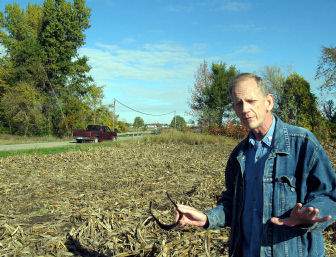
Jim Grimes discusses the events leading to his false imprisonment, while standing at the location where it all began.
Is law too quick on the draw?
Despite acquittal, Noble County man's firearm, license withheld
By Kevin Leininger, The News-Sentinel
It's been nearly two years since a jury of his peers acquitted Jim Grimes of threatening other people with his Smith & Wesson 9 mm automatic pistol.
So why can't he get his gun — or the license to carry it — back?
To the 50-year-old former Navy engineer, the issue is black and white.
He's been victimized twice: first by the habitually reckless driver who rear-ended his pickup in rural Noble County on April 27, 2006, and again by overzealous authorities who prosecuted the wrong man.
But to those same county and state officials, it isn't that simple at all. Grimes may not be legally guilty of misusing a deadly weapon, they say — but that doesn't make him fit to carry one.
It all started innocently enough. It was nearly 2 p.m., and Grimes was driving his 71-year-old mother, Donna, on County Road 900W from their home near Kimmel to visit his sister in Ligonier. Suddenly, his 1997 Silverado was hit from behind twice by a speeding car driven by 19-year-old Dustin Swartzlander, who lived and worked nearby.
According to Grimes, Swartzlander grabbed something from his front seat — Grimes thought it looked like an explosive device — and ran. Rather than allow Swartzlander to flee the scene of an accident with a possible weapon, Grimes pulled his gun and fired a single shot into the air. Not surprisingly, Swartzlander stopped and Grimes held him at gunpoint until a passerby called 911 and Ligonier and Noble County police began arriving minutes later.
But instead of arresting Swartzlander — who lacked both a driver's license and insurance as required by law — Grimes was handcuffed, put on the ground, taken to the Noble County Jail and later tried on two counts of "pointing a firearm," a Class D felony.
A Noble Superior Court jury acquitted him 10 months later, after which foreman Phillip Sensibaugh wrote a 13-page letter of concern to Judge Robert Kirsch. Jurors agreed Grimes had shown poor judgment, but were not convinced he had pointed his gun at anyone. "(And we) believed that the police rushed to judgment and arrested the wrong person in their zest to go after the man with a gun who was posing no immediate threat, rather than disarming (Grimes) and finding out why the firearm was produced in the first place . . .
"The accident would never have occurred if (Swartzlander) had been obeying the law and not been operating a motor vehicle illegally."
According to state law, "if a (firearm) license is suspended or revoked based solely on an arrest . . . the license shall be reinstated upon the acquittal of the defendant." But neither his weapon nor license was returned after Grimes' trial and, after a hearing in Indianapolis in October 2007, a state administrative law judge rescinded Grimes' license for a completely different reason:
He had been declared "not a proper person to be licensed to carry a handgun."
But how could Grimes — who was licensed to carry a gun for 28 years before the accident — be punished after having been declared innocent of a crime?
That's where this story becomes either more critical of state and local officials or more sympathetic, depending on your point of view.
Sensibaugh and the other jurors didn't know it at the time — because Prosecutor Steven Clouse wasn't allowed to introduce it as evidence — that Grimes had been involved in a similar incident once before.
According to a Noble County Sheriff's report, Grimes was driving on County Road 400S on Jan. 17, 2004 when he was rear-ended by a vehicle driven by Carl Liggett. "Grimes advised that Liggett was instigating a fight," the report stated. "Grimes advised that he did have a gun in his hand which he removed from the glove box. Grimes advised that he did not point the gun at Liggett."
Grimes insists he acted legally and rationally on both occasions: In 2004 he was prepared to protect himself against possible violence. Two years later, "I was jailed for trying to stop a crime."
Clouse, Sheriff Gary Leatherman and Indiana State Police attorney Maj. Jerome Ezell interpret Grimes' willingness to pull a gun quite differently: as a sign of a potential threat to public safety they are sworn to prevent if possible.
"I filed charges (against Grimes) because I'm opposed to vigilante justice and took an oath to uphold the law," Clouse said.
Added Leatherman: "As sheriff, one of my responsibilities to the citizens of Noble County is to forward to the State Police Section any information that could bring into question a person's privilege of being issued an unlimited license. I'm all for the Second Amendment. But the burden rests on the person who carries a gun to meet all the requirements."
But that's just the point, according to Grimes and Fort Wayne attorney Robert Vegeler, who represented him in the hearing before Administrative Law Judge Douglas Shelton: To Vegeler, Grimes' acquittal means he does meet all legal requirements, and should get both his gun and license back. What's more, Grimes said, he was not even charged with a crime in connection with the 2004 accident — and police wouldn't know he had pulled his gun at all if he hadn't volunteered the information.
None of that matters, said Ezell, who presented the state's case before Shelton. "It's like the O.J. Simpson case," he said, alluding to a civil judgment against Simpson after his acquittal on murder charges. "The prosecutor has one burden (guilt beyond reasonable doubt), and administrative law has another — is something more likely than not?"
Using that standard, Shelton ruled on Oct. 30, 2007, that Grimes is not a "reasonable person" to have a license to carry a firearm — something state law also seems to allow under certain conditions. In this case, Shelton concluded, Grimes was not justified to fire his weapon, "displayed an inappropriate suspicion of others" and had "demonstrated a propensity for violence and emotionally unstable conduct."
Even in today's terror-conscious climate, you and I might have responded to either accident by drawing a weapon or suspect the presence of a bomb in rural Indiana. But the actions of officials should be subject to at least equal scrutiny.
During Grimes' license hearing, Swartzlander acknowledged he couldn't really tell if Grimes was pointing a weapon in his direction. Swartzlander also admitted to having been involved in four cases of driving with a suspended license and that he was moving an estimated 65 miles per hour — "cooking" — on a two-lane country road when he collided with Grimes. He also admitted to having been charged with possession of a false license and driving uninsured, meaning he could not pay for the $7,000 in damages done to Grimes' truck or the medical bills for Grimes' mother, who suffered a neck injury and a bump to the head.
And yet, as recently as this month, both Clouse and Leatherman seemed relatively uninformed and unconcerned about Swartzlander's driving record. "Did he have a suspended license? I don't remember," said Clouse. "And Grimes couldn't have known that, anyway."
Maybe not, but that would have been — or should have been — one of the first things responding officers discovered.
Noble County officials should be commended for trying to protect the public from improper use of handguns, so long as that is done within the law. But Grimes, whose legal bills are $20,000 and rising, makes a good point: Aren't reckless, unlicensed drivers a threat, too?
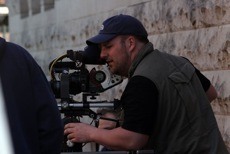
Filmmaker Mark Archer, winner of the Filmmakers' Trophy at the prestigious Sundance Film Festival, was naturally drawn to the plight of an ordinary citizen who was singled-out and crushed by the government.
Filmmaker Archer responds
Award-winning filmmaker Mark Archer knew when he got started making Infringed that much of his efforts were going to be spent reconstructing events and investigating leads that the Noble County prosecutor's office refused to — intentionally or not.
Although the film itself will let loose with all of the details he's uncovered, Archer is gradually releasing tantilizing details in his Production Blog (www.infringedmovie.com).
Tuesday, Archer responded to the statements made by Noble County Prosecutor Steven Clouse, pointing out a seemingly convenient inability to recall key details of the event.
When Clouse was recently interviewed by News-Sentinel reporter Kevin Leininger he said, "Did [Swartzlander] have a suspended license? I don't remember. And Grimes couldn't have known that, anyway."
"Perhaps he's forgotten about his arguments to the jury in the biggest colossal failure to convict that Noble County has likely ever seen," Archer writes. "I know I remember my colossal failures pretty darn well.... 'I don't remember' sounds an awful lot like a politician trying to avoid a question."
Further, the filmmaker has uncovered information pointing to the possibility that the prosecutor purposely did not charge the real guilty party — Dustin Swartzlander.
"Noble County officials will look the other way when they're doing a favor for someone 'in the club'," Archer surmises. "Let it be known that Dustin Swartzlander has friends in...well...highly corrupt places."
How deep will this rabbit hole go?
We'll eventually find out when the film debuts, but until then, Archer's blog promises to offer some facinating glimpses into government corruption and influence.
'Infringed' promises to tell the story of how a common every-man — a veteran of the first Gulf War, an engineer, a writer, and a man who enjoys tinkering with lottery numbers for a hobby — could have the full weight of the government come crashing down on him, all because he tried to do the right thing.
"When you factor in the irrefutable evidence that Dustin Swartzlander repeatedly and knowingly perjured himself, leading to the false imprisonment and constitutional infringement of a law-abiding, upstanding man named Jim Grimes...well, you've got a serious miscarriage of justice."

Go Jim Go!
I hope something good becomes of your problems with the wonderful "government" we have.
Jim, hope you can win the PB jackpot, move to a state where the good ole' boy network isn't so obviously out of control, hair-on-fire for revenge. Sounds like Boss-Hogsborough rural deep south in the 40's-50's. Good luck, fingers crossed for you!!!!!!!!!!!!
It sounds like something I would like to see on the big screen. Miscarriage of Justice seems to be common place if you are in Indiana and not a part of the "good ol boys" club. I wonder if they are sweating yet? Now I feel like you really need a weapon..
It's not just Indiana. It's everywhere.
After awhile, you won't even have jury trials, anymore. Anywhere.
A 3 judge panel will decide how guilty you are.
psyko would like 2 suggest 2 Jim
that he will re-edit movie/include
"Country Boy will Surive" song by
some HICK who work's HARD too
feed his FAMILY & does not >>>
HIP-HOP with his hoe BUTT >>>
work's his A$$ET'ss OFF >>o!o
2 support a 250 year's of LIFE!!!!
PSYKOMO
Just think of the leftists getting power. Govt. run amuk. BOHICA.
this is just to show everyone the miscarriage of justice happens all the time!
Don't mayan27:
Roger Moore & O'BAMA will teach these>>>>
"REDNECK's" from noble county 2 RESPECT>>
R-E-S-P-E-C-T >>>>>>>>>
Deeee"LAW"!!
psyko

Jim is just as I pictured him. Looks like a nice guy. And this sounds like a good movie. Can't wait to watch it.
I hate to disagree without all the facts but I believe, from what we see of this case, that they mostly made the right decision.
Firing a weapon into the air is very dangerous. Firing one because you SUSPECT someone who is fleeing may be up to no good is a VERY hard situation to justify. It sounds like this Mr. Grimes was uneducated about how to properly use his weapon.
This sounds like they are victimizing him because he made a couple very foolish decisions in the heat of the moment.
I am a gun owner and have also been in the rare situation where another person, who was armed, tried to burglarize my home. I know exactly how stressful a situation can be when facing a weapon BUT...you cannot overreact. It's a thin line though. I side more with the courts on this one than Mr. Grimes but I will also say that I don't believe his gun rights should be revoked for a long time. Maybe a couple years.
I'm kinda sorta in a movie, The Wrestler coming out (I believe) in December, we are in the back row of the audience. I wonder if ever there will be a movie about JW or someone similar?
If you agree with the courts, then you agree with Mr. Grimes, because he was acquitted of the crime. Not guilty.
The point is that the guy who was factually guilty (Dustin Swartzlander) got away with multiple crimes because the corrupt prosecutor purposely did not prosecute the guy. If he did in fact prosecute the guilty man (who has political connections), it would have proved that Mr. Grimes acted correctly in trying to stop the man during one of his criminal acts.
That's why this movie is going to be so important. Because corrupt people can get away with crushing innocent people by twisting a complicated series of events, and pushing their powers to the very limits to achieve whatever goals they have politically.
It amazes me how many people think politicians are only overpriced negotiators. The political world is littered with cut-throats. And I don't mean that in the metephorical way.
Here's what happened:
Carl Liggett - January, 2004:
I was driving along a snow-covered county road at about 45 miles an hour. About a quarter-mile ahead, I spotted a small red-and-white pickup sitting in a driveway on the left. I covered my brake in case he pulled out but, as I got closer to him, I thought he was going to wait. I was about 50 yards from him when he slowly meandered into my path, doing maybe 20 mph. There was nothing coming in the other direction, so I pulled out to pass. As I was going around him, Liggett began drifting to the left, nearly forcing me off the road and into the ditch. I couldn't hit my brakes because I was afraid I'd sideswipe him if I did. As I continued to pass, I heard a loud "clap," and I knew our vehicles had collided. Once I had cleared his truck, I pulled over to the right side of the road and brought my truck to a stop. Looking in my rear-view mirror, I could see a man and woman in the cab of the truck behind me. I could also see about four feet of snow between the top of my tailgate and his front bumper, so he was still far enough away that he could have stopped in time, given his speed.
I had stopped my truck, put the gear selector in Park, unlatched my seat belt and opened the door. I had one foot on the pavement when Liggett slammed into the back of my truck. I was thrown forward, and my chest hit the steering wheel hard enough to take my wind. I fell back on the seat and grabbed my gun from the glove compartment, because I had no idea what this guy was up to. At that point, I believed I might become the victim of a case of road rage, as I thought he had hit me on purpose after having tried to run me off the road.
I got out of my truck and assumed a bladed stance (I was standing sideways, with my left side toward Liggett, in order to present as small a target as possible). My gun was in my right hand, held behind my right leg and pointed at the ground behind me. My thumb was on the safety, and my finger was on the rail, NOT in the trigger well.
I watched carefully as Liggett exited his vehicle. He came around the door with both hands in his pockets, and it occurred to me that he would have had to use one hand to open the door, so why was it now in his pocket? I kept my eyes on his hands, and when he withdrew them from his pockets at the same time, I assessed that he was not armed, and I holstered my weapon.
PLEASE keep in mind that no words have yet been spoken. Once I had put my gun away, I stepped to the back of the truck, near where Liggett was now standing, to assess the damage he had caused. I asked Liggett if he was stupid, at which point he let loose with a string of profanity I haven't heard since I was in the Navy. I asked him for his insurance information, and he said, "Eff you." I asked him to call the police (I no longer carry a cell phone, but he had one on his dashboard), and he told me to go eff myself. I said, "Look, just call the cops and let's get this sorted out." Liggett responded with more profanity, saying things about my mother that he couldn't possibly have known (and most of them weren't even true). I took a step toward him and yelled, "CALL THE COPS NOW!" Once again, he suggested I get to know myself more intimately, and I deduced that my continued presence there would only serve to escalate the situation. I thought at the time that Liggett was simply showing off for his girlfriend, standing up to someone who was armed, and I didn't want to get into a fight while I had a weapon on me. I decided to go and call the police myself.
I gathered as many pieces of his truck as I could find, threw them into the bed of my truck and drove about a mile to the gas station in Merriam. I asked the attendant to call 911 to report an accident. As I began to give them details, the dispatcher told me that Liggett was on the other line reporting me as a hit-and-run! Fortunately for me, Deputy Stan Strater was standing nearby when my call came in. He said, "I know this guy; I'll go down and take his report." Stan showed up about ten minutes later, and I told him everything that happened, including that I had drawn my gun, and why I had done so. He asked for my gun license, and ran it for violations, but none were found. He said he was going to talk to Liggett and the prosecutor, and that he'd get back to me.
Stan knocked on my door a couple of hours later. We sat at the kitchen counter, and Stan told me that Liggett wasn't even aware that I was armed; he had never seen the gun, and there was no mention of a weapon in his written statement. He had told Stan that I had whipped my truck into his path after I had passed him and slammed on my brakes, stopping suddenly, and that he was unable to avoid the collision. Stan also spoke with Clouse, who said that no crime had taken place, since I didn't point my gun at Liggett or threaten him with it and, in fact, because he hadn't even seen the gun. Stan advised me to omit any reference to the weapon in my own statement, saying that it would only cause me trouble later, so I took it out.
Geico Insurance sent me a letter a couple of weeks later, explaining that they wouldn't be paying my claim, since Liggett told them I had intentionally caused the accident. I sued in Small Claims Court for $1,500, the amount of damages to my truck. I failed to get a written estimate for the damage to my transmission (remember, I was already in "Park' when he hit me), so I couldn't collect for that. Liggett stuck to his story, that I had stopped suddenly and forced him to hit my truck. I presented my owner's manual, which clearly states that my anti-lock brakes make it virtually impossible to "stop suddenly," even on snow-covered roads. Further, the judge ruled that, if my speed was 45, and his was only 20 (as he testified), simple physics would indicate that my speed would have carried me far beyond his truck before I was able to park.
During cross examination, I asked Liggett how far away he believed my truck was before he pulled into my path. He answered, "About a mile." According to the map Stan had put in his report, Liggett couldn't have seen me from that distance. The judge ruled in my favor, saying I had presented a "prima facie" case, which means the outcome should have been obvious; Liggett had rear-ended ME, so the accident was automatically his fault. The judge also admonished Liggett for "playing games on the road, a very dangerous and ill-advised practice."
When I testified, I told the judge about the gun. As soon as I did, Liggett and his lawyer spun their heads around to look at me, as though they couldn't believe what I had just said. I suddenly realized that that had been his attorney's Ace-in-the-hole, and I had just taken it from him by bringing it up myself. I added, "The next guy Liggett hits might not exercise the same restraint (as I did)." I received a check from Geico about a week later.
That's what happened in the Liggett case; now we'll look at Swartzlander.
_________________________________________
Dustin Swartzlander - April, 2006
On April 27, 2006 (nearly two and a half years since Liggett), I was driving on a different county road. I was taking my mother to visit my older sister in Ligonier. Cathy wanted me to do some work on her bathroom while I was there, so I was wearing some old clothes. I hadn't been to the bank for a few days, so I had three dollars in my pocket (the significance of this will become obvious later). I drove over the railroad tracks on 900 W, and I noticed a groundhog in the road about forty or fifty yards ahead, near the right-hand guardrail of a bridge. If you've ever encountered a groundhog on the road, you'll know that they can be very unpredictable. They'll begin to run across the road, but then they'll change their minds and suddenly reverse direction. I slowed slightly to about 45 mph, in order to allow the animal ample time to clear my path. Within seconds, I felt a hard bump from behind me. I looked in my rear-view mirror and saw a small truck behind me. Realizing the other driver had just hit my truck, I began to pull over. I heard squealing tires behind me when he hit me AGAIN, this time even harder than before. I tried to restrain my mother, but her head hit the dashboard, and I could see a large, red knot on her forehead. Instinctively, I asked her if she was all right, and she replied, "I think so."
Just as she said that, I saw Swartzlander bail out of his truck and begin running through a nearby woods. He had driven 120 feet or more into a farmer's field adjacent to the road, trying to drive away, but his front wheels sank into the soft earth, and he got stuck. I said, "He's taking off!" and jumped out of my truck to give chase. By the time I had unlatched my seat belt, opened the door, rolled out and ran to the tailgate of my truck, Swartzlander had returned from the woods, and was now reaching into his truck with both hands. He stood upright, facing me for about half a second, and resumed his flight through the woods. What he produced from his vehicle appeared, at first glance (the only one I had), to be an explosive device; I saw a plastic bag with yellow and green wires sticking out of it, but I wasn't close enough to see what the bag contained.
AT THIS POINT, I moved to a point where Swartzlander's truck was between my position and his chosen path. I drew my weapon, fired a single warning shot into the air, and yelled, "STOP!" The warning shot was a preemptive decision, as I wanted Swartzlander to know that, if he did have a weapon, I was prepared to engage him then and there, BEFORE he could escape to a populated area or double back to my truck, which was still occupied by my mother. Swartzlander said, "Okay, Dude; Jesus Christ, you have a gun!" I replied, "That's right. I have a gun; now you come back to me and show me your hands." He emerged from the woods with his hands held in front of him. He was wearing shorts and a tee shirt, both of which were too small for him, and I could see that he was not armed. Whatever he carried into the woods remained there, as he was entirely empty-handed when he came out of the woods.
I made Swartzlander lie face-down at the edge of the woods, and asked a passing motorist, who had stopped to watch what was happening, to call the police. He asked, "What's the number?" I turned slightly to my left and told him, "911." Swartzlander seemed unable to keep still, and kept moving around. He tried to get to his feet twice, but I took a couple of steps toward him and pushed him off-balance with my right foot (I didn't kick him, and he even testified that I didn't punch or kick him at any time). He kept saying, "Just let me go, Dude, I live right over there," indicating the nearby Shady Acres trailer court. I told him I didn't care where he lived, and advised him to keep quiet until the police arrived. He just seemed unable to comply with my commands, and the thought crossed my mind that the baggie he retrieved from his truck might have contained illegal drugs.
He kept yelling for someone named Mike. "Mike, Mike, help me!" he cried, "He's going to shoot me!" I was trying to keep an eye on the windows of the two or three trailers I could see while keeping Swartzlander covered. I never aimed my weapon directly at him, and once he was on the ground, I had engaged the safety and moved my finger to the rail, as I was trained to do. My aim was low and slightly to one side, so Swartzlander was never in any danger of being shot once I had subdued him.
Out of the corner of my eye, I noticed a man walking on the other side of the road. He wasn't walking toward me, but rather walking along the opposite shoulder on a perpendicular path. He was wearing a baseball cap, jeans, a tee shirt and an unbuttoned flannel shirt. Once he reached a point where he was clearly in my field of view, he began to cross the road, coming toward me now. My first thought was that this man has had some type of tactical training, because he was making a conscious effort to make sure I could see him, and he was walking at an unusually normal pace. As he approached, he had his right hand in his back pocket, under his shirttail, where I couldn't see it. I swung around and pointed my gun at the ground in front of him, about two feet in front of his shoes, and told him to stop where he was. He said, "Okay; why don't you just calm down and put the gun away." As he said this, he gestured with his right hand (the one that had been in his pocket). I told him I'd put the gun away as soon as the police arrived, and he said, "I understand. Can I go to Dustin?" Since I could now see both of his hands, I assessed that he wasn't armed, and I told him to go ahead. Now, at the same time, I'm thinking that he might still have a gun in his back pocket but, if he had had any intentions to harm me, he would have quickly walked or ran directly toward me from the trailer court, on a diagonal path or "beeline." Mike turned out to be Swartzlander's stepfather. He gathered Swartzlander in his arms and held him while he cried.
The cops arrived about five minutes later. When I heard the first siren, I holstered my weapon and began walking toward the road to meet the officer. Officer Bryan Shearer, Chief of Police of the Ligonier Police Department, rolled out of his car with a .40 caliber Glock in one hand in a ready-to-fire position (the safety was off and his finger was on the trigger). He stuck the weapon in my face and told me to hit the ground. I asked, "Do you mean ME?" He shouted, "I mean you! On the ground NOW or I'll blow your effing head off!" I dropped to the ground and began digging in my wallet to produce my license. He slapped it out of my hand, knee-dropped me in the lower back with ALL of his considerable weight (Noble County cops are notoriously fat ba$tards) and put me in handcuffs. I said, "You're arresting ME??? For what???" Officer Shearer stated, "You're not under arrest; the handcuffs are for your own protection." He walked away for a few moments, and when he came back, he told me to get up. I asked how I was expected to accomplish that feat, since I was lying on my face with my hands cuffed behind me. Another officer, whom I could only identify by his shoes, said, "Maybe we should help him up." I replied, "Well, be sure to rip my effing arms out of their sockets when you do" (I never use profanity until someone accosts me with it). Shearer responded, "Now why would you say that? Have I been overly rough with you up until now?" They helped me to my feet, led me to a squad car, put me in the back seat and left me there for an hour. Shortly after I was put into the car, a small red car pulled up and a blonde woman got out and ran into the field, toward Swartzlander. I learned later that this was Swartzlander's mother, who told Clouse I had pointed my gun at her as well. This would have been a neat trick, since I was already in the squad car with my hands cuffed behind me by the time she arrived on the scene.
As I waited, an officer came to the window and asked for the name of my insurance company. I told him my insurance was through State Farm, adding, "That kid carried something into the woods ..." The cop said, "Just shut your mouth; someone will be with you shortly," and walked away. The only other question I was asked at the scene was, "Mr. Grimes, is this the key to your house?" A little while later, Deputy Steve Lawson silently drove me to jail. I was not told what the charges were. I was never Mirandized, and I had been told that I was NOT under arrest by the officer who handcuffed me. When we got to the jail, I was forced to submit to a breath test. They said that, if I refused, I would automatically lose my driver's license. I passed, as I never drink and drive. Now, keep in mind that Swartzlander hit MY truck, I didn't collide with him. Even so, Swartzlander was not required to take a breath test.
Once I had been processed, I was told that my bail would be $4,500. They said it would have to be paid in cash, since the incident involved the use of a firearm. I called my sister with instructions to bring the money, but when Prosecutor Clouse learned that I had made arrangements to post bond, he added two charges of felony Criminal Recklessness. These charges had no basis in truth, and Clouse was well aware of that, but it's Noble County's policy not to allow bail when a suspect is charged with four or more felonies. The law says that all offenses are bailable, except for murder. The additional charges were added when Clouse learned that I had the means to post bail. When I was taken to jail, I had just three dollars in my pocket, so Clouse believed that I didn't have any money, and would simply roll over and accept whatever plea deal he might offer, as so many who came before me have done. He couldn't imagine that anyone would fight back, and he became very angry when my attorney told him that I was not interested in any plea bargain. He told my lawyer, "Well, if Mr. Grimes wants to go to trial, I'll add more charges and send him to prison for twenty years!" I told him to go ahead and add as many charges as he thought he could spell correctly, and that I'd see him in court.
I was incarcerated in the Noble County Jail for twenty-five hours, until I was arraigned the next day. While I sat there, a deputy came to the cell block and told me to sign a paper that stated I had been advised of my Constitutional Rights (it was now Friday). In point of fact, I hadn't been read my rights, but they needed the document to cover their own butts. Remember, I had not been arrested yet, and I'm sure they realized what a serious issue that could become. I asked the jailer what would happen if I refused to sign the paper. He said, "You'll more than likely be here over the weekend, and you'll be arraigned on Monday or Tuesday." I couldn't afford to sit in jail for three or four days, because I'm legally responsible for my mother's welfare; I'm her legal guardian and power of attorney. I signed the paper under protest, but I made sure to date it as well. When my attorney received a copy through discovery, we noticed that someone at the sheriff's department had changed the date at the bottom.
That following December, I received a letter from the Firearms Section of the Indiana State Police. It said they were suspending my gun license because I had been arrested for a Class B Felony. I sent my license back the next day via certified mail.
I stood trial on February 7, 2007 on two counts of Pointing A Firearm, a Class B felony, which carries a minimum three-year prison sentence at a maximum security (Supermax) prison for violent offenders. Clouse's main argument was that, as a layman, I couldn't have known Swartzlander was committing a felony (actually, he committed seven or eight felonies during this incident). I discovered at my trial that Swartzlander was currently ON PROBATION for Driving While Suspended for having caused previous accidents with no license or insurance. It turns out that the Noble County Sheriff's department has been writing him tickets for these offenses since 2003, when Swartzlander was just fifteen years old. He has 44 points against a license he's never had but, for some reason, the Noble County power structure believes Swartzlander's right to drive illegally and injure people supersedes my right to detain him for the police when he does so.
In truth, I did know that Leaving the Scene of an Accident With Injuries is a felony; it says so right in the Indiana driver's manual. That aside, I believe any reasonable person would have deemed Swartzlander's behavior to be dangerous and extremely erratic; I simply could not determine what he was capable of or what he was planning to do. By Clouse's logic, someone could go out and commit rape, but no crime has taken place unless Clouse charges him with one. The second charge resulted from Donny Griffith, a man who said I had pointed my gun at him as he drove around Tice's truck (Tice was the passing motorist who had called the police for me). I never saw Griffith, and was not aware of his presence until I learned of the second count. The fact is, I would NEVER point a loaded weapon across a road or at moving traffic. Not because it's illegal, but because it's UNSAFE, and my training dictates that ALL weapons are loaded at all times. Anyone who has ever received firearms training will certainly verify this important point.
My trial lasted approximately 19 hours, and I was acquitted of both counts at 2:05am. I think most people would have headed to the nearest bar to celebrate their victory, but I just drove home and went to bed. I didn't feel like celebrating, because the fight wasn't over; I was in full battle mode. The next morning, I called the Indiana State Police and told Major Ezell that I would be forwarding the jury trial entry showing my acquittal, so that he could reinstate my unlimited carry license as required by law. Major Ezell said, "Wait a minute; before I can reinstate your license, I'll have to call the prosecutor and find out why you were acquitted." I objected to this, explaining that I had been acquitted because I had done nothing wrong. He said, "Well, you know what I mean. We have to find out if you were acquitted due to a lack of evidence, or whether the state just failed to prove its case, or whether the jury was just tired and wanted to go home." I read the statute to him over the phone, and asked where it said that a state police officer is allowed to question or overturn the legal verdict of a jury. He said he'd be in touch and hung up the phone.
I had to hire another lawyer to try to get my license back (Clouse still refuses to release my weapon, even though the law requires the restoration of my rights, privileges and property IMMEDIATELY upon my acquittal). So far, I had spent over $15,000 on this stupid case, with no end in sight. I sent letters to the state police, citing statute after statute, and my attorney sent two letters of his own, all of which were summarily ignored. Then, in August, SEVEN MONTHS after I was acquitted at trial, Ezell sent me a second suspension letter. his one stated that my license was suspended because they had "documented evidence that I was not a proper person to carry a firearm." An administrative hearing was scheduled for October 1, 2007 at State Police headquarters in Indianapolis. As soon as I walked in the door, I realized that the decision had already been made, and that now, we were simply going through the motions in order to justify the end result, which was the permanent revocation of my handgun license and of my Constitutional Right to protect myself from violence. The first person I saw when I opened the door was Swartzlander. He spewed the same lies he had spewed in court at my trial. He said that I had fired two shots in his direction, that I had held my loaded gun against the back of his head, and that I threatened to kill him several times. He stated that he believed his life was in danger, and that he had to take off work that day because he had been so traumatized by the entire event.
About a month later, I received a copy of the decision from my attorney. Sure enough, they had revoked my license, saying that I "demonstrated an inarticulable suspicion of others," and that I was essentially prone to violent behavior. My ENTIRE criminal record consists of one count each of Minor Entering a Tavern and Minor Consuming Alcohol, both from the same incident in 1978. I haven't had a chargeable accident since 1985, and I've received only one ticket in that same time frame, for doing 55 in a 50 on the Hospital Curve in Louisville, KY (a commonly known speed trap) in 1998.
In their Findings of Fact, the State Police falsified the evidence against me, because they knew there would be very little (actually nothing) I could do about it. They reversed some critical details in the Liggett incident, saying that I drew my weapon "when Liggett began cursing at him and saying things about his mother." I had testified that I had holstered my weapon before Liggett and I ever exchanged a single word. Further, they took certain parts of sentences from my testimony, coupled them with parts of other sentences, threw quotation marks around the manufactured testimony and wrote, "Mr. Grimes said, "this."" There are five separate points where the evidence or testimony has been drastically altered, but our Attorney General says that's okay with him.
That's it, folks; I've laid bare my soul. If you believe there's something I'm not telling you, all I can say is that Mr. Archer would not have approached me with the idea of turning my story into a feature-length documentary if I wasn't telling the truth. He labored over every page in my entire case file, looking for something that I might not have told him. Actually, his first idea was to produce a fifteen-minute segment to be posted on YouTube.com. If we got enough hits, he told me, he'd consider making an hour-long documentary for television. I agreed, and gave him a copy of everything I had (from the trial and the admin hearing). Mr. Archer spent a couple of weeks reading through it, and then called me back and said that he thought there was enough material here to make a feature-length documentary.
The result will eventually be the movie, "Infringed," which should open in January, barring any post-production delays, and I hope you'll all go and see it. I should point out that I am not being paid for my performance in this film, and neither are any of the other people who will appear in it. They have their own horror stories concerning their experiences with Clouse and the Noble County cops, and some are even more terrifying than my own. They don't even bother to cover their tracks anymore, because they honestly believe they can do anything they want, to anyone they feel like doing it to, because there's NOTHING we can do about it.
So far, they've been correct; no one has been able to stop them, and Swartzlander is still driving ...