Couple of Cartoons
From Investor's Busniness Daily Political Cartoons of Michael Ramirez.


Entry #1,344



The time is now 3:42 pm
You last visited
July 24, 2026, 10:22 am
All times shown are
Eastern Time (GMT-5:00)

From Investor's Busniness Daily Political Cartoons of Michael Ramirez.
Town Hall Meeting with U.S. Congressman Brian Baird
Just found this on Powerlineblog.com which seems to settle the argument about health care rationing of elderly due to death panel decisions. Withhold care to cut costs ..... people die .... equates to bees pushing older workers out of the hive mid winter to freeze.
Live links for reference.
______________
Quote:
"Paul Rahe: Obama to elderly: Drop dead!
August 23, 2009Posted by Scott at 8:02 AM
Source Powerlineblog.com
"Hillsdale College history professor Paul Rahe writes to comment on the current political scene:
Why are the Democrats in such trouble? I think that the answer is three-fold.
First, as I argued in my last Powerline (post, the so-called "stimulus bill" was passed in both the House and the Senate in a manner suggestive of tyranny. It was written in camera with the help of a legion of lobbyists, and it was presented and shoved through before anyone in Congress even had a chance to read it, much less think about it, and the same argument could be made concerning the passage of the cap-and-trade bill in the House and the Obama administration's handling of the bailout and the bankruptcy proceedings of Chrysler and General Motors.
Second, the first of these bills was an obvious scam - a massive pay-off to Democratic party constituencies at the expense of the American taxpayer on a scale that guarantees much higher taxes before long and that almost certainly will drive up interest rates. In the long run, it is not a stimulus bill in any shape or form. It is the sort of spending certain to retard growth.
Third - as I argued in some detail in "Obama's tyrannical ambition," rationing was the point of the Obamacare proposal.
By now, of course, everyone - apart from those so partisan that they believe every lie foisted upon them by the party apparat and those who flack for it at CNN, ABC, MSNBC, and the like - understands as much. They recognize that all of the talk, dripping with compassion, about the supposed health care crisis and the need to cover the uninsured was a cover for an attempt to do away with Medicare and replace it with something less costly. And this prospect they do not like it one bit.
Consider Lee Siegel. He prefaces his recent piece in the Daily Beast with the announcement that he considers "the absence of universal healthcare . . . America's burning shame." Then, however, he acknowledges that "on one point the plan's critics are absolutely correct. One of the key ideas under consideration - which can be read as expressing sympathy for limitations on end-of-life care - is morally revolting."
Make no mistake about it. Determining which treatments are "cost effective" at the end of a person's life and which are not is one of Obama's priorities. It's one of the principal ways he counts on saving money and making universal healthcare affordable.
This reeks of the Big Brother nightmare of oppressive government that the shrewd propagandists on the right are always blathering on about. Except that this time, they could not be more right. . . .
Siegel is not an isolated figure. In Salon, Camille Paglia makes much the same point, praising Sarah Palin for her "shrewdly timed metaphor," which "spoke directly to the electorate's unease with the prospect of shadowy, unelected government figures controlling our lives. A death panel not only has the power of life and death but is itself a symptom of a Kafkaesque brave new world where authority has become remote, arbitrary and spectral."
Even The New York Times is coming around. On August 13, Jim Rutenberg and Jackie Calmes, writing in the news pages, played the conspiracy card, charging that the concerns evidenced at the town-hall meetings were the product of a systematic attempt on the part of conservatives to mislead the gullible. Precisely one week later, however, the same newspaper published another news article by Robert Pear, acknowledging that "Medicare beneficiaries and insurance counselors say the concerns are not entirely irrational," and adding that "the zeal for cutting health costs, combined with proposals to compare the effectiveness of various treatments and to counsel seniors on end-of-life care, may explain why some people think the legislation is about rationing, which could affect access to the most expensive services in the final months of life."
Even more to the point, at the end of his article, Pear notes,
If a bill becomes law, no one can say for sure how it may be applied or extended. The 1965 law that created Medicare prohibited "any federal interference" in "the practice of medicine or the manner in which medical services are provided," or in the operation of any institution providing health care. Sara Rosenbaum, a professor of health law and policy at George Washington University, called this "a majestic message from Congress about how it expected the Medicare program to be run." But the meaning of that guarantee has shrunk as Medicare officials and Congress have set more detailed standards for doctors, hospitals, nursing homes, and others in Medicare.
If we are to understand fully what is going on when we see generally mild-mannered, older people showing up in coats and ties to shout at their Congressman, we must keep in mind that for 44 years working Americans in their generation have been paying in to Medicare. They expect, when they retire, to receive the level of medical care that they were promised, that they paid for, that was provided over the last 44 years to those who paid in for a shorter time or paid in not at all. Obama's attempt to renege on the commitment to them has them hopping mad, for they know a broken promise when they see one.
This is all a portent of trouble to come. Medicare is on the verge of bankruptcy, and the same is true of Social Security. Virtually every state in the Union has promised retired teachers and civil servants pensions that were never properly funded. The bill will soon come due; taxes will be raised - but it is not clear that they can be raised high enough, for tax rates that stifle growth reduce receipts. The welfare state we had before Barack Obama became President was insupportable. Ours will soon be a regime of broken promises, and there will be hell to pay. The first installment will come due on the first Tuesday in November, 2010.
Paul A. Rahe holds the Charles O. Lee and Louise K. Lee Chair in the Western Heritage at Hillsdale College. He is the author, most recently, of < snip >"
"No Recovery, Not Now… Not Ever
By Bill Bonner
Source The Daily Reckoning
08/21/09 Ouzilly, France
"That we live in an age of miracles has become common knowledge. A man may sit on a beach near Sydney, with nothing but the bucket bottom of the universe over his head, and still carry on a casual conversation with an Eskimo near the North Pole. Using an Internet-based phone service, he may do so at negligible cost. If this were not miracle enough, he may now grow himself a new nose, if he needs one, on his own arm.
In this age of miracles, people seem ready to believe that anything is possible. Recklessly crossing the street at the end of the Late Bubble Epoque, the world economy got hit by a cross-town bus. Now, the feds propose to reverse and run over the poor fellow again. It will be as if they had reversed the film; the economy will be as good as new, they say.
But we are suspicious. And we begin today’s rumination by examining the bus driver’s motives.
In its naked form, government is not evil; it is merely a self-interested parasite, like a bank lobbyist. Its main value comes from its ability to elbow out other parasites. Of course, the typical citizen is no saint either. Instead, he is merely a parasite in the larval stage. If he is lucky enough or cunning enough, he could grow into a parasite himself. The citizen, generally, doesn’t mind being lied to and robbed – just so long it is by someone he elected. Or at least by someone whom tradition or local connivance put in place. He does not usually resent his homegrown government, even though it routinely costs him a substantial part of his output. On the contrary, he grows so fond of it he even dons his helmet from time to time to protect it. Naturally, the feds return the favor.
The basic business model of government is to keep order, protect campaign contributors and lure supporters with the promise of other peoples’ money. The game plan of the typical citizen is even simpler: to be on the receiving end, not the paying end. Over time, more and more of them get into position. And the whole society becomes more costly, and more corrupt.
In the United States, entire industries now operate as wards of the state. They may have too little capital. Or, their operations may be too costly. Or, their products may be simply out-of-date and unattractive. Still, government keeps them going – even at the cost of at the expense of competitors. And the money doesn’t only go to business. Cities stay solvent only by the grace of federal government grants. Whole sections of the population depend on government – including 34 million who draw their rations directly from the federal food stamp program. The spectacle is breathtaking and alarming at the same time – like a Pakistani bus on a mountain road, freighted with passengers clinging to the roof. The old rust bucket could tip over at any time, but what politician would tell a voter to get off?
That preface on the state out of the way, we turn to the state of the economy. The key to understanding the great credit bubble of 1945-2007 is to capture the codependent relationship between China and the United States of America. It seemed to serve both parties well. Each enabled each other’s excess. China added mightily to the world’s supply – far more than was actually needed. America, meanwhile, did heroic work on the demand side. While the growth in the United States was led by consumer spending, the growth in China was led by capital investment; factories expanded, towns were built, and output was revved up. But there was a flaw. Americans ran out of money. After the ’70s, they could only increase their buying by going into debt. This they did with insouciance bordering on insanity. Total debt rose 370% of GDP and then blew up in 2007, with major lenders forced into bankruptcy and mergers, while GDP sank at its fastest pace since the end of WWII.
Now, the old formula no longer works – neither for Americans nor for the Chinese. Despite the urging of their government, Americans cannot be expected to take on more debt in order to consume more stuff from China. As savings rates grow toward 10%, demand from the United States will collapse by an estimated $1 trillion per year. With the China trade now accounting for 83% of America’s non-oil trade deficit, you’d think the Chinese would panic. They already have as much as two times the output capacity needed to meet real demand. They should trim their manufacturing sector, not expand it.
We draw out that relationship only to show how hopeless it would be to draw it out further. Borrowing to consume is merely tricking stuff from the future to enjoy in the present. By 2007, some $30 trillion worth of spending that would have occurred ‘in the future’ had already occurred in the past. Factories that would have produced consumer items for 2009 discovered that they had already produced more than enough of them in 2005 and 2006.
It would be better to invite the future in…let her collect her debts…and then get on with things. Yet government officials on both sides of the Pacific continue their numbskull efforts to revive the bubble economy. On the US side, the feds are trying to stimulate demand for more stuff. On the far side, Chinese stimulation is going into producing more stuff. As if the world didn’t have too much stuff already.
But the role of government is neither prosperity nor plausibility…but protection of the pests and parasites. They will keep paying them off and carrying them along…until the bus runs off the road.
But it’s not prosperity that government really cares about. The big bus keeps trundling along – picking up pests and parasites along the way. It will keep going until it runs off the road.
Enjoy your weekend,"
Bill Bonner
The Daily Reckoning"
"Alinsky, Beck, Satan and Me
"Glenn Beck will be on vacation this week but when he returns on the 24th he has invited me to come to New York to talk to him on camera about Saul Alinsky, the strategy guru of the Obama era. For the the Hillary-Soros generation of johnny-come-lately radicals and their ACORN footsoldiers, Alinksy is their Sun-Tzu and his book Rules for Radicals is the field manual for their struggle. I thought while I’m refreshing my acquaintance with this destructive fellow and re-reading his text, I would share my thoughts with you, serially over the next week.
For this first post, let’s just focus on the dedication of the book — to Satan:
“Lest we forget, an over-the-shoulder acknowledgment to the very first radical:” (Pause there for second. Now continue): “from all our legends, mythology, and history(and who is to know where mythology leaves off and history begins — or which is which), the first radical known to man who rebelled against the establishment and did it so effectively that he at least won his own kingdom — Lucifer.”
So Alinsky begins by telling readers what a radical is. He is not a reformer of the system but its would-be destroyer. This is something that in my experience conservatives have a very hard time understanding. Conservatives are altogether too decent, too civilized to match up adequately, at least in the initital stages of the battle, with their adversaries. They are too prone to give them the benefit of the doubt. They assume that radicals can’t really want to destroy a society that is democratic and liberal and has brought wealth and prosperity to so many. Oh yes they can. That is in fact the essence of what it means to be a radical — to be willing to destroy the values, structures and institutions that sustain the society we live in. Marx himself famously cited Alinsky’s first rebel (using another of his names — Mephistopheles): “Everything that exists deserves to perish.”
This is why ACORN activists, for example, have such contempt for the election process, why they are so willing to commit election fraud. Because just as Lucifer didn’t believe in God’s kingdom, so the radicals who run ACORN don’t believe in the democratic system. To them it is itself a fraud — an instrument of the ruling class, or as Alinsky prefers to call it, of the Haves. If the electoral system doesn’t serve all of us, but is only an instrument of the Haves, then election fraud is justified because it is a means of creating a system that serves the Have-Nots — social justice. Until conservatives begin to understand exactly what drives radicals and how dishonest they are — dishonest in the their core — it is going to be very hard to defend the system that is under attack. For radicals the noble end — creating a new heaven on earth — justifies any means. And if one actually believed it was possible to create heaven on earth, would he not willingly destroy any system hitherto created by human beings?
The many names of Satan, by the way, are also a model for radicals who camouflage their agendas by alternatively calling themselves Communists, socialists, new leftists, liberals and most consistently progressives. My parents, who were card-carrying Communists, never referred to themselves as Communists but always as “progressives.” The Progressive Party was run by the Communist Party and split off from the Democrats in 1948 (because Harry Truman opposed Stalin), but rejoined the Democrats in the McGovern campaign of 1972 and with the ascension of Barack Obama has become the Democratic Party.
Alinsky’s tribute to Satan as the first radical, and as the model of radicals to come, should cause us to reflect on how Satan tempted Adam and Eve to destroy their paradise. If you rebel and violate the law that has been laid down for you, “You shall be as gods” the serpent told them. You think Rahm Emmanuel was listening?
Oh, and let’s not forget this — the kingdom that the first radical “won” was hell."
http://newsrealblog.com/2009/08/16/alinsky-beck-satan-and-me/
______________
Source Crossroad.to
"Rules for Radicals
By Saul Alinsky - 1971
Hillary Clinton's 1969 Political Science Thesis ("There is Only the Fight") refers to an earlier version of Alinsky’s training manual. "In 1946,” she wrote, "Alinsky's first book, Reveille for Radicals, was published."
Opening page - Dedication
“Lest we forget at least an over-the-shoulder acknowledgment to
the very first radical: from all our legends, mythology, and history... the first radical known to man who rebelled against the establishment and did it so effectively that he at least won his own kingdom — Lucifer.”
Prologue
"The Revolutionary force today has two targets, moral as well as material. Its young protagonists are one moment reminiscent of the idealistic early Christians, yet they also urge violence and cry, 'Burn the system down!' They have no illusions about the system, but plenty of illusions about the way to change our world. It is to this point that I have written this book."
1. The Purpose
In this book we are concerned with how to create mass organizations to seize power and give it to the people; to realize the democratic dream of equality, justice, peace.... "Better to die on your feet than to live on your knees.' This means revolution." p.3
"Radicals must be resilient, adaptable to shifting political circumstances, and sensitive enough to the process of action and reaction to avoid being trapped by their own tactics and forced to travel a road not of their choosing." p.6
"A Marxist begins with his prime truth that all evils are caused by the exploitation of the proletariat by the capitalists. From this he logically proceeds to the revolution to end capitalism, then into the third stage of reorganization into a new social order of the dictatorship of the proletariat, and finally the last stage -- the political paradise of communism." p.10
"An organizer working in and for an open society is in an ideological dilemma to begin with, he does not have a fixed truth -- truth to him is relative and changing; everything to him is relative and changing.... To the extent that he is free from the shackles of dogma, he can respond to the realities of the widely different situations...." pp.10-11
2. Of Means and Ends [Forget moral or ethical considerations]
"The end is what you want, the means is how you get it. Whenever we think about social change, the question of means and ends arises. The man of action views the issue of means and ends in pragmatic and strategic terms. He has no other problem; he thinks only of his actual resources and the possibilities of various choices of action. He asks of ends only whether they are achievable and worth the cost; of means, only whether they will work. ... The real arena is corrupt and bloody." p.24
"The means-and-ends moralists, constantly obsessed with the ethics of the means used by the Have-Nots against the Haves, should search themselves as to their real political position. In fact, they are passive — but real — allies of the Haves…. The most unethical of all means is the non-use of any means... The standards of judgment must be rooted in the whys and wherefores of life as it is lived, the world as it is, not our wished-for fantasy of the world as it should be...." pp.25-26
"The third rule of ethics of means and ends is that in war the end justifies almost any means...." p.29
"The seventh rule... is that generally success or failure is a mighty determinant of ethics...." p.34
"The tenth rule... is you do what you can with what you have and clothe it with moral garments.... It involves sifting the multiple factors which combine in creating the circumstances at any given time... Who, and how many will support the action?... If weapons are needed, then are appropriate d weapons available? Availability of means determines whether you will be underground or above ground; whether you will move quickly or slowly..." p.36
4. The Education of the Organizer
"To the organizer, imagination... is the dynamism that starts and sustains him in his whole life of action as an organizer. It ignites and feeds the force that drives him to organize for change....
"The organizer knows that the real action is in the reaction of the opposition. To realistically appraise and anticipate the probable reactions of the enemy, he must be able to identify with them, too, in his imagination, and foresee their reactions to his actions....
"The organizers searching with a free and open mind void of certainty, hating dogma, finds laughter not just a way to maintain his sanity but also a key to understanding life."pp.74-75
"...the organizer must be able to split himself into two parts -- one part in the arena of action where he polarizes the issue to 100 to nothing, and helps to lead his forces into conflict, while the other part knows that when the time comes for negotiations that it really is only a 10 percent difference." p.78
"...the organizer is constantly creating new out of the old. He knows that all new ideas arise from conflict; [See Dialectic Process] that every time man as had a new idea it has been a challenge to the sacred ideas of the past and the present and inevitably a conflict has raged." p.79
5. Communication[Notice the emphasis on conflict, dialogue, relationships, etc. Team "service" is essential to building strong relationships through "common involvements"]
"And so the guided questioning goes on without anyone losing face or being left out of the decision-making. Every weakness of every proposed tactic is probed by questions.... Is this manipulation? Certainly...." p.88
"One of the factors that changes what you can and can't communicate is relationships. There are sensitive areas that one does not touch until there is a strong personal relationship based on common involvements. Otherwise the other party turns off and literally does not hear....
"Conversely, if you have a good relationship, he is very receptive.... For example, I have always believed that birth control and abortion are personal rights to be exercised by the individual. If, in my early days when I organized... neighborhood in Chicago, which was 95 per cent Roman Catholic, I had tried to communicate this, even through the experience of the residents, whose economic plight was aggravated by large families, that would have been the end of my relationship with the community. That instant I would have been stamped as an enemy of the church and all communication would have ceased.
"Some years later, after establishing solid relationships, I was free to talk about anything.... By then the argument was no longer limited to such questions as, 'How much longer do you think the Catholic Church can hang on to this archaic notion and still survive?' ...the subject and nature of the discussion would have been unthinkable without that solid relationship." pp.93-94
6. In the Beginning: The Process of Power [Notice the compromise needed to build the power base. Yet, since pragmatism has eroded all values, it's simply a matter of ends justifying means. It's not unlike churches that attract members through the world's entertainment -- then continue to soften or hide Truth in order to keep them happy and lure more. ]
"From the moment the organizer enters a community he lives, dreams... only one thing and that is to build the mass power base of what he calls the army. Until he has developed that mass power base, he confronts no major issues.... Until he has those means and power instruments, his 'tactics' are very different from power tactics. Therefore, every move revolves around one central point: how many recruits will this bring into the organization, whether by means of local organizations, churches, service groups, labor Unions, corner gangs, or as individuals."
"Change comes from power, and power comes from organization." p.113
"The first step in community organization is community disorganization. The disruption of the present organization is the first step toward community organization. Present arrangements must be disorganized if they are to be displace by new patterns.... All change means disorganization of the old and organization of the new." p.116
"An organizer must stir up dissatisfaction and discontent... He must create a mechanism that can drain off the underlying guilt for having accepted the previous situation for so long a time. Out of this mechanism, a new community organization arises....
"The job then is getting the people to move, to act, to participate; in short, to develop and harness the necessary power to effectively conflict with the prevailing patterns and change them. When those prominent in the status quo turn and label you an 'agitator' they are completely correct, for that is, in one word, your function—to agitate to the point of conflict." p.117
"Process tells us how. Purpose tells us why. But in reality, it is academic to draw a line between them, they are part of a continuum.... Process is really purpose." p.122
7. Tactics
"Tactics are those conscious deliberate acts by which human beings live with each other and deal with the world around them. ... Here our concern is with the tactic of taking; how the Have-Nots can take power away from the Haves." p.126
Always remember the first rule of power tactics (pps.127-134):
1. "Power is not only what you have, but what the enemy thinks you have."
2. "Never go outside the expertise of your people. When an action or tactic is outside the experience of the people, the result is confusion, fear and retreat.... [and] the collapse of communication.
3. "Whenever possible, go outside the expertise of the enemy. Look for ways to increase insecurity, anxiety and uncertainty. (This happens all the time. Watch how many organizations under attack are blind-sided by seemingly irrelevant arguments that they are then forced to address.)
4. "Make the enemy live up to its own book of rules. You can kill them with this, for they can no more obey their own rules than the Christian church can live up to Christianity."
5. "Ridicule is man's most potent weapon. It is almost impossible to counteract ridicule. Also it infuriates the opposition, which then reacts to your advantage."
6. "A good tactic is one your people enjoy."
7. "A tactic that drags on too long becomes a drag. Man can sustain militant interest in any issue for only a limited time...."
8. "Keep the pressure on, with different tactics and actions, and utilize all events of the period for your purpose."
9. "The threat is usually more terrifying than the thing itself."
10. "The major premise for tactics is the development of operations that will maintain a constant pressure upon the opposition. It is this unceasing pressure that results in the reactions from the opposition that are essential for the success of the campaign."
11. "If you push a negative hard and deep enough, it will break through into its counterside... every positive has its negative."
12. "The price of a successful attack is a constructive alternative."
13. Pick the target, freeze it, personalize it, and polarize it. In conflict tactics there are certain rules that [should be regarded] as universalities. One is that the opposition must be singled out as the target and 'frozen.'...
"...any target can always say, 'Why do you center on me when there are others to blame as well?' When your 'freeze the target,' you disregard these [rational but distracting] arguments.... Then, as you zero in and freeze your target and carry out your attack, all the 'others' come out of the woodwork very soon. They become visible by their support of the target...'
"One acts decisively only in the conviction that all the angels are on one side and all the devils on the other." (pps.127-134)
Alinsky's Rules for Radicals: "Known as the 'father of modern American radicalism,' Saul D. Alinsky (1909-1972) developed strategies and tactics that take the enormous, unfocused emotional energy of grassroots groups and transform it into effective anti-government and anti-corporate activism. ... Some of these rules are ruthless, but they work."
Notes from an article by Phyllis Schalfly titled "Alinski's Rules: Must Reading In Obama Era," posted at www.ibdeditorials.com/IBDArticles.aspx?id=318470857908277 (2-2-09)
"Alinsky's second chapter, called Of Means and Ends, craftily poses many difficult moral dilemmas, and his 'tenth rule of the ethics of means and ends' is: 'you do what you can with what you have and clothe it with moral arguments.' He doesn't ignore traditional moral standards or dismiss them as unnecessary. He is much more devious; he teaches his followers that 'Moral rationalization is indispensable at all times of action whether to justify the selection or the use of ends or means.'...
"The qualities Alinsky looked for in a good organizer were:
ego ("reaching for the highest level for which man can reach — to create, to be a 'great creator,' to play God"),
curiosity (raising "questions that agitate, that break through the accepted pattern"),
irreverence ("nothing is sacred"; the organizer "detests dogma, defies any finite definition of morality"),
imagination ("the fuel for the force that keeps an organizer organizing"),
a sense of humor ("the most potent weapons known to mankind are satire and ridicule"), and an
organized personality with confidence in presenting the right reason for his actions only "as a moral rationalization after the right end has been achieved.'...
"'The organizer's first job is to create the issues or problems,' and 'organizations must be based on many issues.' The organizer 'must first rub raw the resentments of the people of the community; fan the latent hostilities of many of the people to the point of overt expression. He must search out controversy and issues, rather than avoid them, for unless there is controversy people are not concerned enough to act. . . . An organizer must stir up dissatisfaction and discontent.'"
http://www.crossroad.to/Quotes/communism/alinsky.htm

Heard on the news many dealers in Georgia are also worried about the government paying them for up front cash monies they've rebated to customers.
________________
"NY dealers pull out of clunkers program
Aug 19 02:00 PM US/Eastern
By DAN STRUMPF
AP Auto Writer
Source Breitbart
"NEW YORK (AP) - Hundreds of auto dealers in the New York area have withdrawn from the government's Cash for Clunkers program, citing delays in getting reimbursed by the government, a dealership group said Wednesday.
The Greater New York Automobile Dealers Association, which represents dealerships in the New York metro area, said about half its 425 members have left the program because they cannot afford to offer more rebates. They're also worried about getting repaid......"
"(The government) needs to move the system forward and they need to start paying these dealers," said Mark Schienberg, the group's president. "This is a cash-dependent business." ....."
"..... Schienberg said the group's dealers have been repaid for only about 2 percent of the clunkers deals they've made so far. ......"
http://www.breitbart.com/article.php?id=D9A63RC81&show_article=1
Below is a quote from a previous blog post, draw your own conclusion.
"Entering the Greatest Depression in History
"While we cannot pinpoint precisely when the 'Bailout Bubble' will burst, we are certain it will. When it does, it should be understood that a major war could follow.�[11]
https://www.lotterypost.com/blogentry/32308
______________
Breaking News
'We Need To Beat Taliban To Stop New 9/11'
7:56am UK, Tuesday August 18, 2009
Source Sky News
"Barack Obama has warned that the Taliban must be defeated in Afghanistan to avoid another September 11-style attack.
The US President was addressing veterans in Phoenix, Arizona, in the run-up to the presidential elections in Afghanistan later this week.
He said that US troops were working hard to secure polling stations to enable Afghans to decide their own future.
And he asserted that while the fight against insurgents would not be quick nor easy - it was a war worth fighting.
Afghanistan: 'A War Of Necessity'
His words came as the head of the British Army stated that UK troops could remain active in Afghanistan for another five years.
It also follows a period of increased bloodshed in the conflict, which has resulted in the number of allied casualties jumping over the last month.
Speaking at the Veterans of Foreign Wars' national convention, Mr Obama reiterated his view that a mixture of military power, diplomacy and development was needed to defeat the Taliban.
If left unchecked, the Taliban insurgency will mean an even larger safe haven from which al Qaeda would plot to kill more Americans.
President Barack Obama
He said: "As I said when I announced this strategy, there will be more difficult days ahead.
"The insurgency in Afghanistan didn't just happen overnight and we won't defeat it overnight.
"This will not be quick, this will not be easy."
But he added that Americans should not forget why US troops entered the country.
Mr Obama said: "This is not a war of choice, this is a war of necessity.
"Those who attacked America on 9/11 are plotting to do so again.
"If left unchecked, the Taliban insurgency will mean an even larger safe haven from which al Qaeda would plot to kill more Americans.
"So this is not only a war worth fighting. This is fundamental to the defence of our people."
Going forward, the president said that the US army would adapt its tactics to stay ahead of the enemy.
He also pledged that troops would be given the tools and equipment needed to succeed in Afghanistan.
Mr Obama spoke before Secretary of State Hillary Clinton commended the Afghan people for their courage ahead of the elections.
She said: "We look forward to working with whomever the Afghan people select as their leaders for the next five years.
"We trust that the next President, as well as provincial council members also being elected at this time, will work for the interests of all the people of Afghanistan."
http://news.sky.com/skynews/Home/World-News/Barack-Obama-On-Afghanistan-President-Tells-Veterans-In-Pheonix-Arizona-War-Is-Necessity/Article/200908315363448?lpos=World_News_Second_Article_Teaser_Region_2&lid=ARTICLE_15363448_Barack_Obama_On_Afghanistan%3A_President_Tells_Veterans_In_Pheonix%2C_Arizona%2C_War_Is_Necessity__
I'm very much in favor or an individual making their own decision about their lives and when it's time for them to transition. However, dig my heels in and balk totally when something like this takes place.
___________________
"Elderly Woman Rescued by Family from NHS Dehydration Order
Deemed "due to die" by doctors in February, Ellen Westwood is now home and recovering
By Hilary White
"BIRMINGHAM, UK, July 2, 2008 (LifeSiteNews.com) - "Ellen Westwood was due to die in February but her family's Catholic and for them, life is sacred." So begins the television coverage by the BBC of a battle by a Birmingham family to prevent the NHS from dehydrating their mother to death.
According to the BBC's report, doctors decided on a Friday in February that Mrs. Westwood was "due to die" by the following Monday, but the family, with the intervention of their priest, fought the order to remove the woman's hydration.
Mrs. Ellen Westwood, 88, was in Birmingham's Selly Oak Hospital for two months after she had been admitted into Birmingham's Royal Orthopaedic Hospital for routine shoulder surgery. The woman ended up being treated for dementia and C.difficile ( http://www.cdc.gov/mmwr/preview/mmwrhtml /mm5447a1.htm ), which Westwood's daughter alleges she contracted at the Orthopaedic Hospital after the surgery. The bacterial infection soon spread to her cheeks, face and throat, making it difficult for her to swallow.
Doctors at Selly Oak Hospital then told the family that all food, fluids and hydration were to be stopped and that Mrs. Westwood would be given morphine "because she is dying".
Ellen's daughter, Kathleen Westwood, told the BBC that the decision had been taken because it was "a capacity ruling" and that under current UK law, the family's wishes do not enter into the equation.
"If you deem somebody to have lost capacity, then the doctors can act in the best interests," she said.
The family had an interview with doctors on a Friday afternoon, in which they were told that Mrs. Westwood was going to die.
"In [the doctors'] view the best interests was for my mother to die - and clearly by Monday she would have been dead," Kathleen told BBC.
The family, however, brought the woman food and water. Hospital officials responded by threatening to report the family to social services for feeding Mrs. Westwood.
"We said we don't want this to happen and they said 'it's happening, sorry'. I had to fight very, very hard to get it stopped."
Eventually the family obtained a second opinion and Mrs. Westwood was able to go home, where she is recovering well and is celebrating her 89th birthday today.
A statement from the NHS said, "We have met with the family and are investigating these issues via our normal internal channels." The NHS has said that it followed national guidelines in making its decision.
Under the UK's Mental Capacity Act, passed in 2005, patients deemed to be incapable of making decisions in their own "best interests" can have all fluids withheld until they die. The family can do little to stop this process once doctors have made their decision.
While active euthanasia officially remains illegal in Britain, some are saying that the NHS standard procedure of issuing elderly and vulnerable patients with an "end of life plan" that includes dehydration, is simply euthanasia under a different name. And it is becoming common. A packed meeting this week in Stafford organised by a group called Cure the NHS, heard the stories of families who had been forced to bring in priests and lawyers to stop similar orders from killing their loved ones, even though the patients sometimes are not terminally ill.
Pro-life advocates in Britain deplored the Labour government's "Mental Capacity" legislation, calling it "the end of the Hippocratic tradition of medical ethics in Britain". In January 2005, Baroness Chapman, a disabled peer, said that the Mental Capacity bill failed to make patients safe and left them open to abuse. Speaking during the House of Lords second reading debate on the bill, she said, "The bill ignores the fact that people have a basic right to life."
http://www.lifesitenews.com/ldn/2008/jul/08070205.html
"British Doctors Practising "Slow" Euthanasia through Deep Sedation: BBC Report
By Hilary White
Source LifeSiteNews.com
LONDON, August 18, 2009 (LifeSiteNews.com) - A BBC report has revealed that physicians in the UK are increasingly seeing and using "continuous deep sedation" as a form of "slow" euthanasia. Adam Brimelow, BBC News health correspondent, writes that the use of continuous deep sedation, also known as "terminal sedation" is becoming more common in the UK and may be the way physicians are skirting the law prohibiting direct euthanasia.
Research has shown that 16.5 percent of all deaths in the UK are associated with continuous deep sedation until death, a number twice that of Belgium and the Netherlands, both countries that already have legalised direct euthanasia.
Deep sedation can be used intermittently or continuously until death, and the depth of sedation can vary from a lowered state of consciousness to unconsciousness. Under UK law, patients can give a directive to medical staff that they refuse 'palliative care' or 'terminal sedation', or 'any drug likely to suppress respiration'.
Alex Schadenberg, the head of Canada's Euthanasia Prevention Coalition, said that continuous deep sedation is a technique that can be used ethically in cases of dying patients to alleviate intractable pain, such as neuropathic pain that does not respond to morphine, but the ethics depends upon the situation and the intention.
"It's important to make the distinction," Schadenberg told LifeSiteNews.com, "between what we do with someone who is nearing death and someone who is in pain but not dying." In some cases, he said, patients who are not dying but may be suffering are put into deep sedation, and then dehydrated to death - a use that is always unethical.
However, "if your patient is nearing death and is experiencing organ failure, you really can't be putting food and fluid into a body that can't use the fluids. When the body is shutting down, this is a natural part of the dying process. But when they're not dying, like Terri Schiavo, or someone who is experiencing great pain associated with cancer, that is a different issue, because then we are talking about causing that person's death.
"[Deep sedation] can be a backdoor route to euthanasia if it is used unethically," he said. "The issue is intention. The intention must be the alleviation of pain and suffering. Even a long-term sedation can be ethical as long as the person is not being dehydrated to death. A good palliative care physician won't use the technique very often."
Last year, Dutch researchers found that the use of continuous deep sedation until death was becoming more widespread in the Netherlands where direct euthanasia is already legal. In 2001, researchers found that in six European countries deep sedation was used in 8.5 percent of all deaths in patients with cancer and other diseases.
"The increased use of continuous deep sedation for patients nearing death in the Netherlands suggests that this practice is increasingly considered as part of regular medical practice," said lead researcher Judith Rietjens, a postdoctoral researcher in the Department of Public Health at Erasmus University Medical Center in Rotterdam.
"Also, the use of continuous deep sedation may in some situations be a relevant alternative to the use of euthanasia for patients," Rietjens said.
Deep sedation is associated now with approximately 10 percent of all deaths in the Netherlands, an increase that coincided with an increase in public disquiet about the numbers of active euthanasia cases - numbers that have since declined.
Schadenberg said that the answer to the puzzle is simple: "The statistics of active euthanasia have gone down in the Netherlands because they are simply resorting to deep sedation instead.
"But in fact this simply means that patients are being euthanised slowly in conjunction with the withdrawal of fluids. It is why this is being called 'slow euthanasia'. A lethal injection is quicker, but in fact the ethics are no different. Both intend death."
Judith Rietjens confirmed this, saying, "We can see in our study that those sub-groups where we saw an increase of continuous deep sedation - just in those sub-groups - we saw a lowering of the frequency of euthanasia."
http://www.lifesitenews.com/ldn/2009/aug/09081803.html
"Thousands of surgeries may be cut in Metro Vancouver due to government underfunding, leaked paper
By Darah Hansen, Vancouver SunAugust 18, 2009
Source VancouverSun.com
"VANCOUVER — Vancouver patients needing neurosurgery, treatment for vascular diseases and other medically necessary procedures can expect to wait longer for care, NDP health critic Adrian Dix said Monday.
Dix said a Vancouver Coastal Health Authority document shows it is considering chopping more than 6,000 surgeries in an effort to make up for a dramatic budgetary shortfall that could reach $200 million.
“This hasn’t been announced by the health authority … but these cuts are coming,” Dix said, citing figures gleaned from a leaked executive summary of “proposed VCH surgical reductions.”
The health authority confirmed the document is genuine, but said it represents ideas only.
“It is a planning document. It has not been approved or implemented,” said spokeswoman Anna Marie D’Angelo.
Dr. Brian Brodie, president of the BC Medical Association, called the proposed surgical cuts “a nightmare.”
“Why would you begin your cost-cutting measures on medically necessary surgery? I just can’t think of a worse place,” Brodie said.
According to the leaked document, Vancouver Coastal — which oversees the budget for Vancouver General and St. Paul’s hospitals, among other health-care facilities — is looking to close nearly a quarter of its operating rooms starting in September and to cut 6,250 surgeries, including 24 per cent of cases scheduled from September to March and 10 per cent of all medically necessary elective procedures this fiscal year.
The plan proposes cutbacks to neurosurgery, ophthalmology, vascular surgery, and 11 other specialized areas.
As many of 112 full-time jobs — including 13 anesthesiologist positions — would be affected by the reductions, the document says.
“Clearly this will impact the capacity of the health-care system to provide care, not just now but in the future,” Dix said.
Further reductions in surgeries are scheduled during the Olympics, when the health authority plans to close approximately a third of its operating rooms.
Two weeks ago, Dix released a Fraser Health Authority draft communications plan listing proposed clinical care cuts, including a 10-per-cent cut in elective surgeries and longer waits for MRI scans.
The move comes after the province acknowledged all health authorities together will be forced to cut staff, limit some services and increase fees to find $360 million in savings during the current fiscal year.
In all, Fraser Health is looking at a $160-million funding shortfall.
D’Angelo said Vancouver Coastal’s deficit is closer to $90 million — almost a third of which ($23 million) has already been absorbed through reductions in non-clinical administration efficiencies.
Vancouver Coastal performed 67,000 surgeries last year, an increase of 6,500 surgeries over 2007.
“What has now happened is that now our wait times are about 25 per cent lower than the provincial average,” D’Angelo said. “We have put a dent in that wait list.”
Brodie acknowledged surgical waiting times have dropped significantly in recent years, particularly for patients needing hip and joint replacements.
He said the proposed cuts threaten those advancements.
“It sounds like we are going backwards here,” he said.
Total health spending in British Columbia was $15.7 billion this year, up about four per cent over last year’s total of 15.1 billion, according to figures provided by the ministry of health.
Health Minister Kevin Falcon was unavailable for comment Monday on the proposed health-care cuts. A ministry spokesman said Falcon is away on his honeymoon until the end of August.
Elsewhere in British Columbia, the province will look to replace the head of the Interior Health Authority, Murray Ramsden, after he announced he will step down at the end of the year.
Ramsden has said his decision to retire is not related to financial problems faced by the authority."
http://www.vancouversun.com/story_print.html?id=1878506&sponsor
You be the judge. Video.
____________
Cops Tazer Child 19 Times Leaving Him in a Coma
http://eclipptv.com/viewVideo.php?video_id=6873&title=Cops_Tazer_Child_19_Times_Leaving_Him_in_a_Coma
"A Rancid Deal with Big Pharma
By William Greider
August 6, 2009
Source The Nation
"So now we know why the president wants everyone to make nice in the healthcare debate. His White House has cut a deal with Big Pharma that smells like the same old rotten politics that candidate Obama regularly denounced and promised to end. The drug industry agrees to deliver $80 billion in future savings and the president promises the government will not use its awesome purchasing power to negotiate lower drug prices.
Wow. This is roughly the same deal that George W. Bush cut with the drug makers when he was legislating Medicare's new coverage of drug purchases. It is the same bargain that Democrats in Congress universally condemned as wasteful and corrupt. The deal does not smell any better now that a Democratic president is embracing it.
In effect, Obama wants to give away one of the principal objectives of strong reform. The details were spelled out in today's New York Times and revealed by Big Pharma's top-dog lobbyist, Billy Tauzin, a former Republican congressman who leads the industry association. Tauzin called it a "rock-solid deal," and the White House did not dispute as much. But that is not the last word.
People who believe in real healthcare reform should not be nice about this. They must rise up and rebel against our popular new president's outrageous concession. They must demand that Congress declare the private deal-making null and void. If Congress lacks the nerve to do this, then this exercise in reform begins to look more and more like previous attempts that were eviscerated by the clout of the corporate interests.
The fate of healthcare reform may depend not on the Senate or the White House but on Nancy Pelosi and the Democratic majority in the House of Representatives. What prompted Billy Tauzin to spill the beans on his deal-making with White House chief of staff Rahm Emanuel was the House measure that specifies government's right to bargain for lower prices. No, no, no! Tauzin said. We've got a deal with the president, who says that won't be allowed.
But House Speaker Nancy Pelosi simply responds that the House is not bound by any deals made with the Senate or the White House. Her caucus must back up her words. They should pass the House bill, which will allow the government to do what any major customer would do in the same circumstances--use its leverage to demand lower prices.
If House Democrats stand their ground, then they will force a debate they can win with the American public. President Obama will have to choose between standing with the drug manufacturers or defending the original purpose of healthcare reform."
http://www.thenation.com/doc/20090817/greider
"Stock Market Dollar Store: U.S. Dollar Down 12.5 Percent and S&P 500 Up 50 Percent since March. How the U.S. Treasury and Federal Reserve Juice the Stock Market.
Source mybudget360
"Americans have missed one serious correction since the manic stock market took off in March. Since that time the value of the U.S. dollar, the bedrock of our economic system has fallen a stunning 12.5 percent. Currencies should not fluctuate this much especially the world’s reserve currency. Back in December, I talked about how the U.S. Treasury and Federal Reserve were determined to destroy the dollar for the sake of bailing out our massive debt. The plan in the short run has created a stunning stock market rally that has set the S&P 500 on fire to a 50 percent rally. In a recession this profound, you don’t typically turn things around in two years (the recession started officially in December of 2007). Yet this appears to be more of a bear market rally since the unemployment picture will remain bleak for months to come.
It is interesting how little coverage the tanking dollar is receiving. Maybe people are just happy that their stocks are running back up even though P/E ratios are extremely expensive. Yet the correlation between the dollar going under and stocks rallying is undeniable:
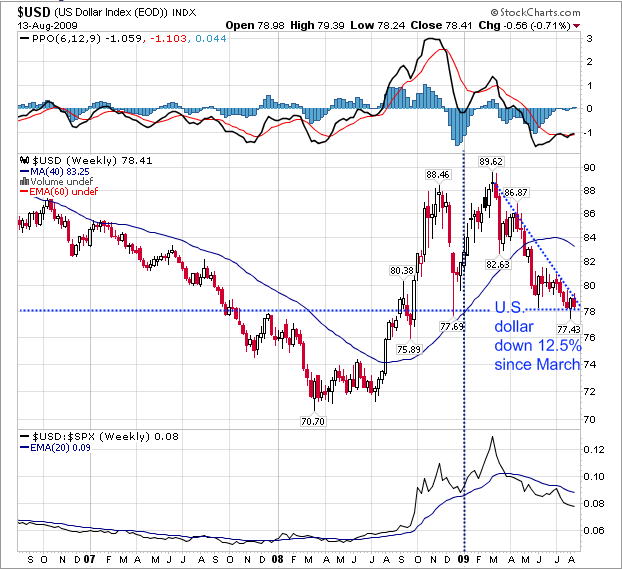
Now you might ask, why at the peak of the panic did the U.S. dollar reach a 3-year high? You have to remember that for almost a year, the notion of decoupling was making the rounds across investment communities. This idea was based on the premise that the U.S. was going to have a silo like decline while nations around the world somehow prospered with the biggest economy going under. This had as much merit as believing subprime loans would be a contained issue. So in late 2008, the idea was put to rest and people started rushing to safety especially with the implosion of banks like Lehman Brothers and the virtual nationalization of Fannie Mae and Freddie Mac. In March, investors had enough and the U.S. dollar still reigned supreme as a safe haven.
Since that time, the U.S. Treasury and Federal Reserve have done everything possible to crush the dollar rally including committing to buy $1.25 trillion in various forms of debt much of it in the form of mortgages and going with quantitative easing. What happened after this?
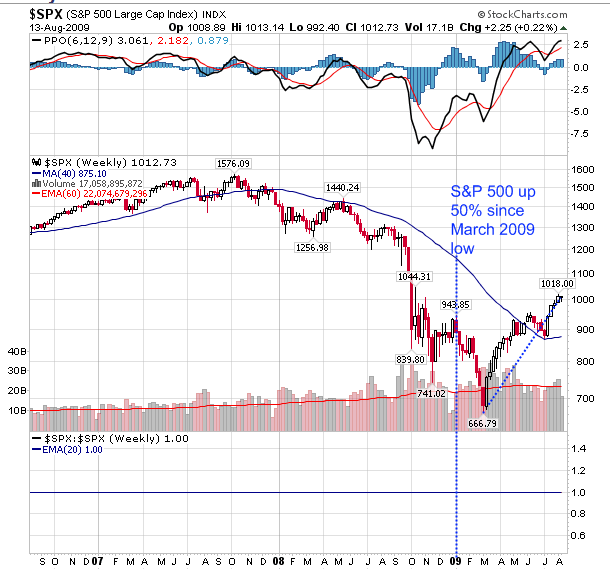
The stock market took off while the U.S. dollar continued a steady decline. And of course this would only be logical because why would foreigners want to purchase debt that is inherently following a policy of inflation by its issuer? U.S. items have become cheaper on a global stage. For those setting this policy, it makes a lot of sense because they are trying to inject inflation and slowly grow ourselves out of trillions in debt. U.S. households are still mired in massive amounts of debt:
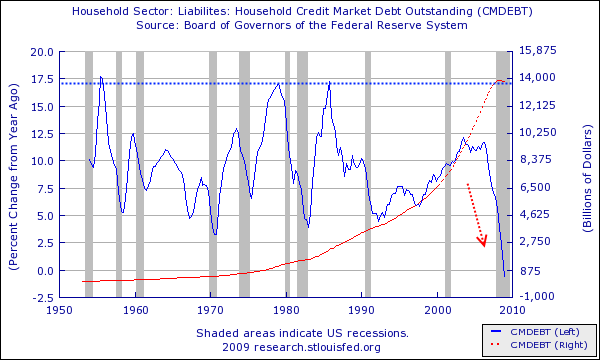
Now one thing is certain and that is American households are cutting back on debt. Much of this is happening because of a forced austerity but many are simply choosing to spend less by choice. And given that most of our borrowing comes from foreigners who hold enormous amounts of our debt, a declining dollar makes the amount we have to pay back that much cheaper. Now rightfully so, foreigners really do not like this kind of arrangement so the U.S. Treasury and Federal Reserve have to walk this trillion dollar debt tightrope. Their solution? Juice the stock market and make saving your money as unattractive as possible for domestic consumers. Cash for clunkers. Massive tax rebates for buying homes. All these are steroids for consumption and over consumption ironically is what led us into this financial crisis.
So should you worry? You may be thinking that it would be great if you can simply inflate all your debts away. That is assuming that the U.S. Treasury and Federal Reserve actually succeed in their objective. Keep in mind, never in the history of our country has the Fed loaded up their books with so much questionable debt:
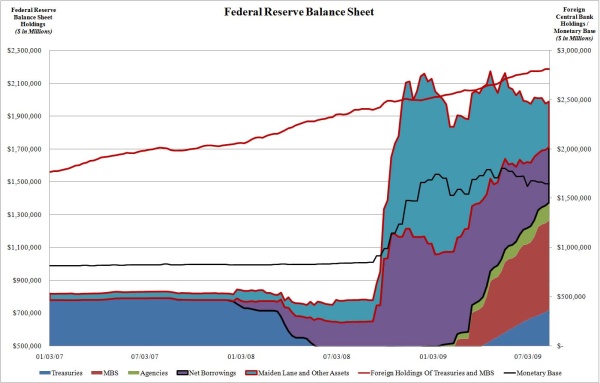
Source: Zero Hedge
This is unprecedented but the gist of all this is that we can somehow engineer ourselves out of this mess with targeted inflation. Given the size of the housing and credit bubble it is hard to see how this is even possible. The average American household is not able to balance this out given the number of rising bankruptcies and record high foreclosures.
The more troubling sign is how our currency is being sacrificed for easy finance for the banking industry. Many banks are now staying solvent even with bad loans on their books because they are now able to raise money in the open casino (stock market) by suspending belief with massaged mark to surreal accounting methods.
The S&P 500 is not up because of earnings. It is up because of the systematic destruction of the U.S. dollar and massive subsidies to failed banking institutions. We still have major issues including $3 trillion in commercial real estate yet this rally has the wind blowing on its back. Yet this is a stock bubble engineered by the juice of the U.S. Treasury and Federal Reserve. Those who use steroids usually have it catch up on them."
http://www.mybudget360.com/stock-market-dollar-store-us-dollar-down-125-percent-and-sp-500-up-50-percent-since-march-how-the-us-treasury-and-federal-reserve-juice-the-stock-market/
Introduction
"While there is much talk of a recovery on the horizon, commentators are forgetting some crucial aspects of the financial crisis. The crisis is not simply composed of one bubble, the housing real estate bubble, which has already burst. The crisis has many bubbles, all of which dwarf the housing bubble burst of 2008. Indicators show that the next possible burst is the commercial real estate bubble. However, the main event on the horizon is the “bailout bubble” and the general world debt bubble, which will plunge the world into a Great Depression the likes of which have never before been seen.
Housing Crash Still Not Over
The housing real estate market, despite numbers indicating an upward trend, is still in trouble, as, “Houses are taking months to sell. Many buyers are having trouble getting financing as lenders and appraisers struggle to figure out what houses are really worth in the wake of the collapse.” Further, “the overall market remains very soft [...] aside from speculators and first-time buyers.” Dean Baker, co-director of the Center for Economic and Policy Research in Washington said, “It would be wrong to imagine that we have hit a turning point in the market,” as “There is still an enormous oversupply of housing, which means that the direction of house prices will almost certainly continue to be downward.” Foreclosures are still rising in many states “such as Nevada, Georgia and Utah, and economists say rising unemployment may push foreclosures higher into next year.” Clearly, the housing crisis is still not at an end.[1]
The Commercial Real Estate Bubble
In May, Bloomberg quoted Deutsche Bank CEO Josef Ackermann as saying, “It's either the beginning of the end or the end of the beginning.” Bloomberg further pointed out that, “A piece of the puzzle that must be calculated into any determination of the depth of our economic doldrums is the condition of commercial real estate -- the shopping malls, hotels, and office buildings that tend to go along with real- estate expansions.” Residential investment went down 28.9 % from 2006 to 2007, and at the same time, nonresidential investment grew 24.9%, thus, commercial real estate was “serving as a buffer against the declining housing market.”
Commercial real estate lags behind housing trends, and so too, will the crisis, as “commercial construction projects are losing their appeal.” Further, “there are lots of reasons to suspect that commercial real estate was subject to some of the loose lending practices that afflicted the residential market. The Office of the Comptroller of the Currency's Survey of Credit Underwriting Practices found that whereas in 2003 just 2 percent of banks were easing their underwriting standards on commercial construction loans, by 2006 almost a third of them were relaxing.” In May it was reported that, “Almost 80 percent of domestic banks are tightening their lending standards for commercial real-estate loans,” and that, “we may face double-bubble trouble for real estate and the economy.”[2]
In late July of 2009, it was reported that, “Commercial real estate’s decline is a significant issue facing the economy because it may result in more losses for the financial industry than residential real estate. This category includes apartment buildings, hotels, office towers, and shopping malls.” Worth noting is that, “As the economy has struggled, developers and landlords have had to rely on a helping hand from the US Federal Reserve in order to try to get credit flowing so that they can refinance existing buildings or even to complete partially constructed projects.” So again, the Fed is delaying the inevitable by providing more liquidity to an already inflated bubble. As the Financial Post pointed out, “From Vancouver to Manhattan, we are seeing rising office vacancies and declines in office rents.”[3]
In April of 2009, it was reported that, “Office vacancies in U.S. downtowns increased to 12.5 percent in the first quarter, the highest in three years, as companies cut jobs and new buildings came onto the market,” and, “Downtown office vacancies nationwide could come close to 15 percent by the end of this year, approaching the 10-year high of 15.5 percent in 2003.”[4]
In the same month it was reported that, “Strip malls, neighborhood centers and regional malls are losing stores at the fastest pace in at least a decade, as a spending slump forces retailers to trim down to stay afloat.” In the first quarter of 2009, retail tenants “have vacated 8.7 million square feet of commercial space,” which “exceeds the 8.6 million square feet of retail space that was vacated in all of 2008.” Further, as CNN reported, “vacancy rates at malls rose 9.5% in the first quarter, outpacing the 8.9% vacancy rate registered in all of 2008.” Of significance for those that think and claim the crisis will be over by 2010, “mall vacancies [are expected] to exceed historical levels through 2011,” as for retailers, “it's only going to get worse.”[5] Two days after the previous report, “General Growth Properties Inc, the second-largest U.S. mall owner, declared bankruptcy on [April 16] in the biggest real estate failure in U.S. history.”[6]
In April, the Financial Times reported that, “Property prices in China are likely to halve over the next two years, a top government researcher has predicted in a powerful signal that the country’s economic downturn faces further challenges despite recent positive data.” This is of enormous significance, as “The property market, along with exports, were leading drivers of the booming Chinese economy over the past decade.” Further, “an apparent rebound in the property market was unsustainable over the medium term and being driven by a flood of liquidity and fraudulent activity rather than real demand.” A researcher at a leading Chinese government think tank reported that, “he expected average urban residential property prices to fall by 40 to 50 per cent over the next two years from their levels at the end of 2008.”[7]
In April, it was reported that, “The Federal Reserve is considering offering longer loans to investors in commercial mortgage-backed securities as part of a plan to help jump-start the market for commercial real estate debt.” Since February the Fed “has been analyzing appropriate terms and conditions for accepting commercial mortgage-backed securities (CMBS) and other mortgage assets as collateral for its Term Asset-Backed Securities Lending Facility (TALF).”[8]
In late July, the Financial Times reported that, “Two of America’s biggest banks, Morgan Stanley and Wells Fargo ... threw into sharp relief the mounting woes of the US commercial property market when they reported large losses and surging bad loan,” as “The disappointing second-quarter results for two of the largest lenders and investors in office, retail and industrial property across the US confirmed investors’ fears that commercial real estate would be the next front in the financial crisis after the collapse of the housing market.” The commercial property market, worth $6.7 trillion, “which accounts for more than 10 per cent of US gross domestic product, could be a significant hurdle on the road to recovery.”[9]
The Bailout Bubble
While the bailout, or the “stimulus package” as it is often referred to, is getting good coverage in terms of being portrayed as having revived the economy and is leading the way to the light at the end of the tunnel, key factors are again misrepresented in this situation.
At the end of March of 2009, Bloomberg reported that, “The U.S. government and the Federal Reserve have spent, lent or committed $12.8 trillion, an amount that approaches the value of everything produced in the country last year.” This amount “works out to $42,105 for every man, woman and child in the U.S. and 14 times the $899.8 billion of currency in circulation. The nation’s gross domestic product was $14.2 trillion in 2008.”[10]
Gerald Celente, the head of the Trends Research Institute, the major trend-forecasting agency in the world, wrote in May of 2009 of the “bailout bubble.” Celente’s forecasts are not to be taken lightly, as he accurately predicted the 1987 stock market crash, the fall of the Soviet Union, the 1998 Russian economic collapse, the 1997 East Asian economic crisis, the 2000 Dot-Com bubble burst, the 2001 recession, the start of a recession in 2007 and the housing market collapse of 2008, among other things.
On May 13, 2009, Celente released a Trend Alert, reporting that, “The biggest financial bubble in history is being inflated in plain sight,” and that, “This is the Mother of All Bubbles, and when it explodes [...] it will signal the end to the boom/bust cycle that has characterized economic activity throughout the developed world.” Further, “This is much bigger than the Dot-com and Real Estate bubbles which hit speculators, investors and financiers the hardest. However destructive the effects of these busts on employment, savings and productivity, the Free Market Capitalist framework was left intact. But when the 'Bailout Bubble' explodes, the system goes with it.”
Celente further explained that, “Phantom dollars, printed out of thin air, backed by nothing ... and producing next to nothing ... defines the ‘Bailout Bubble.’ Just as with the other bubbles, so too will this one burst. But unlike Dot-com and Real Estate, when the "Bailout Bubble" pops, neither the President nor the Federal Reserve will have the fiscal fixes or monetary policies available to inflate another.” Celente elaborated, “Given the pattern of governments to parlay egregious failures into mega-failures, the classic trend they follow, when all else fails, is to take their nation to war,” and that, “While we cannot pinpoint precisely when the 'Bailout Bubble' will burst, we are certain it will. When it does, it should be understood that a major war could follow.”[11]
However, this “bailout bubble” that Celente was referring to at the time was the $12.8 trillion reported by Bloomberg. As of July, estimates put this bubble at nearly double the previous estimate.
As the Financial Times reported in late July of 2009, while the Fed and Treasury hail the efforts and impact of the bailouts, “Neil Barofsky, special inspector-general for the troubled asset relief programme, [TARP] said that the various US schemes to shore up banks and restart lending exposed federal agencies to a risk of $23,700bn [$23.7 trillion] – a vast estimate that was immediately dismissed by the Treasury.” The inspector-general of the TARP program stated that there were “fundamental vulnerabilities . . . relating to conflicts of interest and collusion, transparency, performance measures, and anti-money laundering.”
Barofsky also reports on the “considerable stress” in commercial real estate, as “The Fed has begun to open up Talf to commercial mortgage-backed securities to try to influence credit conditions in the commercial real estate market. The report draws attention to a new potential credit crunch when $500bn worth of real estate mortgages need to be refinanced by the end of the year.” Ben Bernanke, the Chairman of the Fed, and Timothy Geithner, the Treasury Secretary and former President of the New York Fed, are seriously discussing extending TALF (Term Asset-Backed Securities Lending Facility) into “CMBS [Commercial Mortgage-Backed Securities] and other assets such as small business loans and whether to increase the size of the programme.” It is the “expansion of the various programmes into new and riskier asset classes is one of the main bones of contention between the Treasury and Mr Barofsky.”[12]
Testifying before Congress, Barofsky said, “From programs involving large capital infusions into hundreds of banks and other financial institutions, to a mortgage modification program designed to modify millions of mortgages, to public-private partnerships using tens of billions of taxpayer dollars to purchase 'toxic' assets from banks, TARP has evolved into a program of unprecedented scope, scale, and complexity.” He explained that, “The total potential federal government support could reach up to 23.7 trillion dollars.”[13]
Is a Future Bailout Possible?
In early July of 2009, billionaire investor Warren Buffet said that, “unemployment could hit 11 percent and a second stimulus package might be needed as the economy struggles to recover from recession,” and he further stated that, “we're not in a recovery.”[14] Also in early July, an economic adviser to President Obama stated that, “The United States should be planning for a possible second round of fiscal stimulus to further prop up the economy.”[15]
In August of 2009, it was reported that, “THE Obama administration will consider dishing out more money to rein in unemployment despite signs the recession is ending,” and that, “Treasury secretary Tim Geithner also conceded tax hikes could be on the agenda as the government worked to bring its huge recovery-related deficits under control.” Geithner said, “we will do what it takes,” and that, “more federal cash could be tipped into the recovery as unemployment benefits amid projections the benefits extended to 1.5 million jobless Americans will expire without Congress' intervention.” However, any future injection of money could be viewed as “a second stimulus package.”[16]
The Washington Post reported in early July of a Treasury Department initiative known as “Plan C.” The Plan C team was assembled “to examine what could yet bring [the economy] down and has identified several trouble spots that could threaten the still-fragile lending industry,” and “the internal project is focused on vexing problems such as the distressed commercial real estate markets, the high rate of delinquencies among homeowners, and the struggles of community and regional banks.”
Further, “The team is also responsible for considering potential government responses, but top officials within the Obama administration are wary of rolling out initiatives that would commit massive amounts of federal resources.” The article elaborated in saying that, “The creation of Plan C is a sign that the government has moved into a new phase of its response, acting preemptively rather than reacting to emerging crises.” In particular, the near-term challenge they are facing is commercial real estate lending, as “Banks and other firms that provided such loans in the past have sharply curtailed lending,” leaving “many developers and construction companies out in the cold.” Within the next couple years, “these groups face a tidal wave of commercial real estate debt -- some estimates peg the total at more than $3 trillion -- that they will need to refinance. These loans were issued during this decade's construction boom with the mistaken expectation that they would be refinanced on the same generous terms after a few years.”
However, as a result of the credit crisis, “few developers can find anyone to refinance their debt, endangering healthy and distressed properties.” Kim Diamond, a managing director at Standard & Poor's, stated that, “It's not a degree to which people are willing to lend,” but rather, “The question is whether a loan can be made at all.” Important to note is that, “Financial analysts said losses on commercial real estate loans are now the single largest cause of bank failures,” and that none of the bailout efforts enacted “is big enough to address the size of the problem.”[17]
So the question must be asked: what is Plan C contemplating in terms of a possible government “solution”? Another bailout? The effect that this would have would be to further inflate the already monumental bailout bubble.
The Great European Bubble
In October of 2008, Germany and France led a European Union bailout of 1 trillion Euros, and “World markets initially soared as European governments pumped billions into crippled banks. Central banks in Europe also mounted a new offensive to restart lending by supplying unlimited amounts of dollars to commercial banks in a joint operation.”[18]
The American bailouts even went to European banks, as it was reported in March of 2009 that, “European banks declined to discuss a report that they were beneficiaries of the $173 billion bail-out of insurer AIG,” as “Goldman Sachs, Morgan Stanley and a host of other U.S. and European banks had been paid roughly $50 billion since the Federal Reserve first extended aid to AIG.” Among the European banks, “French banks Societe Generale and Calyon on Sunday declined to comment on the story, as did Deutsche Bank, Britain's Barclays and unlisted Dutch group Rabobank.” Other banks that got money from the US bailout include HSBC, Wachovia, Merrill Lynch, Banco Santander and Royal Bank of Scotland. Because AIG was essentially insolvent, “the bailout enabled AIG to pay its counterparty banks for extra collateral,” with “Goldman Sachs and Deutsche bank each receiving $6 billion in payments between mid-September and December.”[19]
In April of 2009, it was reported that, “EU governments have committed 3 trillion Euros [or $4 trillion dollars] to bail out banks with guarantees or cash injections in the wake of the global financial crisis, the European Commission.”[20]
In early February of 2009, the Telegraph published a story with a startling headline, “European banks may need 16.3 trillion pound bail-out, EC document warns.” Type this headline into google, and the link to the Telegraph appears. However, click on the link, and the title has changed to “European bank bail-out could push EU into crisis.” Further, they removed any mention of the amount of money that may be required for a bank bailout. The amount in dollars, however, nears $25 trillion. The amount is the cumulative total of the troubled assets on bank balance sheets, a staggering number derived from the derivatives trade.
The Telegraph reported that, “National leaders and EU officials share fears that a second bank bail-out in Europe will raise government borrowing at a time when investors - particularly those who lend money to European governments - have growing doubts over the ability of countries such as Spain, Greece, Portugal, Ireland, Italy and Britain to pay it back.”[21]
When Eastern European countries were in desperate need of financial aid, and discussion was heated on the possibility of an EU bailout of Eastern Europe, the EU, at the behest of Angela Merkel of Germany, denied the East European bailout. However, this was more a public relations stunt than an actual policy position.
While the EU refused money to Eastern Europe in the form of a bailout, in late March European leaders “doubled the emergency funding for the fragile economies of central and eastern Europe and pledged to deliver another doubling of International Monetary Fund lending facilities by putting up 75bn Euros (70bn pounds).” EU leaders “agreed to increase funding for balance of payments support available for mainly eastern European member states from 25bn Euros to 50bn Euros.”[22]
As explained in a Times article in June of 2009, Germany has been deceitful in its public stance versus its actual policy decisions. The article, worth quoting in large part, first explained that:
Europe is now in the middle of a perfect storm - a confluence of three separate, but interconnected economic crises which threaten far greater devastation than Britain or America have suffered from the credit crunch: the collapse of German industry and employment, the impending bankruptcy of Central European homeowners and businesses; and the threat of government debt defaults from loss of monetary control by the Irish Republic, Greece and Portugal, for instance on the eurozone periphery.
Taking the case of Latvia, the author asks, “If the crisis expands, other EU governments - and especially Germany's - will face an existential question. Do they commit hundreds of billions of euros to guarantee the debts of fellow EU countries? Or do they allow government defaults and devaluations that may ultimately break up the single currency and further cripple German industry, as well as the country's domestic banks?” While addressing that, “Publicly, German politicians have insisted that any bailouts or guarantees are out of the question,” however, “the pass has been quietly sold in Brussels, while politicians loudly protested their unshakeable commitment to defend it.”
The author addressed how in October of 2008:
[...] a previously unused regulation was discovered, allowing the creation of a 25 billion Euros “balance of payments facility” and authorising the EU to borrow substantial sums under its own “legal personality” for the first time. This facility was doubled again to 50 billion Euros in March. If Latvia's financial problems turn into a full-scale crisis, these guarantees and cross-subsidies between EU governments will increase to hundreds of billions in the months ahead and will certainly mutate into large-scale centralised EU borrowing, jointly guaranteed by all the taxpayers of the EU.
[...] The new EU borrowing, for example, is legally an ‘off-budget’ and ‘back-to-back’ arrangement, which allows Germany to maintain the legal fiction that it is not guaranteeing the debts of Latvia et al. The EU's bond prospectus to investors, however, makes quite clear where the financial burden truly lies: “From an investor's point of view the bond is fully guaranteed by the EU budget and, ultimately, by the EU Member States.”[23]
So Eastern Europe is getting, or presumably will get bailed out. Whether this is in the form of EU federalism, providing loans of its own accord, paid for by European taxpayers, or through the IMF, which will attach any loans with its stringent Structural Adjustment Program (SAP) conditionalities, or both. It turned out that the joint partnership of the IMF and EU is what provided the loans and continues to provide such loans.
As the Financial Times pointed out in August of 2009, “Bank failures or plunging currencies in the three Baltic nations – Latvia, Lithuania and Estonia – could threaten the fragile prospect of recovery in the rest of Europe. These countries also sit on one of the world’s most sensitive political fault-lines. They are the European Union’s frontier states, bordering Russia.” In July, Latvia “agreed its second loan in eight months from the IMF and the EU,” following the first one in December. Lithuania is reported to be following suit. However, as the Financial Times noted, the loans came with the IMF conditionalities: “The injection of cash is the good news. The bad news is that, in return for shoring up state finances, the new IMF deal will require the Latvian government to impose yet more pain on its suffering population. Public-sector wages have already been cut by about a third this year. Pensions have been sliced. Now the IMF requires Latvia to cut another 10 per cent from the state budget this autumn.”[24]
If we are to believe the brief Telegraph report pertaining to nearly $25 trillion in bad bank assets, which was removed from the original article for undisclosed reasons, not citing a factual retraction, the question is, does this potential bailout still stand? These banks haven’t been rescued financially from the EU, so, presumably, these bad assets are still sitting on the bank balance sheets. This bubble has yet to blow. Combine this with the $23.7 trillion US bailout bubble, and there is nearly $50 trillion between the EU and the US waiting to burst.
An Oil Bubble
In early July of 2009, the New York Times reported that, “The extreme volatility that has gripped oil markets for the last 18 months has shown no signs of slowing down, with oil prices more than doubling since the beginning of the year despite an exceptionally weak economy.” Instability in the oil and gas prices has led many to “fear it could jeopardize a global recovery.” Further, “It is also hobbling businesses and consumers,” as “A wild run on the oil markets has occurred in the last 12 months.” Oil prices reached a record high last summer at $145/barrel, and with the economic crisis they fell to $33/barrel in December. However, since the start of 2009, oil has risen 55% to $70/barrel.
As the Times article points out, “the recent rise in oil prices is reprising the debate from last year over the role of investors — or speculators — in the commodity markets.” Energy officials from the EU and OPEC met in June and concluded that, “the speculation issue had not been resolved yet and that the 2008 bubble could be repeated.”[25]
In June of 2009, Hedge Fund manager Michael Masters told the US Senate that, “Congress has not done enough to curb excessive speculation in the oil markets, leaving the country vulnerable to another price run-up in 2009.” He explained that, “oil prices are largely not determined by supply and demand but the trading desks of large Wall Street firms.” Because “Nothing was actually done by Congress to put an end to the problem of excessive speculation” in 2008, Masters explained, “there is nothing to prevent another bubble in oil prices in 2009. In fact, signs of another possible bubble are already beginning to appear.”[26]
In May of 2008, Goldman Sachs warned that oil could reach as much as $200/barrel within the next 12-24 months [up to May 2010]. Interestingly, “Goldman Sachs is one of the largest Wall Street investment banks trading oil and it could profit from an increase in prices.”[27] However, this is missing the key point. Not only would Goldman Sachs profit, but Goldman Sachs plays a major role in sending oil prices up in the first place.
As Ed Wallace pointed out in an article in Business Week in May of 2008, Goldman Sachs’ report placed the blame for such price hikes on “soaring demand” from China and the Middle East, combined with the contention that the Middle East has or would soon peak in its oil reserves. Wallace pointed out that:
Goldman Sachs was one of the founding partners of online commodities and futures marketplace Intercontinental Exchange (ICE). And ICE has been a primary focus of recent congressional investigations; it was named both in the Senate's Permanent Subcommittee on Investigations' June 27, 2006, Staff Report and in the House Committee on Energy & Commerce's hearing last December. Those investigations looked into the unregulated trading in energy futures, and both concluded that energy prices' climb to stratospheric heights has been driven by the billions of dollars' worth of oil and natural gas futures contracts being placed on the ICE—which is not regulated by the Commodities Futures Trading Commission.[28]
Essentially, Goldman Sachs is one of the key speculators in the oil market, and thus, plays a major role in driving oil prices up on speculation. This must be reconsidered in light of the resurgent rise in oil prices in 2009. In July of 2009, “Goldman Sachs Group Inc. posted record earnings as revenue from trading and stock underwriting reached all-time highs less than a year after the firm took $10 billion in U.S. rescue funds.”[29] Could one be related to the other?
Bailouts Used in Speculation
In November of 2008, the Chinese government injected an “$849 billion stimulus package aimed at keeping the emerging economic superpower growing.”[30] China then recorded a rebound in the growth rate of the economy, and underwent a stock market boom. However, as the Wall Street Journal pointed out in July of 2009, “Its growth is now fuelled by cheap debt rather than corporate profits and retained earnings, and this shift in the medium term threatens to undermine China’s economic decoupling from the global slump.” Further, “overseas money has been piling into China, inflating foreign exchange reserves and domestic liquidity. So perhaps it is not surprising that outstanding bank loans have doubled in the last few years, or that there is much talk of a shadow banking system. Then there is China’s reputation for building overcapacity in its industrial sector, a notoriety it won even before the crash in global demand. This showed a disregard for returns that is always a tell-tale sign of cheap money.”
China’s economy primarily relies upon the United States as a consumption market for its cheap products. However, “The slowdown in U.S. consumption amid a credit crunch has exposed the weaknesses in this export-led financing model. So now China is turning instead to cheap debt for funding, a shift suggested by this year’s 35% or so rise in bank loans.”[31]
In August of 2009, it was reported that China is experiencing a “stimulus-fueled stock market boom.” However, this has caused many leaders to “worry that too much of the $1-trillion lending binge by state banks that paid for China's nascent revival was diverted into stocks and real estate, raising the danger of a boom and bust cycle and higher inflation less than two years after an earlier stock market bubble burst.”[32]
The same reasoning needs to be applied to the US stock market surge. Something is inherently and structurally wrong with a financial system in which nothing is being produced, 600,000 jobs are lost monthly, and yet, the stock market goes up. Why is the stock market going up?
The Troubled Asset Relief Program (TARP), which provided $700 billion in bank bailouts, started under Bush and expanded under Obama, entails that the US Treasury purchases $700 billion worth of “troubled assets” from banks, and in turn, “that banks cannot be asked to account for their use of taxpayer money.”[33]
So if banks don’t have to account for where the money goes, where did it go? They claim it went back into lending. However, bank lending continues to go down.[34] Stock market speculation is the likely answer. Why else would stocks go up, lending continue downwards, and the bailout money be unaccounted for?
What Does the Bank for International Settlements (BIS) Have to Say?
In late June, the Bank for International Settlements (BIS), the central bank of the world’s central banks, the most prestigious and powerful financial organization in the world, delivered an important warning. It stated that, “fiscal stimulus packages may provide no more than a temporary boost to growth, and be followed by an extended period of economic stagnation.”
The BIS, “The only international body to correctly predict the financial crisis ... has warned the biggest risk is that governments might be forced by world bond investors to abandon their stimulus packages, and instead slash spending while lifting taxes and interest rates,” as the annual report of the BIS “has for the past three years been warning of the dangers of a repeat of the depression.” Further, “Its latest annual report warned that countries such as Australia faced the possibility of a run on the currency, which would force interest rates to rise.” The BIS warned that, “a temporary respite may make it more difficult for authorities to take the actions that are necessary, if unpopular, to restore the health of the financial system, and may thus ultimately prolong the period of slow growth.”
Of immense import is the BIS warning that, “At the same time, government guarantees and asset insurance have exposed taxpayers to potentially large losses,” and explaining how fiscal packages posed significant risks, it said that, “There is a danger that fiscal policy-makers will exhaust their debt capacity before finishing the costly job of repairing the financial system,” and that, “There is the definite possibility that stimulus programs will drive up real interest rates and inflation expectations.” Inflation “would intensify as the downturn abated,” and the BIS “expressed doubt about the bank rescue package adopted in the US.”[35]
The BIS further warned of inflation, saying that, “The big and justifiable worry is that, before it can be reversed, the dramatic easing in monetary policy will translate into growth in the broader monetary and credit aggregates,” the BIS said. That will “lead to inflation that feeds inflation expectations or it may fuel yet another asset-price bubble, sowing the seeds of the next financial boom-bust cycle.”[36]
Major investors have also been warning about the dangers of inflation. Legendary investor Jim Rogers has warned of “a massive inflation holocaust.”[37] Investor Marc Faber has warned that, “The U.S. economy will enter ‘hyperinflation’ approaching the levels in Zimbabwe,” and he stated that he is “100 percent sure that the U.S. will go into hyperinflation.” Further, “The problem with government debt growing so much is that when the time will come and the Fed should increase interest rates, they will be very reluctant to do so and so inflation will start to accelerate.”[38]
Are We Entering A New Great Depression?
In 2007, it was reported that, “The Bank for International Settlements, the world's most prestigious financial body, has warned that years of loose monetary policy has fuelled a dangerous credit bubble, leaving the global economy more vulnerable to another 1930s-style slump than generally understood.” Further:
The BIS, the ultimate bank of central bankers, pointed to a confluence a worrying signs, citing mass issuance of new-fangled credit instruments, soaring levels of household debt, extreme appetite for risk shown by investors, and entrenched imbalances in the world currency system.
[...] In a thinly-veiled rebuke to the US Federal Reserve, the BIS said central banks were starting to doubt the wisdom of letting asset bubbles build up on the assumption that they could safely be "cleaned up" afterwards - which was more or less the strategy pursued by former Fed chief Alan Greenspan after the dotcom bust.[39]
In 2008, the BIS again warned of the potential of another Great Depression, as “complex credit instruments, a strong appetite for risk, rising levels of household debt and long-term imbalances in the world currency system, all form part of the loose monetarist policy that could result in another Great Depression.”[40]
In 2008, the BIS also said that, “The current market turmoil is without precedent in the postwar period. With a significant risk of recession in the US, compounded by sharply rising inflation in many countries, fears are building that the global economy might be at some kind of tipping point,” and that all central banks have done “has been to put off the day of reckoning.”[41]
In late June of 2009, the BIS reported that as a result of stimulus packages, it has only seen “limited progress” and that, “the prospects for growth are at risk,” and further “stimulus measures won't be able to gain traction, and may only lead to a temporary pickup in growth.” Ultimately, “A fleeting recovery could well make matters worse.”[42]
The BIS has said, in softened language, that the stimulus packages are ultimately going to cause more damage than they prevented, simply delaying the inevitable and making the inevitable that much worse. Given the previous BIS warnings of a Great Depression, the stimulus packages around the world have simply delayed the coming depression, and by adding significant numbers to the massive debt bubbles of the world’s nations, will ultimately make the depression worse than had governments not injected massive amounts of money into the economy.
After the last Great Depression, Keynesian economists emerged victorious in proposing that a nation must spend its way out of crisis. This time around, they will be proven wrong. The world is a very different place now. Loose credit, easy spending and massive debt is what has led the world to the current economic crisis, spending is not the way out. The world has been functioning on a debt based global economy. This debt based monetary system, controlled and operated by the global central banking system, of which the apex is the Bank for International Settlements, is unsustainable. This is the real bubble, the debt bubble. When it bursts, and it will burst, the world will enter into the Greatest Depression in world history."
Notes (1-42)"