New President Could Bypass Congress, on Key Issues
|



The time is now 9:49 am
You last visited
July 20, 2026, 9:34 pm
All times shown are
Eastern Time (GMT-5:00)

|
Which do you think Sarah Palin would be better suited for and why? If you think both or neither, tell why.
|
|
Venus Williams has defeated the Russian, Vera Zvonareva 6(6)- 7, 6 - 0, 6 - 2 in the year ending WTA Tour Sony Ericsson Championships in Doha, Qatar. The purse was a whopping $1.3 million for the winner and $715 thousand for the runner-up. Venus will be number 6 in the world on Monday when the final rankings come out.
Way To Go, Venus Williams!!!
U.S.A

Sunday 11-9-08
039, 493, 223, 087, 618, 735, 951, 106
398, 498, 916, 517, 617, 308, 813, 000
4880, 5522, 4823, 5523, 4829, 8811

Saturday, November 8, 2008
Venus beats top-ranked Jankovic; Zvonareva awaits for WTA final
Associated Press
DOHA, Qatar -- Venus Williams advanced to the final of the Sony Ericsson Championships with a 6-2, 2-6, 6-3 win Saturday over top-ranked Jelena Jankovic.
Williams will face Vera Zvonareva, who defeated Olympic champion Elena Dementieva 7-6 (7), 3-6, 6-3 in the other semifinal at the WTA Tour's season-ending event.
| Venus Williams improved her record against Jelena Jankovic to 4-5. |
Williams saved five break points before winning a grueling service game in the third set to go up 4-2. That game also featured a 26-stroke rally, the longest of the match. She went on to clinch the victory with a backhand crosscourt winner on her first match point.
"My game is about being aggressive and taking chances," Williams said. "I really needed to put a lot more balls in play."
The American dominated in the first set, but made more errors in the second as Jankovic dictated play with her aggression. She broke Williams to lead 4-2, and closed out the set with relative ease.
The eighth-ranked Williams improved her record against Jankovic to 4-5. Despite the loss, the Serb will end the year at No. 1. She secured the top spot last month.
"I can go to vacation with a smile on my face," Jankovic said. "It will be really weird not to have my rackets with me."
The ninth-ranked Zvonareva, the lowest-ranked player in the eight-woman field, improved to 2-4 against Dementieva and avenged her semifinal loss at the Beijing Olympics.
"I knew I had to start to play good every single game," Zvonareva said.
Zvonareva frustrated Dementieva with solid groundstrokes in the final set and capitalized on a string of errors by her opponent to win the last game at love.
Zvonareva recovered from a 1-4 deficit in the first set. In the tiebreaker, Dementieva rallied from 5-1 down and lost a set point before hitting a backhand wide on Zvonareva's second set point. The Russians broke each other four times in the first set.
Dementieva also had a 4-1 lead in the second set, and this time held it to even the match. She called Zvonareva a strong competitor.
"You have to put pressure all the time," Dementieva said.
JERUSALEM (CNN) -- An unusual sight greeted Jerusalem police as they entered one of Christianity's holiest sites Sunday morning: dozens of monks punching and kicking each other in a massive brawl.
Monks from the Greek Orthodox and Armenian denominations were preparing for a ceremony at the Church of the Holy Sepulcher in the Old City when a disagreement led to a full-fledged fist fight.
Many among the dozens of monks came away with cuts and bruises, said police spokesman Mickey Rosenfeld.
Officers were called to the scene to break up the brawl. They detained two monks, one from each denomination, Rosenfeld said.
The Church of the Holy Sepulcher in Jerusalem is thought to be built on the site of Jesus' crucifixion and resurrection.
Rivalries between the different sects that share control of the church often lead to tensions between the sides.
November 8, 2008 ·
Both the Obama and McCain campaign computer systems came under cyberattack earlier this year. The attacks were serious enough to prompt an FBI investigation.
The Obama campaign first discovered something was amiss with its campaign's computer system back in August. Initially, staff members thought they were dealing with a run-of-the-mill computer virus — perhaps someone was breaking into their system to get the campaign's credit card numbers or steal their passwords. It was only after they asked the FBI to step in that they realized something much more sinister was afoot.
The FBI told them that someone was actually downloading the bulk of their files. And it wasn't just the Obama campaign in the cross hairs. The McCain campaign was apparently having similar issues. The breach was first reported by Newsweek magazine.
Government officials familiar with the case told NPR that the attack is likely to have originated from China. The working hypothesis is that whoever was behind the attack was going after information, not money. They wanted to glean information on policy positions and the thinking that went into them. Officials said they believe the culprits wanted to see how the policies were developed — tracking discussion threads to gain an advantage in future negotiations.
The FBI has been dealing with a lot of this kind of cyber-espionage. Universities have been major victims, and one of the FBI's big initiatives has been working with schools to help safeguard sensitive research.
Cyberterrorism is just one of the many issues on which the FBI is preparing to brief the Obama team. FBI officials told NPR that the pre-Sept. 11 world doesn't provide much guidance on how to get new administrations properly briefed.
Before the al-Qaida attacks, FBI transition briefings included detailed discussions on specific crime fighting and techniques. Now the briefings include a discussion of terrorist threat trip wires, attack prevention and how to fight spies — not just at home, but on the Internet.
That's one reason there seems to have been some unprecedented cooperation so far during the post-election transition. There is real concern that terrorists might try to take advantage of a time when this country's guard might be down. The first World Trade Center attack came just weeks after the Clinton administration took office in 1993. The cooperation, security clearances and early terrorism briefings are all about trying to avoid any security lapses between administrations.
President-elect Obama dodged a question about his terrorism briefings during his first news conference Friday. When a reporter asked whether anything he had heard during his first briefing worried him, Obama declined to answer. The only thing he would allow was that while intelligence had gotten better, it wasn't necessarily where he wanted it to be.
Teams from the Obama camp are expected to start parachuting into various agencies next week. They are expected at the Department of Homeland Security and will very likely drop by the FBI. The idea is for these teams to work with people who are already doing these jobs so they can make the handoff to the new administration as seamless as possible.
That whole anti-American, friend-to-the-terrorists thing about President-elect Barack Obama? Never mind.
Just a few weeks ago, at the height of the campaign, Representative Michele Bachmann of Minnesota told Chris Matthews of MSNBC that, when it came to Mr. Obama, “I’m very concerned that he may have anti-American views.”
But there she was on Wednesday, after narrowly escaping defeat because of those comments, saying she was “extremely grateful that we have an African-American who has won this year.” Ms. Bachmann, a Republican, called Mr. Obama’s victory, which included her state, “a tremendous signal we sent.”
And it was not too long ago that Senator John McCain’s running mate, Gov. Sarah Palin of Alaska, accused Mr. Obama of “palling around with terrorists.”
But she took an entirely different tone on Thursday, when she chastised reporters for asking her questions about her war with some staff members in the McCain campaign at such a heady time. “Barack Obama has been elected president,” Ms. Palin said. “Let us, let us — let him — be able to kind of savor this moment, one, and not let the pettiness of maybe internal workings of the campaign erode any of the recognition of this historic moment that we’re in. And God bless Barack Obama and his beautiful family.”
There is a great tradition of paint-peeling political hyperbole during presidential campaign years. And there is an equally great tradition of backing off from it all afterward, though with varying degrees of deftness.
But given the intensity of some of the charges that have been made in the past few months, and the historic nature of Mr. Obama’s election, the exercise this year has been particularly whiplash-inducing, with its extreme before-and-after contrasts.
The shift in tone follows the magnanimous concession speech from Mr. McCain, of Arizona, who referred to Mr. Obama’s victory Tuesday night as “a historic election” and hailed the “special pride” it held for African-Americans. That led the vice president-elect, Senator Joseph R. Biden Jr., to get into the act. During the campaign, Mr. Biden said he no longer recognized Mr. McCain, an old friend. Now, he says, “We’re still friends.” President Bush, in turn, also hailed Mr. Obama’s victory, saying his arrival at the White House would be “a stirring sight.”
Whether it all heralds a new era of cooperation in Washington remains to be seen, and it may be downright doubtful. But for now, at least, it would seem to be part of an apparent rush to join what has emerged as a real moment in American history.
The presidential historian Doris Kearns Goodwin said she was hard-pressed to find a similar moment when the tone had changed so drastically, and so quickly, among so many people of such prominence.
“I don’t think that’s happened very often,” Ms. Goodwin said. “The best answer I can give you is they don’t want to be on the wrong side of history, and they recognize how the country saw this election, and how people feel that they’re living in a time of great historic moment.”
Others in the professional political class were not so sure. Some wondered whether simple pragmatism was the explanation.
“My experience is, it’s less an epiphany and more a political reality,” said Chris Lehane, a former Democratic strategist who worked on the presidential campaign of Al Gore. “I’m thinking they will continue in this direction so long as the polls indicate it’s a smart place to be.”
There are notable exceptions: Rush Limbaugh has given no quarter. And while his fellow conservative radio hosts Sean Hannity and Laura Ingraham have noted the significance of his victory — on Wednesday, Ms. Ingraham said “Obama did make history” and “It’s not the time to vilify him” — they seem to be in line with Bill O’Reilly of Fox News. Relishing his new role in the opposition camp, Mr. O’Reilly said, “The guy is still a mystery, so our oversight will be intense.”
Some lawmakers also do not appear inclined to give up the fight. Representative John A. Boehner, the House minority leader, has already criticized Mr. Obama’s choice of Representative Rahm Emanuel, Democrat of Illinois, as his chief of staff.
But other people who opposed Mr. Obama, like Senator Joseph I. Lieberman of Connecticut, have good reason to try to make up with the winning ticket. As an ardent backer of Mr. McCain, Mr. Lieberman angered the Democrats, who in 2000 nominated him as their vice-presidential candidate. After losing a Democratic primary challenge in 2006 and then winning as an independent, he still continued to caucus with the Democrats.
Attending an event with Mr. McCain in York, Pa., in August, Mr. Lieberman said the race was “between one candidate, John McCain, who has always put the country first, worked across party lines to get things done, and one candidate who has not.”
As a speaker at the Republican National Convention, Mr. Lieberman went further than Democrats expected by criticizing Mr. Obama for “voting to cut off funding for our troops on the ground.” (Mr. Obama voted for bills that included plans for withdrawal from Iraq and against others that did not.)
This week Mr. Lieberman, who has been asked by the Democratic Senate leadership to consider giving up his position as the chairman of the Committee on Homeland Security and Governmental Affairs, released a statement congratulating Mr. Obama for “his historic and impressive victory.” It continued, “The American people are a people of extraordinary fairness.”
Marshall Wittmann, a spokesman for Mr. Lieberman, said that as far as the senator was concerned, “It’s over, and it’s genuinely time to find unity and move forward behind the new president.”
And what about that whole bit about Mr. Obama not always putting his country first? “He believes that President-elect Obama — and, then, Senator Obama — is a genuine patriot and loves his country,” Mr. Wittmann said. “The only point he was making in his campaign was about partisanship.”
Mr. Obama is apparently ready to bury the hatchet with his new fans. “President-elect Obama has made it clear that he wants to put partisanship behind and work together to solve the many challenges confronting the country,” said Stephanie Cutter, a spokeswoman for the Obama transition team. “We’re pleased that others do as well.”
The Senate majority leader, Harry Reid of Nevada, who will help decide Mr. Lieberman’s committee assignment, sounded less ready to forgive, at least when it came Mr. Lieberman’s support for Mr. McCain. “Joe Lieberman has done something that I think was improper, wrong, and I’d like — if we weren’t on television, I’d use a stronger word of describing what he did,” he said on CNN Friday.
1 hour ago
EVANSTON, Ill. (AP) — A 90-year-old woman apparently has been living in a house with the bodies of her three siblings, one of whom may have been dead since the early 1980s, police in suburban Chicago said.
The bodies were found Friday morning by police who were called by a senior advocate, said Evanston police Cmdr. Tom Guenther.
The 90-year-old woman was taken to a hospital for observation. The Cook County medical examiner's office said Saturday that the people had died of natural causes, but it would not say how long they had been dead.
The office has identified the dead as Anita Bernstorff, who was born in 1910, Frank Bernstorff, who was born in 1920, and Elaine Bernstorff, who was born in 1916. Anita Bernstorff was last seen alive in May 2008, Frank Bernstorff in 2003 and Elaine Bernstorff in the early 1980s, authorities said.
Neighbors described the woman as alert and aware, and they said she was well-liked on their close-knit block of large historic homes. She enjoyed gardening and shared her plants with others, they said.
One longtime resident said the woman explained away her siblings' absence by telling neighbors her brother had gone to live with other relatives and that one of her sisters was agoraphobic — afraid to leave the home. The resident said neighbors, who often took the woman food and groceries, were never inside.
ISLAMABAD, Pakistan - Militants killed two people they claimed were spies for the United States and dumped their bodies with a warning in a Pakistani border region at the center of a campaign of suspected American missile strikes, an official said Saturday.
Police found the bullet-ridden bodies of the two men on Saturday in the North Waziristan tribal region after a tip from residents, police official Gul Marjan said.
"See the fate of this man. He was an American spy," was written on notes pinned to each of the bodies found in the village of Ghulam Khan, Marjan said. The notes said the men were from the neighboring Afghan province of Khost.
The warning was an indication that Taliban and al-Qaida militants are on the lookout for spies in Pakistan's wild border belt as the frequency of suspected American missile strikes on their hide-outs increases.
At least 18 strikes from what are believed to be unmanned U.S. military and CIA aircraft have hit Pakistan's tribal regions since August, more than three times as many as in 2007. The rugged, mountainous region — where the Pakistani government has never had much control — is considered a likely hiding place for Osama bin Laden and his No. 2 Ayman al-Zawahri.
Many of the cross-border attacks have targeted North Waziristan, a base for Afghan and foreign militants involved in the growing insurgency against the U.S.-backed government in Afghanistan.
Militants have executed scores of Afghans and Pakistanis in the region in recent years for alleged spying. It is unclear whether the victims, many of whom have been beheaded, were marking or informing on targets for U.S. missile strikes.
The missile strikes have drawn condemnation from Pakistan's government, which argues that they undermine the country's sovereignty and its own efforts to combat Islamic radicalism.
"The U.S. administration's reluctance to consider the repercussions of such operations is damaging the whole purpose of global efforts to combat terrorism," Pakistani Information Minister Sherry Rehman said after an attack in North Waziristan on Friday killed some 13 people.
However, the Pakistani government has also renewed its commitment to the seven-year-old war on terror, even as it hopes that President-elect Barack Obama will be more receptive to its arguments.
Rehman said in a statement late Friday that Pakistani President Asif Ali Zardari was urging Washington to halt the attacks. It was unclear if Zardari raised the matter in an overnight telephone call with Obama.
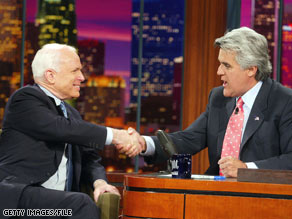
LOS ANGELES (AP) — Sen. John McCain will make his first post-election TV appearance on the "Tonight" show next week, NBC said Friday.
The Republican presidential candidate is set to join "Tonight" host Jay Leno on Tuesday in honor of Veteran's Day, the network announced. McCain is a former Naval officer and prisoner of war in
Vietnam.
Picking a talk show over a news show for his first TV interview guarantees McCain a more lighthearted experience after his loss to President-elect Obama.
That McCain chose "Tonight" instead of David Letterman's "Late Show" on CBS may have its roots in the campaign. Letterman repeatedly roasted McCain for canceling a September guest shot because of the economic crisis, finally relenting when McCain came on and said he had "screwed up."
By Phil Rosenthal
Tribune media columnist
7:41 PM CST, November 7, 2008
The chief executive of Oprah Winfrey's business partner in her Oprah Winfrey Network, or OWN, cable channel said today he expects the Queen of Daytime Talk to retire her nationally syndicated Chicago-based TV show in 2011, but Winfrey's spokeswoman insisted that's not yet set in stone.
OWN is a 50-50 multi-platform venture between Winfrey's Harpo Productions and Discovery Communications that's set to launch next year.
"The expectation is that after [the 2010-11 season] her show will go off of … syndication, and she will come to OWN," David Zaslav, Discovery's president and CEO, said in a call with analysts. "We're talking now about what that presence would be and what programming she would be involved in directly. But this is her Chapter Two, and building the OWN brand online and on-air is something that she and I, we're working [on] together and it's a core mission for her."
Winfrey's current contract with CBS Television Distribution to do "The Oprah Winfrey Show" does in fact expire in 2011 after her 25th season on national TV. But Lisa Halliday, chief spokeswoman for Winfrey's Harpo Productions, cast Zaslav's remark as premature.
"She has not made a final decision as to whether she will continue her show in syndication beyond that," Halliday said in a statement.
CBS Television Distribution, in its own statement, said it "would certainly welcome and hope that 'The Oprah Winfrey Show' would continue in syndication beyond [2011], but that is a decision only Ms. Winfrey will be making."
The talk show continues to be successful despite ratings erosion over the last year or so that some have pegged to her political involvement off-camera in support of Barack Obama's presidential bid. Others have attributed it to changing overall media consumption patterns coupled with the challenge of remaining so dominant for so long.
OWN was announced in January and will replace the Discovery Health channel when it launches in more than 70 million homes in the second half of 2009. Winfrey is its chairman and will enjoy editorial control. What, if any on-camera role she might play has yet to be delineated, however, and, in fact, her syndication deal limits her ability even to put reruns of her daytime show on the channel.
Winfrey has floated the notion of ending the show that originates from her Harpo compound on Chicago's Near West Side before only to reconsider and embrace a lucrative new renewal deal.
It happened in 1997 before she signed a renewal through 2002. When she re-signed in 2002, she said her 20th season in 2006 would be the end. By 2004, she changed her mind again and extended the deal yet once more. She only recently informed CBS that she was picking up the option on the final 2010-11 season of the current deal.
Winfrey has explained she sees OWN as not merely an opportunity to expand her media empire, which already includes O magazine, the "Oprah & Friends" satellite radio channel and a movie and television production company. It is a way to extend her legacy and that of the show that catapulted her to prominence.
"The truth of the matter is one day the show has to end. That may be 2011 and that may be after 2011," Winfrey told reporters in January. "This is an evolution of what I've been able to do every day. I will now have the opportunity to do that 24 hours a day on a platform that goes on forever.
"This network isn't just about me," she said. "It's using the voice and the brand and the vision, but it really is about creating possibilities for any number of people ... to extend the vision in a way that obviously I cannot 24 hours a day."
BY KATHLEEN LUCADAMO
DAILY NEWS STAFF WRITER
Saturday, November 8th 2008, 11:08 AM
The winter stomach bug is on the move in New York, sending 400 people a day to emergency rooms for vomiting and diarrhea - a 19% jump in the last two weeks, the Health Department says.
Officials said the "norovirus," also known as the highly contagious stomach flu, usually lasts a few days, but they warned New Yorkers to wash their hands regularly to avoid the bug.
"Norovirus infection is a miserable experience, and can be serious if you become dehydrated," said Sharon Balter, a medical epidemiologist at the Health Department who called hand-washing "the best way to avoid it."
New Yorkers can contract the infection by sharing food or drinks with an infected person, coming into contact with their vomit, using their utensils or changing the diaper of a sick child, officials said.
The Health Department warned those who get the bug, particularly if they are children, to stay home and rest until the illness passes.
"If you get sick with diarrhea or vomiting, stay home so that you don't spread the infection to others," she said.
"Keeping sick kids home from school or day care is especially important."
There is typically a surge in stomach bug cases this time of year. Symptoms include vomiting, diarrhea, nausea, stomach cramping, fever, chills, aches and tiredness.
The flu vaccine does not prevent the norovirus, and there are no specific treatments for recovery other than rest and drinking plenty of fluids. People who feel dehydrated as a result of the virus should go to a doctor or the hospital.
By FELICIA FONSECA – 1 hour ago
ST. JOHNS, Ariz. (AP) — It's a crime that police officers in a small eastern Arizona community can hardly fathom yet have to deal with: an 8-year-old charged in the fatal shootings of his father and another man.
"Who would think an 8-year-old kid could kill two adults?" St. Johns Police Chief Roy Melnick said Friday.
The killings on Wednesday sent shock waves through St. Johns, a community of about 4,000 people. The boy had no disciplinary record at school, and there was no indication he had any problems at home, prosecutors said.
"It was such a tragedy," said the boy's defense attorney, Benjamin Brewer. "You have two people dead; you have an 8-year-old in jail. It tugs at the heart strings. It's a shocker, no doubt about it."
On Friday, a judge determined there was probable cause to show that the boy fatally shot his father, Vincent Romero, 29, and Timothy Romans, 39, of San Carlos, with a .22-caliber rifle. The boy faces two counts of premeditated murder. Under Arizona law, charges can be filed against anyone 8 or older.
Melnick said the boy didn't act on the "spur of the moment," though he didn't elaborate on what the motive might have been.
Melnick said officers arrived at Romero's home within minutes of the shooting Wednesday. They found one victim just outside the front door and the other dead in an upstairs room.
Romans had been renting a room at the Romero house, prosecutors said. Both men were employees of a construction company working at a Salt River Project power plant near St. Johns, which is about 170 miles northeast of Phoenix.
The boy went to a neighbor's house and said he "believed that his father was dead," said Apache County attorney Brad Carlyon.
Melnick said police obtained a confession from the boy, but Brewer said police overreached in questioning the boy without representation from a parent or attorney and did not advise him of his rights.
"They became very accusing early on in the interview," Brewer said. "Two officers with guns at their side, it's very scary for anybody, for sure an 8-year-old kid."
A judge ordered a psychological evaluation of the boy, who was being held at the Apache County juvenile detention center.
Prosecutors aren't sure where the case is headed, Carlyon said.
"There's a ton of factors to be considered and weighed, including the juvenile's age," he said. "The counter balance against that, the acts that he apparently committed."
Carlyon said the boy had no record of complaints with Arizona Child Protective Services.
"He had no record of any kind, not even a disciplinary record at school," he said. "He has never been in trouble before."
City Manager Greg Martin said the community was "saddened" and "shocked."
"Not something that happens very often and hopefully never happens again," he said. "It's been on their minds every since it happened."
FBI statistics show instances of children younger than 11 committing homicides are very rare. According to recent FBI supplementary homicide reports, there were at least three such cases each year in 2003, 2004 and 2005; there were at least 15 in 2002. More recent statistics weren't available, nor were details of the cases.
Earlier this year in Arizona, prosecutors in Cochise County filed first-degree murder charges against a 12-year-old boy accused of killing his mother.
Defense attorney Mike Piccarreta, who is not involved in the latest case, said each case has to be considered on its own merits, but it would be hard for him to comprehend that an 8-year-old has the mental capacity to understand the act of murder and its implications.
"If they actually prosecute the guy, it's a legal minefield," he said. "And, two, society has to make a decision as to whether they want to start using the criminal justice system to deal with 8-year-olds. That doesn't mean you don't have a troubled kid."
Wednesday's homicides were the first in at least four years in the community, where most people know one another, Melnick said. No one else had been killed there since 20 years ago, he said.
Romero had full custody of the child. The boy's biological mother visited St. Johns during the weekend from Mississippi, and returned to Arizona after the shootings, Carlyon said.
Brewer said the boy "seems to be in good spirits.
"He's scared," he said. "He's trying to be tough, but he's scared."
From expansive executive privilege to hard-line tactics in the war on terrorism, Obama must decide what he'll undo and what he'll embrace.
The stakes couldn't be higher.
On one hand, civil libertarians and other critics of the Bush administration may feel betrayed if Obama doesn't move aggressively to reverse legal policies that they believe have violated the Constitution and international law.
On the other hand, Obama risks alienating some conservative Americans and some — but by no means all — military and intelligence officials if he seeks to hold officials accountable for those expansive policies.
These are some of the legal issues confronting him:
Undoing some policies will take time.
With 316 conservative appointments to the federal courts over the last eight years, Obama could attempt to tilt the courts back to the center or even to the left with his nominees. He could alter the Supreme Court's bent by replacing two or three justices who'll probably retire soon.
Civil libertarians, who feel emboldened by a Democrat in the White House, tick off a long list of what they think Obama should do as soon as he takes office. Not only should Guantanamo be closed, they say, Obama should revoke the immunity for telecommunications companies that cooperated with secret eavesdropping, ban the use of secret prisons by the CIA and investigate and perhaps prosecute administration officials for authorizing controversial interrogation methods.
Anthony D. Romero, the executive director of the American Civil Liberties Union, which has led many of the challenges to the Bush administration's terrorism policies, said Obama could take action on most of these fronts "on day one" by issuing executive orders, such as closing Guantanamo.
"Unless he acts quickly, he runs the risk of showing the American people that their hope and optimism may have been misplaced, and reinforcing people's deep-seated cynicism that it's politics as usual in D.C.," he said.
Although Obama is likely to ban waterboarding and other aggressive techniques soon after taking office, prosecuting administration officials not only would be legally challenging because legislation has granted them immunity but also would be seen by Republicans as highly divisive.
Negotiating that minefield may be among the most difficult legal dilemmas Obama faces early in his administration because of pressure from the left and the right.
"There will be hell to pay if people are prosecuted," said Sanford Levinson, a University of Texas law professor. "But there'll be hell to pay if they just walk away scot-free."
He predicted that Obama might sidestep the controversy with the Bush administration's help. If President Bush issues pre-emptive pardons to prevent prosecutions, the Obama administration should form a bipartisan panel, similar to the Sept. 11 commission, to oversee an inquiry, he said. Once pardoned, officials implicated in the controversy would be required to discuss details of the policies because they'd be unable to assert their Fifth Amendment right to avoid self-incrimination.
The best person to lead such a commission? Levinson thinks it's John McCain, who condemned the interrogation techniques when he was running against Obama.
"There would be widespread support if the Obama administration did reach out to someone like McCain," Levinson said. "More people would regard it as not so much of a Democratic vendetta but as a necessary cleansing of an episode in recent American history that has had phenomenal costs to us around the world."
Democratic Sen. Dianne Feinstein of California, a senior member of the Senate Judiciary and Intelligence committees, predicted that Obama would move to close Guantanamo relatively quickly. She'll reintroduce legislation to do so early next year.
"The handwriting is on the wall," Feinstein said. "It's just a matter of time."
Although Guantanamo isn't expected to be as thorny as the issues of interrogation techniques, detention without charges and eavesdropping, it may take longer to close than Obama wants because of the question of what to do with high-value terrorists. The Obama administration could end up moving them to prisons scattered across the United States as it sorts out who should remain jailed and where others should be sent.
The Bush Justice Department chose to fight the court-ordered releases of many of the detainees, even those whom the military had cleared. Obama's attorney general is likely to soften that stance and begin releasing them with court oversight, or perhaps order new legal reviews of all detainees.
Three dozen district-court and 15 appellate court vacancies await. Appellate court decisions set precedents for multiple states. Whoever fills the vacant seat on the San Francisco-based 9th U.S. Circuit Court of Appeals, for instance, will shape the law covering nine Western states.
For this reason, appellate court vacancies can become battlegrounds. On the 4th Circuit Court of Appeals, which spans five states, including the Carolinas, a vacancy lingers after eight years.
Considerable speculation in the legal community has centered on potential female appointees to the Supreme Court, where Justice Ruth Bader Ginsburg is the only woman. One potential candidate is Judge Sonia Sotomayor, the first Hispanic woman to serve on the 2nd Circuit Court of Appeals. Another is Harvard Law School's Dean Elena Kagan, who like Obama was on the University of Chicago Law School faculty.
Noncourt appointments, too, can shape the law in important ways.
Whomever Obama appoints as attorney general and in other top positions in the Justice Department could move in new directions on hot-button issues such as gun control and immigration. And after pledging to tackle the financial crisis and concerns about global warming, Obama might dedicate more resources to prosecuting white-collar and environmental crimes.
Paul Charlton, one of the nine U.S. attorneys whom the Bush administration ousted, predicted that an Obama administration would take a different approach to the death penalty. Charlton clashed with Bush appointees who pushed prosecutors to seek the death penalty in a wide array of cases, including drug trafficking. "I expect there will be a more judicious use of the death penalty," he said.
However, Bush administration critics who hope an Obama White House will be the antidote to what they see as excessive executive power may be disappointed.
Gene Healy, a Cato Institute vice president and the author of the book "The Cult of the Presidency: America's Dangerous Devotion to Executive Power," said expanding presidential power was a bipartisan reflex.
"People tend to think more positively about having robust executive authority when they're the ones who are actually wielding the authority," he said.
Obama, however, is unlikely to be aggressive as Bush. "He'll probably seek congressional approval, and that may be more effective at growing executive power than the unilateral, go-it-alone approach," Healy said.


