
- Home
- Premium Memberships
- Lottery Results
- Forums
- Predictions
- Lottery Post Videos
- News
- Search Drawings
- Search Lottery Post
- Lottery Systems
- Lottery Charts
- Lottery Wheels
- Worldwide Jackpots
- Quick Picks
- On This Day in History
- Blogs
- Online Games
- Premium Features
- Contact Us
- Whitelist Lottery Post
- Rules
- Lottery Book Store
- Lottery Post Gift Shop


The time is now 6:03 pm
You last visited
June 10, 2026, 10:04 am
All times shown are
Eastern Time (GMT-5:00)

Key DigitsPrev TopicNext Topic
-
These snapshots occurred at approximately around 6 p.m. MST from Feb 11 thru Feb 14.
These snapshots track all state games in U.S. and Canada for the longest out digit in any position for a particular game.
Once a game reaches approximately 5x its expected skip count you should consider playing the digit.
If you play the key digit, select only single combos, and exclude 3 other digits (i.e. leaving you with 7 digits) you are left with 90 combos to consider.
If you play online this will give you 10 chances to profit or break even.
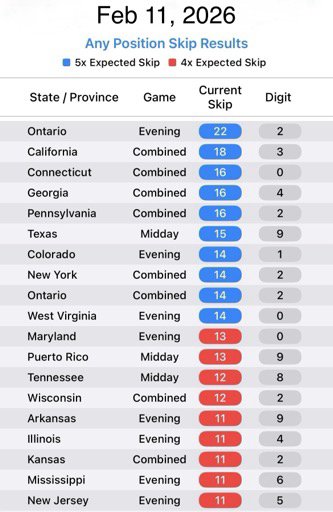
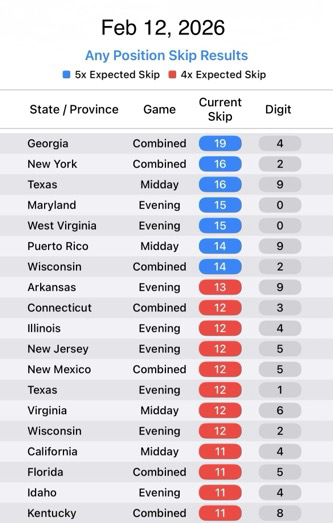
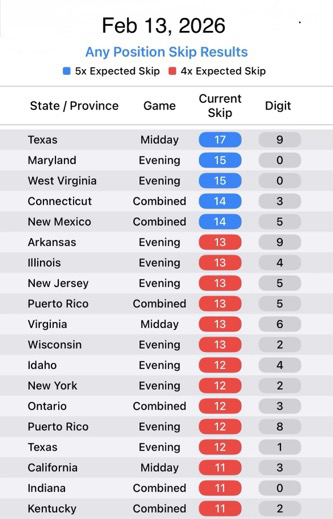
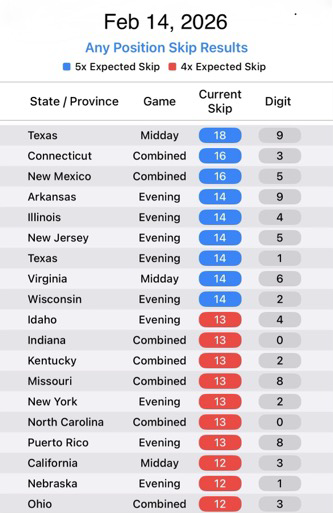
You can see that on Feb 11 10 games are considered 5x overdue (highlighted in blue). By Feb 13, 8 of the 10 games have hit with only Texas Midday, and West Virginia Evening not having hit. But West Virginia hit later that night. Connecticut Combined switched from Digit 0 to Digit 3 after Digit 0 hit.
Anyway its a strategy to consider.
Good Luck !!!
-

-

FEB. 14 2026
Any position skip results
New Mexico Combined
Current Skip 16
Digit 5
Sun, Feb 15,
4-5-2
I'm looking for more
-
-
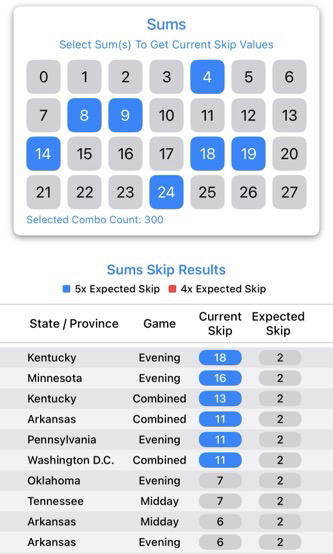
I don't track root sums, but I do track sums, and last digit sums.
This is the current state for last digit sums 4, 8, 9 which equates to 300 combos
-
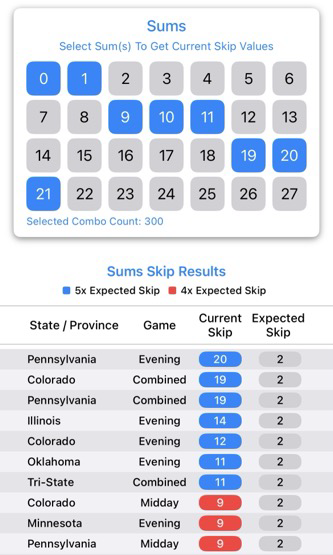
Last Digit Sums or Short Sums 0,1,9 are overdue for Pennsylvania.
-
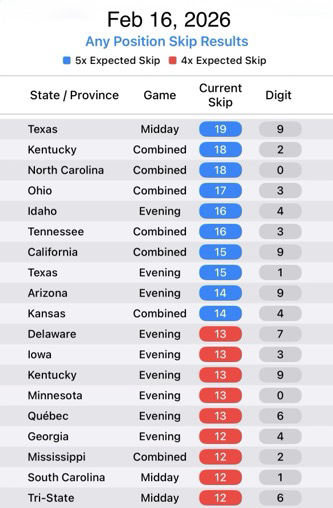
From 2/14 Midday to end of day on 2/15 the following games that were at 5x expected skip hit.
Connecticut Combined Key Digit 3 hit
New Mexico Combined Key Digit 5 hit
Arkansas Evening Key Digit 9 hit
Illinois Evening Key Digit 4 hit
New Jersey Evening Key Digit 5 hit
Virginia Midday Key Digit 6 hit
Wisconsin Evening Key Digit 2 hit7 out of 9 games is not bad at all.
-
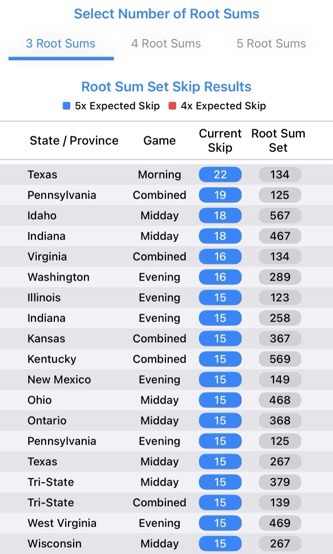
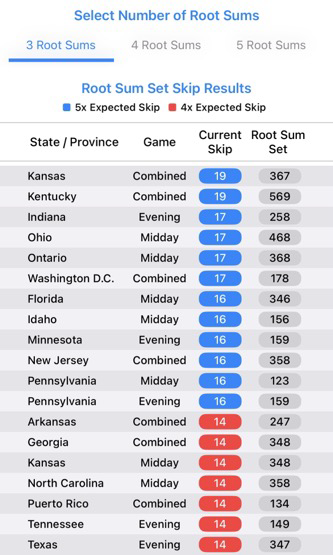
Added Root Sum Sets.
At end of day 02/17 this is the following state using 3 root sums.
For example for Pennsylvania Combined the Root Sums 1, 2, and 5 (which represents 333 straight combos) have skipped 19 consecutive draws.
-
Texas Morning 661 or root sum 4

Pennsylvania Evening 434 or root sum 2
Virginia Midday 793 or root sum 1
Washington Evening 315 or root sum 9
Illinois Evening 496 or root sum 1
New Mexico Evening 334 or root sum 1
Wisconsin Midday 096 or root sum 6 -
Lets see how many of these root sums hit today on 02/20/2026
-
-