truesee's Blog

Breast-Milk Ice Cream: Dangerous?

Well, That Was Fast: Health Officials Stop Sales of Breast Milk Ice Cream


Elizabeth Tyler 

Time

March 2, 2011 


They'll be no more milk from mommy for customers of The Icecreamists, after local government officials confiscated ice cream made from human breast milk.  

The action came on Monday, when representatives of Westminster City Council removed the offending dairy products from the central London store. The infamous "Baby Gaga" ice cream was launched last week amid a flurry of press attention.

But it seems not everyone was enraptured by the discovery. A number of complaints arrived at the City Council's door questioning the sale of edibles made from bodily fluids, and the myriad health hazards this could entail. It was these complaints that prompted the confiscation of the ice cream.

Officials from the Council said that the product is now being thoroughly tested with full cooperation from the producers, The Icecreamists. Although the company insists that the milk was screened in line with blood donor requirements before it was processed,  this further testing and guidance from the UK's Food Standards Agency will be needed before it can be put back on the market.

The daring dessert is lightly flavored with lemon zest and vanilla pods and is served in a martini glass, to whichever brave customer is willing, and eager to fork out £14 ($22.50) for their taste of the trend. The ice cream sold out as soon as it launched on Friday, but further production is in the pipeline, with more women coming forward offering to donate milk. The first batch was sourced from women, paid by the company, who had responded to an online ad calling for their breast milk.

Matt O'Connor, founder of The Icecreamists said that "As far as we are aware there is no law prohibiting a business from selling breast milk ice cream," and that the company had had a "huge response" to the new product line. The company's website proclaims them to be "Agents of Cool" who are "liberating the world one lick at a time." But it looks like the world might need a bit more time to come round to the idea of 'breast milk' ice cream. (Via Yahoo News)


Read more: http://newsfeed.time.com/2011/03/01/well-that-was-fast-health-officials-stop-sales-of-breast-milk-ice-cream/#ixzz1FVYMyanX

Entry #4,047

Westboro Baptist Church Wins Supreme Court Appeal Over Funeral Protests

Westboro Baptist Church Wins Supreme Court Appeal Over Funeral Protests

MARK SHERMAN   03/ 2/11 08:09 PM   AP

Westboro Baptist Church Arizona


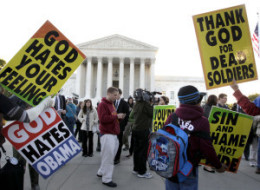
WASHINGTON — The Supreme Court ruled Wednesday that a grieving father's pain over mocking protests at his Marine son's funeral must yield to First Amendment protections for free speech. All but one justice sided with a fundamentalist church that has stirred outrage with raucous demonstrations contending God is punishing the military for the nation's tolerance of homosexuality.

The 8-1 decision in favor of the Westboro Baptist Church of Topeka, Kan., was the latest in a line of court rulings that, as Chief Justice John Roberts said in his opinion for the court, protects "even hurtful speech on public issues to ensure that we do not stifle public debate."

The decision ended a lawsuit by Albert Snyder, who sued church members for the emotional pain they caused by showing up at his son Matthew's funeral. As they have at hundreds of other funerals, the Westboro members held signs with provocative messages, including "Thank God for dead soldiers," `'You're Going to Hell," `'God Hates the USA/Thank God for 9/11," and one that combined the U.S. Marine Corps motto, Semper Fi, with a slur against gay men.

Justice Samuel Alito, the lone dissenter, said Snyder wanted only to "bury his son in peace." Instead, Alito said, the protesters "brutally attacked" Matthew Snyder to attract public attention. "Our profound national commitment to free and open debate is not a license for the vicious verbal assault that occurred in this case," he said.

The ruling, though, was in line with many earlier court decisions that said the First Amendment exists to protect robust debate on public issues and free expression, no matter how distasteful. A year ago, the justices struck down a federal ban on videos that show graphic violence against animals. In 1988, the court unanimously overturned a verdict for the Rev. Jerry Falwell in his libel lawsuit against Hustler magazine founder Larry Flynt over a raunchy parody ad.

What might have made this case different was that the Snyders are not celebrities or public officials but private citizens. Both Roberts and Alito agreed that the Snyders were the innocent victims of the long-running campaign by the church's pastor, the Rev. Fred Phelps, and his family members who make up most of the Westboro Baptist Church. Roberts said there was no doubt the protesters added to Albert Snyder's "already incalculable grief."

But Roberts said the frequency of the protests – and the church's practice of demonstrating against Catholics, Jews and many other groups – is an indication that Phelps and his flock were not mounting a personal attack against Snyder but expressing deeply held views on public topics.

Indeed, Matthew Snyder was not gay. But "Westboro believes that God is killing American soldiers as punishment for the nation's sinful policies," Roberts said.

"Speech is powerful. It can stir people to action, move them to tears of both joy and sorrow, and – as it did here – inflict great pain. On the facts before us, we cannot react to that pain by punishing the speaker," Roberts said.

Snyder's reaction, at a news conference in York, Pa.: "My first thought was, eight justices don't have the common sense God gave a goat." He added, "We found out today we can no longer bury our dead in this country with dignity."

He said it was possible he would have to pay the Phelpses around $100,000, which they are seeking in legal fees, since he lost the lawsuit. The money would, in effect, finance more of the same activity he fought against, Snyder said.

Margie Phelps, a daughter of the minister and a lawyer who argued the case at the Supreme Court, said she expected the outcome. "The only surprise is that Justice Alito did not feel compelled to follow his oath," Phelps said. "We read the law. We follow the law. The only way for a different ruling is to shred the First Amendment."

She also offered her church's view of the decision. "I think it's pretty self-explanatory, but here's the core point: the wrath of God is pouring onto this land. Rather than trying to shut us up, use your platforms to tell this nation to mourn for your sins."

Veterans groups reacted to the ruling with dismay. Veterans of Foreign Wars national commander Richard L. Eubank said, "The Westboro Baptist Church may think they have won, but the VFW will continue to support community efforts to ensure no one hears their voice, because the right to free speech does not trump a family's right to mourn in private."

The picketers obeyed police instructions and stood about 1,000 feet from the Catholic church in Westminster, Md., where the funeral took place in March of 2006.

The protesters drew counter-demonstrators, as well as media coverage and a heavy police presence to maintain order. The result was a spectacle that led to altering the route of the funeral procession.

Several weeks later, Albert Snyder was surfing the Internet for tributes to his son from other soldiers and strangers when he came upon a poem on the church's website that assailed Matthew's parents for the way they brought up their son.

Soon after, Snyder filed a lawsuit accusing the Phelpses of intentionally inflicting emotional distress. He won $11 million at trial, later reduced by a judge to $5 million.

The federal appeals court in Richmond, Va., threw out the verdict and said the Constitution shielded the church members from liability. The Supreme Court agreed.

Forty-eight states, 42 U.S. senators and veterans groups had sided with Snyder, asking the court to shield funerals from the Phelps family's "psychological terrorism."

While distancing themselves from the church's message, media organizations, including The Associated Press, urged the court to side with the Phelps family because of concerns that a victory for Snyder could erode speech rights.

Roberts described the court's holding as narrow, and in a separate opinion Justice Stephen Breyer suggested that in other circumstances governments would not be "powerless to provide private individuals with necessary protection."

But in this case, Breyer said, it would be wrong to "punish Westboro for seeking to communicate its views on matters of public concern."

___

Associated Press writer Maria Sudekum Fisher in Kansas City, Mo., contributed to this report.

Entry #4,046

New Billboard Tells The Date When Christ Will Return

Billboards Claim To Know When Christ Will Return

Billboards Claim To Know When Christ Will Return

Memphis

Candace McCowan 2:22 p.m. CST, March 2, 2011

FAST FACTS:
  • Billboards all over the mid south claiming they know when Christ is returning
  • Those behind the billboard say it's soon
  • One local pastor says not so fast

(Memphis 3/2/2011) You can find one on Crump Boulevard near downtown or near Bartlett at I-40 and Whitten Road.

There are 17 billboards near the city of Memphis claiming May 21 will be the day Christ returns.

Sandy Willson is the senior pastor at Second Presbyterian.

He says the claim isn't true, "Here is what the bible said about it, no one knows the day or the hour," said Willson.

Wecanknow.com is the website listed on the billboards. Allison Warden is the operator. She calls herself a Christian. And says it's no vision or dream, just scripture.

"It's a calendar, it coincidences with secular records, to when certain kings ruled and things like that. There is another date in that calendar and it's when Christ returns," said Warden.

Although she's read the verse in the bible saying Christ return will be a surprise, she says that read alone it's out of context.

"Yea brethren are not in darkness, that day should overtake you as a thief... That verse is saying believers will know," added Warden.

She says the web site has been seen by hundreds of thousands; everywhere from the United States to India.

No matter what you read or believe, Pastor Willson says you should turn to the bible for the truth.

"The bible is a collection of books and it's not always easy to understand, and we need teachers and we need time to study it carefully," said Willson.

The billboards were paid for by people throughout the United States wanting to get the word out.

They say the website has had hit from people in 130 plus countries
Entry #4,045

Where's Obama? The president is often strangely absent from the most important debates

Obama's 'Where's Waldo?' presidency


Ruth Marcus

Washington Post
Wednesday, March 2, 2011; 12:00 AM


For a man who won office talking about change we can believe in, Barack Obama can be a strangely passive president. There are a startling number of occasions in which the president has been missing in action - unwilling, reluctant or late to weigh in on the issue of the moment. He is, too often, more reactive than inspirational, more cautious than forceful.

Each of these instances can be explained on its own terms, as matters of legislative strategy, geopolitical calculation or political prudence.

He didn't want to get mired in legislative details during the health-care debate for fear of repeating the Clinton administration's prescriptive, take-ours-or-leave-it approach. He doesn't want to go first on proposing entitlement reform because history teaches that this is not the best route to a deal. He didn't want to say anything too tough about Libya for fear of endangering Americans trapped there. He didn't want to weigh in on the labor battle in Wisconsin because, well, it's a swing state.

Yet the dots connect to form an unsettling portrait of a "Where's Waldo?" presidency: You frequently have to squint to find the White House amid the larger landscape.

This tough assessment from someone who generally shares the president's ideological perspective may be hard to square with the conservative portrait of Obama as the rapacious perpetrator of a big-government agenda. If the president is being simultaneously accused of overreaching ambition and gutless fight-ducking, maybe he's doing something right.

Maybe, or else Obama has at times managed to do both simultaneously. On health care, for instance, he took on a big fight without being able to articulate a clear message or being willing to set out any but the broadest policy prescriptions. Lawmakers, not to mention the public, were left guessing about what, exactly, the administration wanted to see in the measure and where it would draw red lines.

That was not an isolated case. Where, for example, is the president on the verge of a potential government shutdown - if not this week, then a few weeks from now?

Aside from a short statement from the Office of Management and Budget threatening a presidential veto of the House version of the funding measure, the White House - much to the frustration of some congressional Democrats - has been unclear in public and private about what cuts would and would not be acceptable.

By contrast, a few weeks before the shutdown in 1995, Clinton administration aides had dispatched Cabinet members and other high-ranking officials to spread the message that cuts in education, health care and housing would harm families and children. Obama seems more the passive bystander to negotiations between the House and Senate than the chief executive leading his party.

He performs best on a stage that permits the grandest sweep. He rises to the big occasion, from his inspiring introduction to the public in his 2004 Demoncratic convention speed to his healing words in the aftermath of the Tucson shootings.  The president has faltered, though, when called on to translate that rhetoric to more granular levels of specificity: What change, exactly, does he want people to believe in? How, even more exactly, does he propose to get there? "Winning the future" doesn't quite do it.

My biggest beef is with the president's slipperiness on fiscal matters. Obama has said he agrees with some of his fiscal commission's recommendations and disagrees with others. Which ones does he disagree with? I asked this question the other day of Austan Goolsbee, the chairman of the Council of Economic Advisers.

Here's what I got: "The view espoused by some of the . . . commission that we ought to do Social Security 100 percent off of benefit cuts for sure he doesn't agree with." But of course, the plan that 11 of the commission members endorsed did nothing of the sort.

I was unfair to Goolsbee because I asked him a question he didn't have the leeway to answer. You can't blame the aide for ducking when the boss fudges.

Where's Obama? No matter how hard you look, sometimes he's impossible to find.

Entry #4,044

Is Sarah Palin smart enough to be president?

Boulder Weekly

Thursday, December 2, 2010

Last Updated  Monday, Mar 01, 2011 10:09am


Is Sarah Palin smart enough to be president?


Paul Danish


Good question. Are you? Come on now — no false modesty.  No quips about being smart enough not to run for president, or any other dodges.  The question is do you think you are smart enough to be CEO of the United States of America, and to, as the presidential oath puts it, “faithfully execute the office of president of the United States, and … to the best of [your] ability, preserve, protect, and defend the Constitution of the United States?”  That’s a pretty simple and straight- forward job description — think you’re smart enough to handle it?  Or put the question another way:  Do you think you’re too dumb to be president?  Again, no false modesty.  Fess up.  If it’s any comfort, I think it’s a good bet that you are smart enough to be president.  This isn’t because you’re so <snip>ed smart;  it’s because being president of the United States,  although it requires some extraordinary personal attributes, doesn’t demand extraordinary intelligence and erudition.


The truth is that when it comes to running the United States, you don’t have to be much above average in terms of smarts. The genius of the Constitution is that it created a government that doesn’t require a genius to run it. Academic credentialing, which supposedly says something about a person’s smarts, hasn’t been much of a predictor of success when it comes to the presidency.

While it is true that most American presidents have had university degrees, the two greatest — Washington and Lincoln — did not.

Washington was home-schooled; his hopes for a formal education in England ended with his father’s death in 1743 when he was 11.  (He eventually earned a Surveyor’s Certificate from the College of William and Mary.)

Lincoln had about 18 months of formal schooling.  His legal education consisted of reading law books after he was elected to the Illinois legislature.

You would have to be pretty dumb to argue that the lack of formal education, never mind college degrees, rendered either Washington or Lincoln unfit for the presidency.

Between 1789 and 1869, seven of the first 17 U.S. presidents didn’t have college degrees. (Washington, Jackson, Van Buren, Taylor, Fillmore, Lincoln and Andrew Johnson.)

From 1869 to the present, only two presidents lacked college degrees — Grover Cleveland and Harry Truman. History’s judgment of both has been “better than average.”

If you are going to run the United States, it certainly helps to be intelligent and reasonably well educated, but there are more important qualities to have.

What might those be?  Well, that’s a question that a senior colloquium in American government could argue about all semester.  However, my personal answer comes not from political science, but from poetry.  It’s the list of character traits in Rudyard Kipling’s poem  “If.” Here are some of them, cast as questions to a potential candidate and semi-delyriced (if that’s a word) to keep the poetry from distracting from the content:

Can you keep your head in a crisis when all your advisers and political allies are panicking and blaming you?  (It’s something that can be a big plus when your finger is on the nuclear trigger.)

Can you trust yourself when everyone doubts you, but make allowance for their doubting, too? (Like Bush, ordering the surge in Iraq.)

Can you dream — and not make dreams your master? Can you think — and not make thoughts your aim? ( JFK and Theodore Roosevelt could.)

Can you talk with crowds and keep your virtue? (Obama may have a problem here.)

Can you walk with kings and not lose the common touch? (Reagan could and did.)

Can you wait and not be tired by waiting? (Truman, Eisenhower, Kennedy, Johnson, Ford, Carter, and Reagan could. That’s why we won the Cold War.)

Do you have the inner strength and tenacity to keep going after you have nothing left in the tank physically, intellectually or emotionally except the will that says to you, “Hold on.”  (Think Lincoln in 1864. Think Ulysses S. Grant’s entire life.)

Do all men count with you, but none too much?  (The prime directive for any democratically elected political leader is to do the greatest good for the greatest number.  In order to do that, all men must count with you, but none too much.)

And so on. These “presidential” qualities are expressions of morality, integrity, character, even wisdom, but not necessarily of smarts.

So to return to the original question: Is Sarah Palin smart enough to be President? Yes, she is, and so are you.

But the real question is does Sarah Palin have what it takes to be president?  It’s too soon to say, but I think if measured against the Kipling standard, she would stack up pretty well — probably better than a lot of those who have occupied the Oval Office.

Would you?

Entry #4,043

If Gov. Scott Walker prevails, will Wisconsin look more like the South?

The Christian Science Monitor
If Gov. Scott Walker prevails, will Wisconsin look more like the South?


The South's small-government, pro-business, boot-strap ideals are drawing jobs to states in the region. That economic model may hold appeal for Wisconsin's Scott Walker and other Northern GOP governors. But it also has a dark side.

Temp Headline Image
Patrik Jonsson
Staff writer
March 1, 2011 at 3:51 pm EST Atlanta


If Gov. Scott Walker (R) has his way in the labor dispute that has rocked Wisconsin for two weeks, will his state in effect look a lot more like those in the South?

Their economies marked by weak unions, a business-friendly climate, a thin social safety net, and lower taxes, Southern states may be an inspiration to some Northern politicians looking to grow jobs and dig out of budgetary holes.

Governors around the United States are "really under tremendous pressure ... to transform their economies," said Bruce Katz, director of metropolitan policy at the Brookings Institution, at a recent symposium. Collectively, states' deficits for the next fiscal year add up to $125 billion, forcing at least 41 states to propose cuts in education. Help from the federal government is probably not on the way, either, with Congress having no appetite for another stimulus bill or a bailout.

That leaves financially strapped states looking around for other solutions, and their gaze may be fastening on what some economists call the South's "moonlight and magnolias" strategy. Under that economic construct, the focus is on creating a competitive place to locate businesses, so the premium is on investments in benefits for corporations and on keeping wages relatively low. Worker rights, social services, even education take a back seat to "job creators" under this model – which critics denounce as a race to the bottom.

"Members of the modern Republican Party, and the 'Tea Party movement' in particular, gravitate naturally toward models of growth that treat public programs and investments as mere obstacles in the path of dynamic corporate 'job creators,' '' writes Ed Kilgore, a fellow at the Progressive Policy Institute, in The New Republic this week. "Many look South in admiration." But "if Wisconsin and other states – not to mention the country as a whole – end up adopting these atavistic economic ideals," warns Mr. Kilgore, "they will simply begin to resemble the dysfunctional Old South societies that spawned them in the first place."

Others note, though, that people are voting with their feet. Northerners – including African-Americans – have decamped in a massive migration to the South during the past two decades, evidently perceiving that's where the jobs are going.

"When you talk about folks in New Jersey, Ohio, and Wisconsin, there's not a lot of optimism about the future right now," says David Woodard, a political scientist at Clemson University, in South Carolina. "They're not as optimistic as someone living in Atlanta."

Of the top 10 states with the smallest share of public employees eligible for collective bargaining, nine are in the South. In Wisconsin, Governor Walker is trying to curtail unions' collective bargaining rights; other states seek steep concessions in pay and benefits from public employee unions to close budget gaps and make their states more competitive.

The top 10 entrepreneurial states, moreover, are all in the South and the West – and all in so-called right-to-work states that ban closed union shops, according to the Kaufmann Index of Entrepreneurial Activity.

For many Southerners, the strategy is hardly a race to the bottom. Blacks on average now make more money in the South than they do in the North. Professor Woodard relates the story of a former South Carolina landscaper who used to drive a beat-up Chevy pickup truck but now works at the nonunion BMW plant in Greenville, S.C. He drives a new BMW, and "you couldn't convince him that he's worse off," says Woodard.

Wisconsin's Walker has said that stronger taxpayer representation in state governments will pave the way for economic recovery – and eventually more opportunity for all. But getting there means breaking a social compact that has been in place since the 1950s and that was strengthened in the 1990s boom years, when many public employee unions secured generous health and pension benefits in exchange for slightly lower pay scales.

Mississippi Gov. Haley Barbour (R), who has without much opposition cut pay and benefits for state workers in order to offer incentive packages for corporations, supports Walker's moves in Wisconsin. (A new Toyota plant is opening in Mississippi this year.)

"When they have collective bargaining in Wisconsin, on one side of the table there's state employee unions or the local employee unions. On the other side of the table are politicians that they paid for the election of those politicians," the potential presidential aspirant tells the Washington Post. "Now, who represents the taxpayers in that negotiation? Well, actually, nobody."

There is a darker side to the Southern model. Former slave states and territories have greater income disparities, receive more in federal subsidies than the tax dollars they send to Washington, and lag behind in educational achievement, especially for the poorest residents. Critics say that's what happens when economic policies put the "job creators" ahead of consumers of state services and benefits, including education.

Southern states receive more than their fair share of federal dollars per resident largely because they get a lot of farm and military subsidies, have fewer high-wage earners, and in effect outsource much of their indigent care to Washington. Obviously, the federal government could not long afford a situation in which a greater number of states get more federal dollars than they give. The US would need to cut entitlements and social programs much more than lawmakers in Congress – including GOP conservatives – are currently contemplating.

"Texas, for example, has a huge debt problem, and it's a state with no social safety net to begin with and they're now planning to cut services for the needy more deeply," says Norm Ornstein, a fellow with the nonpartisan American Enterprise Institute in Washington. "The great irony here is that people who are now most agitated about deficits and debt are the ones who not only want to keep $4 trillion in tax cuts, but want to have even more tax cuts."

That core idea – that tax-cut opportunity trumps tax-paid benefits – is built into the South's Jeffersonian society, which backs limits on federal power and promotes the state's role in safeguarding individual property and rights. It comes at a price. "By design, life is tougher in the South," concedes Clemson's Woodard.

Entry #4,040

Diagnosing Charlie Sheen, from afar

Diagnosing Charlie Sheen, from afar

charlie sheen on 20/20

Actor Charlie Sheen talks to ABC News' Andrea Canning for a "20/20" broadcast airing Tuesday. (Reuters / ABC News)


Eryn Brown
Los Angeles Times
March 1, 2011, 4:24 p.m. 
Last month, when actor Charlie Sheen was hospitalized with severe abdominal pain, his camp reported that he had a hiatal hernia. 

This week, Sheen launched into a media blitz-slash-meltdown after CBS canceled his show, "Two and a Half Men," for the remainder of the season.  In interviews on ABC, CNN and other outlets, he spoke of "tiger blood" running through his veins, insulted his bosses and questioned the value of Alcoholics Anonymous in fighting addiction.

No explanations for his behavior have been forthcoming this time around, leading experts to engage in remote diagnosis instead.

Discussion continues, of course, about the actor's alleged substance abuse.  On a recent radio show, Sheen -- who began an in-home rehab program for drug use soon after the hernia incident -- denied that he had a problem. 

"I have a disease?" he said. "I cured it right now with my mind." 

Deni Carise, the chief clinical officer of substance abuse program Phoenix House, wrote that Sheen's behavior indicates he may still be abusing drugs. "When people with a history of abusing drugs suddenly can't control their words or behavior, it's a strong indication that they may indeed be abusing drugs again," she said.     

Sheen's mental health has come into question too. Psychologist Deborah Serani, writing at Psychology Today, joined the camp that thinks he might have bipolar disorder.  (Last week, celebrity-addiction celebrity Dr. Drew Pinsky suggested that Sheen was "clearly manic.") A lengthy analysis of Sheen's recent comments on Time Magazine's Healthland blog made a similar suggestion.

"His recent ranting behavior has led viewers to question whether the actor was still on drugs and denying addiction. Or whether he was exhibiting manic symptoms of bipolar disorder. Or some combination of the two. Sheen's negative drug test suggests that addiction is unlikely to be his only problem," wrote Maia Szalavitz  .

"Although it isn't possible to diagnose patients at a distance, Sheen's case illustrates why it can be sometimes difficult for experts to distinguish between symptoms of a cocaine or meth high, drug withdrawal and bipolar mania," she added. 

The debate will likely continue Tuesday evening as Sheen appears on ABC's "20/20."
Entry #4,039

Facebook feud over $20 loan for diapers ends in tragedy

Kayla Henriques confesses to fatal stab of Kamisha Richards in fight over diaper money: cop sources


Joe Jackson, Barry Paddock and Rocco Parascandola
DAILY NEWS WRITERS

Originally Published:Tuesday, March 1st 2011, 8:10 AM
Updated: Tuesday, March 1st 2011, 4:32 PM

Kamisha Richard, left, was allegedly stabbed to death by her boyfriend's sister, Kayla Henriques, right, over a $20 loan for diapers.

via FacebookKamisha Richard, left, was allegedly stabbed to death by her boyfriend's sister, Kayla Henriques, right, over a $20 loan for diapers.


A Brooklyn teen was busted Tuesday for fatally stabbing her brother's girlfriend in a fight sparked by an argument over a $20 loan to buy diapers, police sources said.

Kayla Henriques, 18, calmly ate Chinese food after confessing to the Monday night attack in a Brooklyn housing project, sources told the Daily News.

John Jay College graduate Kamisha Richards was knifed once in the chest in the Cypress Hills Houses on Sutter Ave. in East New York about 10:35 p.m., officials said.

"It didn't look like she was stabbed," said a relative of Richard's boyfriend. "She just stumbled, and I caught her. Then all she said was, 'Oh, God.' I tried to help her, stop a rag on to stop the bleeding."

Richards was an on-and-off resident of the Cypress Hills complex, home to her boyfriend of seven years, Ramel Henriques.

Kayla Henriques, known in the neighborhood as KK, is the mother of an 11-month-old boy. She was grabbed by police in a building near the crime scene.

Facebook exchanges from over the weekend showed Richards and Henriques trading online insults.

"Kayla now u getin outa hand...I hope u having fun entertaining the world...Trust, IMA HAVE THE LAST LAUGH!!!" Richards posted Sunday night.

Kayla Henriques offered a terse, ominous reply: "We will see."


Kayla Henriques, 18, is known as KK. Via Facebook.

One of Henriques' uncles said the hard feelings escalated through a series of text messages.

The wounded Richards was discovered by one of her boyfriend's relatives, who came home from work to find the life seeping out of the victim.

"She wasn't panicking," the relative said. "She was calm. I called the ambulance and put pressure on (the wound). I did everything I could to try to save the girl."

Richards - who hoped to apply to law school in the fall - was rushed to Brookdale University Hospital, but never opened her eyes again.

"My daughter's dead!" the victim's father screamed out at the crime scene, where about 25 stunned relatives and friends gathered. "My daughter's dead!"

Richards was a graduate of John Jay College of Criminal Justice, and relatives said she worked security for JPMorgan Chase.

Richards' friends and relatives said the victim had recently loaned the sister $20 to buy disposable diapers and milk for KK's infant - and became angry after learning the money was spent on other things.

"My daughter takes care of the whole family there," Richards' father said. "(The sister) had a baby recently. My daughter gave her $20 to go buy some milk and Pampers. She went and spent the money on something else. They argued about it. ... She (the boyfriend's sister) waited for her to come home from work, and did her."

A relative of the sister said the woman acted in self-defense.

"She said she didn't mean to do it," the woman said. "They were arguing. Kamisha tried to stab her with scissors, and it was self-defense. She said that she came at her and she had to do it. She was sorry. That's all she kept saying, that it wasn't supposed to be like this."

The relative said the boyfriend is "devastated."
"He was just crying, asking why," the relative said. "We were all crying. Kamisha was like my sister.

"I just wish this was a dream."


Read more: http://www.nydailynews.com/news/ny_crime/2011/03/01/2011-03-01_kamisha_richards_john_jay_college_grad_stabbed_to_death_in_projects_over_fight_a.html#ixzz1FOZqbkad

Entry #4,037

Whose the blame for possible government shutdown

washingtonpost.com 


Poll: Blame for possible government shutdown is divided

 
Jon Cohen and Paul Kane
Washington Post Staff Writers
Tuesday, March 1, 2011; 12:24 AM


Americans are divided over who would be to blame for a potential government shutdown, with large numbers saying Republicans and President Obama are playing politics with the issue, according to a new Washington Post poll.

Thirty-six percent say Republicans would be at fault if the two sides cannot reach a budget deal in time to avert a temporary stoppage of government services, and just about as many, 35 percent, say primary responsibility would rest with the Obama administration. Nearly one in five say the two camps would be equally culpable.

Obama and congressional leaders are on the verge of passing an interim spending bill to keep federal agencies open through March 18, giving themselves an extra two weeks to try to craft a longer-term bill that would fund the government for the remainder of fiscal 2011. The poll results suggest that neither side would likely have much to gain politically in the near term from allowing the government to close.

The new numbers contrast with a Post-ABC poll taken just before the brief November 1995 shutdown, which was followed by a three-week closure of many agencies. There are similarities between then and now: In both cases, a new Republican-led Congress clashed with a Democratic president who was in the second half of his first term.

But in 1995, when Bill Clinton was president, 46 percent said they would blame House Speaker Newt Gingrich and congressional Republicans for the impending stoppage, compared with 27 percent who said Clinton would be at fault.

If there is a government shutdown, the decisive group to watch would be independent voters, who form the bulk of those who said they had not decided who would be to blame. On the question of blame, conducted jointly by The Post and the Pew Research Center, about three-quarters of conservative Republicans fault Obama; a similar proportion of liberal Democrats blame the GOP. Independents tilt marginally toward blaming Obama, 37 to 32 percent.

The chances of a shutdown later this week are waningas Democrats have increasingly embraced the House Republican proposal of providing two weeks of funding at current levels in exchange for $4 billion worth of budget cuts.

White House press secretary Jay Carney said Monday the administration was "pleased" with progress on Capitol Hill toward the stopgap measure, but warned against the prospect of keeping the government open for business by continuing to pass short-term funding resolutions through the end of the fiscal year on Sept. 30.

"If we keep returning to this process every couple of weeks, that will be bad for the economy because of the uncertainty it creates," Carney said in a briefing with reporters.

House Republicans expect to approve the interim measure Tuesday, sending it to the Senate for likely passage before the Friday deadline to keep the government functioning through the weekend and beyond. House Majority Leader Eric Cantor (R-Va.) called it "really good news" that Senate Majority Leader Harry M. Reid (D-Nev.) has signaled his support for the $4 billion in cuts. But Cantor talked tough on the longer-term negotiation involving the rest of 2011 funding, saying that House Republicans still stood behind their legislation that would cut $61 billion in federal agency funding, to return to 2008 spending levels.

"We are where we are, we're at '08 levels," Cantor said, suggesting Reid needs to make the next move.

Democrats pointed to a new report Monday from Mark Zandi, chief economist of Moody's Analytics, which found that the Republican plan would cost 700,000 jobs through 2012, giving fresh ammunition to Democrats seeking to block the proposed GOP cuts. Zandi's report comes after a similar analysis last week by the investment bank Goldman Sachs, which predicted the cuts would do even greater damage to the economy.

Republicans have dismissed both reports as flawed. They cited Stanford University economist John B. Taylor, who argued that the macroeconomic models employed by Zandi and many other independent forecasters - including the Congressional Budget Office - overstate the economic impact of government spending.

If the interim spending plan is signed into law by Friday, as expected, that puts the next potential showdown in mid-March. According to the Post poll, Obama does have some advantages over Republicans.

Like Clinton did in 1995, Obama has an edge over the GOP when it comes to public assessments about whether each side is making a real effort to keep the government open. A third of all Americans say Republicans are trying to resolve the budget battle. For Obama, that number is 10 percentage points higher. Still, 50 percent say the president is just playing politics; 59 percent say so of the GOP.

Democrats and Republicans alike overwhelmingly see the other side as not working to resolve the budget impasse. Among independents, 63 percent say the Republicans are politicking the issue, and a similarly large percentage, 61 percent, say the same about Obama.

The telephone poll was conducted Feb. 24 to 27 among a random national sample of 1,009 adults. The margin of sampling error is plus or minus 3.5 percentage points.


LINK TO VIDEO:


http://www.washingtonpost.com/wp-dyn/content/video/2011/03/01/VI2011030102570.html

Perry Bacon Jr., Lori Montgomery, Felicia Sonmez and Peyton Craighill contributed to this report.

Entry #4,036

Scholarships offered to white males only

Texas State students offer scholarships exclusively for white males

Group founder Colby Bohannan says his demographic is often left out when it comes to college funding.


Patrick George

AMERICAN-STATESMAN STAFF

7:59 p.m. Thursday, Feb. 24, 2011


SAN MARCOS — Colby Bohannan said that when he first applied to college, his family didn't have a huge stockpile of money set aside to pay for school. He found many scholarships for women and minorities, but none aimed at people like him: white men.

"I felt excluded," said Bohannan, a Texas State University student. "If everyone else can find scholarships, why are we left out?"

So Bohannan, a mass communication major and Iraq war veteran, and others formed the Former Majority Association for Equality — a San Marcos-based nonprofit group that is offering five $500 scholarships exclusively to white male students.

Bohannan, the group's president, said the name comes from the idea that "if you're not a male, and if you're not white, you're called a minority." However, he said, "I'm not sure white males are the majority anymore."

Recent U.S. census data indicate Bohannan is right, at least in Texas, where Hispanics accounted for two-thirds of the population growth over the past decade and where non-Hispanic whites now make up about 45 percent of residents.

The 501(c)3 nonprofit was formally incorporated with the state in March. The group hasn't received any applications, Bohannan said.

A search of public records indicates Bohannan pleaded no contest to charges of theft of property of less than $500 in 2001 and of issuance of a bad check in 2003. William Lake , the group's treasurer, pleaded no contest to issuance of a bad check in 2008.

Bohannan said he was charged with theft after authorities found a county speed limit sign in his Texas State dorm room and with writing a bad check for groceries, also while in college. Lake said he was charged with writing a bad check while managing a now-defunct business he started. Both said the charges have been disposed of.

Bohannan said the group is raising money — as of Monday , the group had raised $485, according to its website — and that he hopes to award scholarships by July 4. The money can be used to go to any college, not just Texas State, Bohannan said.

Applicants need to be at least 25 percent Caucasian, have a GPA exceeding 3.0 and demonstrate financial need.

"There's a scholarship out there for just about any demographic, except this one," Lake said. "We realize it's for good reason — this is a touchy subject."

Bohannan said the nine-member volunteer board includes three women, one Hispanic and one African American.

Bohannan said that in person, he's only been met with support for his group. But online, he said, he's seen some criticism.

One opinion column that ran in the Texas State newspaper, the University Star, offered praise for evening the scholarship playing field, while another argued aid should not be given on the basis of race or ethnicity at all.

Joanne Smith , Texas State's vice president for student affairs, said the scholarship is no different from ones offered to other ethnic groups. "From the university's standpoint, we can't take issue with a scholarship offered to a certain group."

Bohannan's group isn't the first to offer scholarships only for white students. In 2006, Boston University's College Republicans created a program with similar requirements. A Republican group at a university in Rhode Island offered a similar award in 2004.

Those groups claimed the scholarships made a statement against affirmative action. Bohannan said his group is not taking any stance for or against affirmative action.

"It's time in our society to look at the way our culture views race," he said. "It's time to give everyone an equal shot."

LINK TO PHOTO OF FOUNDER:

http://www.statesman.com/news/local/texas-state-students-offer-scholarships-exclusively-for-white-1279749.html

Entry #4,034

Free Pancakes at IHOP Today

Free pancakes at IHOP

Categories:
Dining Event

When: March 1st : 7 a.m. - 10 p.m.
Price: Free

View Website:

http://www.ihoppancakeday.com/ 

Description:

IHOP restaurants will celebrate National Pancake Day by offering a free shortstack of its famous buttermilk pancakes to each guest. In return, diners will be asked to donate to the Make-A-Wish Foundation

Entry #4,033