Man Survives Without Food For 70 Years
Entry #2,199



The time is now 4:57 pm
You last visited
July 7, 2026, 7:15 pm
All times shown are
Eastern Time (GMT-5:00)

Opponents of Arizona's new anti-immigrant law are calling for a boycott of the state's products - including the popular Arizona Iced Tea.
The problem: Arizona Iced Tea is actually brewed in New York.
Online, misguided tea fans vowed to switch to Lipton or Snapple.
"Dear Arizona: If you don't change your immigration policy, I will have to stop drinking your enjoyable brand of iced tea," Twittered Jody Beth in Los Angeles.
"It is the drink of fascists," wrote Travis Nichols in Chicago.
The company did not return messages asking if they planned to set the public straight.
Founded in Brooklyn in 1992, the firm was based in Queens before moving into a new $35 million headquarters in Nassau County last year.
The new state law allows cops to demand citizenship papers from anyone they think looks illegal.
Actual Arizona firms facing a boycott: Cold Stone Creamery, U-Haul and Best Western.
Baltimore Sun
Why were there no tea parties with Bush’s record deficits?
2:49 PM EDT, April 23, 2010
Let's see: The Bush administration inherits a budget surplus, racks up record deficits, and more than doubles the national debt. No tea partiers. Through lax regulations, our economic house of cards comes tumbling down and Wall St., GM, and Chrysler are bailed out by the Bush administration. No tea partiers. President Obama enters office on Jan. 20, 2009. Within about a month we get the Tea Partiers. Perhaps Ron Smith is correct. Perhaps there is no racism involved. Perhaps it's only stupidity.
F. Mark Walters, Grasonvile
ARTICLE BY RON SMITH
Baltimore Sun
Legitimate grievance, not racist anger
Tea party people and other dissenters feel government is working against them, and there’s plenty of evidence to support them
Ron Smith
April 23, 2010
It's understandable that the disquiet rampant in Middle America and expressed so vividly by the so-called tea partiers should prompt such angst amongst the Guardians of Correct Thought. To Frank Rich, former theater critic turned political pundit for The New York Times, it's a matter of racism. His latest rant on that theme is titled "Welcome to Confederate History Month." In this 1,400-word column, he manages to interpret the anger of Americans opposed to Obamacare, infuriated by the continuing bailout of the fat cats on Wall Street, concerned about joblessness and underemployment, and worried about the countless trillions of dollars being amassed in our collective debt, as being a sure sign of their persistent, vile racism, as expressed, for example, in Virginia's Republican Gov. Robert McDonnell's issuing a state proclamation celebrating April as Confederate History Month.
It's surely a blessing for Mr. Rich and his kind that the current occupant of the White House is a black man. That happy fact allows commentators on the political left to assume the high ground and unleash volleys of invective at the great unwashed milling about below. If the president were a white person of the hard left, presumably the matters referred to above would take place without such a tempest. The millions of the formerly employed would acquiesce to shouldering whatever burdens were placed on them without complaint. The tea partiers would presumably stay home and not express their outrage over the causes of the Great Recession and the threat it represents to their retirements, the future prospects of their children and grandchildren, and to the future of the republic itself. They would be accepting of the greatly increased taxes they'll be paying in the years to come if only the president wasn't so doggone dark complexioned.
Joe Klein of Time magazine went so far as to insinuate that Sarah Palin and Glen Beck could well be guilty of sedition (incitement of discontent or rebellion against a government) for their comments at gatherings of the discontented. Forget the First Amendment. That only applies when lefties express their anger, such as when George W. Bush was portrayed as Hitler or with a bullet hole in his forehead. The president himself seems to regard the opposition to his policies as somewhat of a joke. He said most of the tea partiers ought to thank him for tax breaks they enjoy because of his stimulus plan. He apparently thinks there's nothing much to worry about with this public discontent. If so, he's not on the same page with his defenders, who seem a tad hysterical about the whole thing.
Then there is former president Bill Clinton, under whose name a column appeared in The New York Times on Monday, the 15 anniversary of the bombing of the Federal Building in Oklahoma City. It was titled "Violence Is Unacceptable in a Democracy," and echoes his response to the incident when it happened. In short, that people who distrust government help fuel the fire in people like Timothy McVeigh, who was executed for the Oklahoma City bombing, which killed 149 people. That expressing opposition to government is kind of, sort of, being complicit in mass murder.
Journalist James Bovard calls this "A Lethal Hypocrisy." "Casting a net of collective guilt over much of the contiguous 48 states," says Mr. Bovard, "Clinton announced that the 1995 bombing was the fault of people who believed ‘that the greatest threat to American freedom is our government, and that public servants do not protect our freedoms, but abuse them.' People who distrusted government helped echo ideas that somehow persuaded ‘deeply alienated and disconnected' Americans to carry out the attack.
"Clinton declared that ‘we do not have the right to resort to violence — or the threat of violence — when we don't get our way.' Unless you're the government, that is." Bovard goes on to elaborate on the violent actions initiated by the federal government during the Clinton years, including the bombing of Serbia, which killed hundreds or perhaps thousands of Serbian civilians, and the enforcement of sanctions against Iraq, which resulted in hundreds of thousands of Iraqi deaths.
Mr. Clinton's op/ed does mention, but only in passing, that the OKC bombing took place on the second anniversary of the final assault on the Branch Davidian compound near Waco, Texas. There is no mention that it was the killing of 80 American men, women and children as FBI tanks leveled the Davidian home that triggered the subsequent actions of Gulf War veteran McVeigh, not the exhortations of radio hosts or militia members.
They may not be your cup of tea, but the tea partiers are not violent. They exist as a political force, the ultimate effect of which remains undetermined. They make the rulers nervous, and I'm all for that.
Ron Smith can be heard weekdays, 3 p.m. to 6 p.m., on 1090 WBAL-AM and WBAL .com. His column appears Fridays in The Baltimore Sun
Mexican President Felipe Calderon speaks about Arizona's new immigration law on Monday.
Mexican President Felipe Calderon slammed Arizona's tough new immigration law, saying it "opens the door to intolerance, hate, discrimination and abuse in law enforcement."
Calderon vowed to help protect the rights of Mexicans living in the United States, offering lawyers and immigration experts."
"Nobody can sit around with their arms crossed in the face of decisions that so clearly affect our countrymen," he said.
The new state law, which makes it a crime to be an illegal immigrant, is set to take effect this summer.
Tensions are already simmering along the border.
For the first time in 40 years, the Mexican state of Sonora, which borders Arizona, canceled a joint meeting of the Sonora-Arizona Commission in Phoenix.
"This is not about a breaking of relations with Arizona, but rather a way to protest the approval of the law," government officials said.
Some Mexican legislators have urged a trade boycott against Arizona.
"In Congress, we support any trade and transport boycott necessary to reverse this law," said Oscar Martin Arce, a lawmaker from the president's National Action Party.
Mexico is Arizona's largest foreign market, with $4.5 billion in exports last year alone, according to the U.S. International Trade Administration.
The controversial law requires Arizona police to question people about their immigration status if they suspect they are there illegally. Day laborers can be arrested for soliciting work if they are in the U.S. illegally, and police departments can be sued if they don't carry out the law.
Arizona is home to an estimated 460,000 illegal immigrants.
President Obama has asked the Justice Department to review the law and see if it's legal.
Read more: http://www.nydailynews.com/news/world/2010/04/27/2010-04-27_mexican_president_felipe_calderon_condemns_arizonas_immigration_law.html#ixzz0mLDddFpr
Can 200,000 women cause a Boobquake?
Purdue student rebuts Iranian cleric's claim
Updated: Monday, 26 Apr 2010, 4:48 PM EDT
Published : Monday, 26 Apr 2010, 4:02 PM EDT
WEST LAFAYETTE, Ind. (WLFI) - Women gathered on Purdue campus this afternoon as part of "Boobquake," an event which boasts over 200,000 participants across the world.
Purdue Senior Jennifer McCreight is the mind behind Boobquake. She heard that Iranian cleric Kazem Sedighi had suggested that immodestly dressed women caused earthquakes by angering God.
McCreight, a Genetics and Evolution major at Purdue, had an idea for a lighthearted rebuttal: why not treat this religious assertion as a serious scientific hypothesis and test it?
Thus, Boobquake was born.
McCreight created a Facebook event and invited 30 friends to dress immodestly for a day and see if there was a significantly higher number of earthquakes. She was stunned when she checked the event later to see that tens of thousands had signed up.
McCreight said last week that she isn't imposing a specific dress code, just asking people to dress as immodestly as they feel comfortable with.
"Even showing an ankle to some people would be immodest, so you can interpret that however you wish,” said McCreight.
McCreight said she will study today's seismic activity to see if there were a greater number of earthquakes or more severe earthquakes during the event. A 6.5-magnitude earthquake hit Taiwan earlier today, and a minor 2.7-magnitude quake hit Ohio, a little closer to McCreight's home in Indiana.
On her blog , McCreight said that the quakes so far are likely not statistically significant. She said that several other high-magnitude quakes would be required today to indicate that immodest women were the driving force.
LINK TO VIDEO:
http://www.wwlp.com/dpps/news/strange/can-200k-women-cause-a-boobquake_3330816
More sex helps high-blood pressure, official says
Apr. 26, 2010 12:04 PM
Associated Press
RIO DE JANEIRO - Brazil's health minister has a remedy for the nation's high-blood- pressure problem: More sex.
Minister Jose Temporao says adults should be exercising more to help keep their blood pressure down - and he says a good cardiovascular workout includes sex, "always with protection, obviously."
Temporao also recommends dancing, a healthy diet and regular blood-pressure checks.
The minister made the comments Monday while launching a national campaign against high blood pressure in the Brazilian capital of Brasilia.
The Health Ministry says that 21.5 percent of Brazilians had high blood pressure in 2006. That jumped to 24.4 percent in 2009.
Anne Arundel Community College to offer midnight class
Late-night offering in psychology is response to booming demand
Childs Walker
The Baltimore Sun
6:37 p.m. EDT, April 26, 2010
It would be a disaster, Paul Vinette figures, to read from PowerPoint slides when he teaches his introduction to psychology class this fall at Anne Arundel Community College.
Students might tolerate a droning lecture at 2 p.m. But at 2 a.m.?
No, that's not a typo. Vinette will teach a psychology class from midnight to 3 a.m. Thursdays this fall. It's the latest, and perhaps most drastic, example of the steps community colleges are taking to deal with rapid increases in demand.
"We're trying to be as innovative as possible," Vinette said. "This is honestly one of the most unique applications I've seen at a brick-and-mortar institution."
Anne Arundel is not the first two-year school to offer late-night classes in response to booming demand. Bunker Hill Community College in Boston started such classes last year and others in Indiana, Missouri and Oregon have joined in.
Two-year colleges across the country have tried every method imaginable to keep up with a 17 percent increase in enrollment this year, said Norma Kent, spokeswoman for the American Association of Community Colleges.
"It really fits into the notion of access, which is what we do," she said. "We're known for being agile in our attempts to meet demand, and this is just an extreme example. We don't turn students away. It's not in our DNA."
The class, informally labeled "Midnight Madness," is the brainchild of psychology department chair Matt Yeazel. He had watched introductory courses fill and then overflow in recent semesters and turned his attention to less familiar time slots in the quest to reach more students.
"We're basically casting a wider net," he said. "We think this can become the kind of thing that people talk about on campus. You know, ‘Are you in that crazy Midnight Madness class?' "
Whether they're seeking bargain classes or more marketable job skills, students have flooded community colleges across the Baltimore area during the nation's economic downturn. Enrollment was up 10 percent at Anne Arundel Community College last fall and is expected to rise again this summer and fall. The extra students have forced two-year schools to transform basements and locker rooms into teaching spaces and to add courses in the early morning, late afternoon and on Sundays. Community colleges have also beefed up online offerings to serve students who can't attend class at traditional times.
Kent said a community college in Texas went as far as bribing faculty members with donuts so they would leave precious parking spaces available to students.
But the midnight class is a new frontier in the effort to reach more students. Some people who work 3 p.m. to 11 p.m. might not want to take online classes. Other students might simply be attracted to the novelty of class in the wee hours.
Bunker Hill started with two midnight classes last fall, added a third this spring and will offer five in the fall, said President Mary L. Fifield. The classes have been particularly popular among those who work unusual schedules — police officers, baggage handlers from the airport, single mothers who have put their children to bed.
"I think a hallmark of community colleges is our flexibility," Fifield said. "We'll try any new, creative idea as long as it serves some group of students. The basic belief is that everyone should have an opportunity to go to college, and we'll do everything necessary to make that possible."
Wick Sloane, who has taught midnight writing classes at Bunker Hill in the fall and spring, said, "What pleasantly surprised us is that the students have as much energy as they do at any other time of day. I'll look at my watch, and it's 2:30 a.m. and we're still talking."
Sloane finds it somewhat troubling that students feel forced to take classes under such unusual circumstances. "But these are people of tremendous motivation," he said. "And as long as they show up, we'll show up."
To help the midnight learners, Bunker Hill offers unlimited free coffee, donuts and taxi vouchers for those who might struggle to get home in the wee hours. Sen. John Kerry sent a letter to each student last semester, praising them for going above and beyond normal measures to get educated.
"They feel special," Fifield said.
Whatever draws students to the class at Anne Arundel, Vinette and Yeazel are determined to make it a fun, attention-grabbing experience. For example, they're working on cross-promotions with local eateries so students will get free pizza, Chinese food or coffee at least once a month.
In fact, Yeazel said, Vinette was his first choice to teach the class because the adjunct professor has a reputation for engaging students and getting them excited to talk about psychology. Though some professors might have balked at the request, Vinette said, "I was all gung-ho about it. I'm a night owl anyway."
It's unclear whether students will be equally gung-ho. The psychology department has begun publicizing "Midnight Madness" in its spring classes and will make another push during orientation this summer. But Yeazel won't know if his idea is a hit until students enroll in late August.
"The vibe I've gotten is that people are surprised and intrigued," he said. "There's definitely a novelty to it."
Republican operatives have started duplicating the political fundraising and organizational structure that catapulted state Democrats to power in 2004 and has helped keep them there since.
A PowerPoint presentation obtained by The Denver Post details the formation for Republicans of an outside-the- party umbrella organization called Common Sense Colorado, which hopes to direct $10 million to loosely affiliated conservative political groups.
A network of at least a half-dozen entities has taken shape in the past 16 months. And while there are no records with the secretary of state's office showing what they've raised so far, the presentation puts that total at $702,000 from a handful of corporate and industry donors, with prospects for $8.8 million.
The documents describe a "formal structure that controls all soft money efforts in Colorado" that's overseen by "political managers, business executives and attorneys to ensure full compliance."
But the lawyer who's helping establish the mass of nonprofit corporations and 527 political advocacy groups said the entities tied to Common Sense Colorado are just the tip of the conservative, soft-money iceberg.
"This is just one set of entities. This is 10 percent overall of what people are doing out there," said Jon Anderson, a lawyer with Holland and Hart and former chief legal counsel to Gov. Bill Owens. "There are a ton doing this sort of thing. There are so many entities out there that are being formed because of people's general dissatisfaction with government right now."
What works for Democrats . . .
The "Colorado Model" is widely credited as the source of the Democrats' recent success in the state and has been exported to liberal groups across the country.
Common Sense Colorado's presentation points out the control Republicans have lost since 2002: two U.S. Senate seats, two U.S. House seats, the governorship, the state treasurer's office, the secretary of state's office, and the state House and Senate.
Republicans were stunned in 2004 — a banner year for the GOP in the presidential election and elsewhere — when Colorado Democrats took back control of the state House and Senate for the first time in more than four decades.
Two years later, Democrat Bill Ritter reclaimed the governor's mansion for his party, giving the Democrats control of the governorship and both houses of the legislature for the first time in nearly half a century.
Then, just before the 2008 election, the liberals' model came to light, revealing a scheme where a high-powered board directed millions to a network of advocacy, get-out-the-vote, outreach and media groups. In 2006, the Democratic alliance marshaled at least $16 million to a web of 37 diffuse organizations, records show.
The organized effort with a decentralized structure allowed for control by key politicos without providing an obvious target for political opponents and their lawsuits.
It was completely new, said author and former Republican state Rep. Rob Witwer.
"It was a better political mousetrap, and it was perfectly allowed under the rules," said Witwer, who co-authored the book "The Blueprint: How the Democrats Won Colorado (and Why Republicans Everywhere Should Care)" with journalist Adam Schrager. "Now that the model is well-known, I think people are impressed with the simplicity and the innovation of the model."
"The poor voters"
Informed of the Common Sense Colorado model outlined in the presentation, Mark Grueskin, an attorney at Isaacson Rosenbaum PC who represents Democratic causes, said: "If this is their way to organize, so be it. There are still constraints, and they still have to operate within the law."
Republican political analyst Katy Atkinson said her side would be crazy not to borrow a page from the Democrats' playbook. She pointed out that with both sides funneling money through soft-money back channels, voters have a less clear view of who is influencing elections.
"You really feel for the poor voters. Every time they get a chance, they vote for campaign finance reform thinking they're going to get big money out of politics," Atkinson said. "They end up with more big money in politics — you just don't know where it is."
It's unclear who sits on the board of Common Sense Colorado. Anderson declined to give details.
The group's overall goal is $10 million, with half going to the gubernatorial race and $4 million headed to the statehouse races, according to the presentation.
Targeting legislature control
In Common Sense Colorado's crosshairs are six state House seats and four state Senate seats, enough to flip control in the chambers. And the biggest target in terms of proposed spending — a planned $800,000 — is sitting Senate Majority Leader John Morse, D-Colorado Springs.
The largest donor as of April 14 — the most recent date listed in the presentation — is the oil and gas industry, weighing in at $500,000. The industry is targeted for $5 million of the group's fundraising prospects.
Since January 2009, Anderson has established a series of mostly c4 nonprofit corporations, named after their tax-exempt status with the Internal Revenue Service. Four of the six have formed since December. In at least two cases, the entities' objectives appear to align with oil and gas interests.
Nonprofit corporations The Centennial Project and Colorado First both have as their goals "promoting public policy that strengthens affordable and reliable energy sources," according to secretary of state files. Other entities seek to "promot(e) public policy that strengthens strong business and a growing economy."

Obama Cigarette Portrait To Be Replaced With Official Portrait At Nebraska's Adams County Courthouse
AP/Huffington Post
First Posted: 04-26-10 04:07 PM
Updated: 04-26-10 08:38 PM
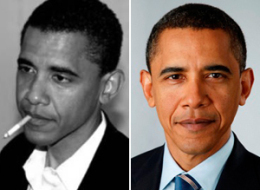
HASTINGS, Neb. -- The Adams County Courthouse meeting room will soon be getting an official portrait of President Barack Obama nearly 18 months after Obama was elected.
The portrait will hang in a spot that had held a framed black-and-white image depicting the President with a cigarette hanging from his mouth. That photo -- a notorious fake -- drew a complaint from a county official who found it disrespectful.
County Supervisor Eldon Orthmann, a Republican, told the Hastings Tribune that he had the smoking photo matted and framed at his own expense. Orthmann said he had hung it next to an official photo of Gov. Dave Heineman as a joke.
County Supervisor Lee Saathoff, the board's lone Democrat, said Monday that U.S. Sen. Ben Nelson's office is sending the county an official presidential portrait.
Census says women equal to men in advanced degrees
Hope Yen
The Associated Press
7:59 p.m. EDT
April 22, 2010
Women are now just as likely as men to have completed college and to hold an advanced degree, part of an accelerating trend of educational gains that have shielded women from recent job losses. Yet they continue to lag behind men in pay.
Among adults 25 and older, 29 percent of women in the U.S. have at least a bachelor's degree, compared with 30 percent of men, according to 2009 census figures released Tuesday. Measured by raw numbers, women already surpass men in undergraduate degrees by roughly 1.2 million.
Women also have drawn even with men in holding advanced degrees. Women represented roughly half of those in the U.S. with a master's degree or higher, due largely to years of steady increases in women opting to pursue a medical or law degree.
At current rates, women could pass men in total advanced degrees this year, even though they still trail significantly in several categories such as business, science and engineering.
"It won't be long before women dominate higher education and every degree level up to Ph.D.," said Mark Perry, an economics professor at the University of Michigan-Flint who is a visiting scholar at the American Enterprise Institute, a conservative think-tank. "They are getting the skills that will protect them from future downturns."
While young women have been exceeding men in college enrollment since the early 1980s, the educational gains have now progressively spread upward to older age groups. That could have wide ramifications in the workplace: more working mothers, increased child-care needs and a greater focus on pay disparities among them.
Women with full-time jobs now have weekly earnings equal to 80.2 percent of what men earn, up slightly from 2008 but lower than a high of 81 percent in 2005.
"I don't know if we can be heartened by the educational gains, because it is persistent wage discrimination that is driving women to get a higher education," said Terry O'Neill, president of the National Organization for Women. "As more women enter the workplace, I think they will realize the unfairness of the situation they're experiencing and demand change."
Women outnumber men in the U.S. -- among adults 25 and older, 103 million are women, 96 million are men.
And women now represent a majority in the nation's work force. They have consistently outpaced men in employment rates in the current economic downturn that some researchers are now dubbing a "man-cession." The main reason is that the male-dominated construction and manufacturing industries, which require less schooling, shed millions of jobs after the housing bust.
Still, despite recent gains, women's advantage in the work force is expected to be temporary as job losses spread to other sectors, such as state and local government, where women are more highly represented. Some men are also returning to school for degrees in female-dominated industries such as nursing and teaching, which tend to fare better during recessions.
Unemployment for men now stands at 10.7 percent compared with 8.6 percent for women. That 2.1 percentage point gap is down from a record of 2.7 in August but remains far higher than in the previous three recessions, when women were almost as likely as men to be out of work.
The findings are the latest to highlight a shift of traditional roles of the sexes, caused partly by massive job losses in the Great Recession. The effects have included a growing number of working moms who are the sole breadwinners in their families, declining births and small increases in stay-at-home dads.
Many women returning to the work force say they are now realizing how critical it is to get good training and a higher education. Linda Lorde, 62, of York, S.C., retired as a U.S. postmaster three years ago, but began looking for a new job after her husband was laid off as a newspaper distribution manager and their 401(k) accounts shriveled in the recession.
Aiming for a fresh career in hotel management, Lorde is now taking college-level business finance courses and in the meantime is the family's sole wage-earner in customer service for local companies. "In this tough economy, you have to know how to compete," she said.
Other census findings:
--The share of women who hold an advanced degree has doubled to 10.1 percent from 5 percent in 1980. In 1960, the share was 1.7 percent.
--Eighty-seven percent of adults have a high school diploma or more. A higher proportion of women (87 percent) than men (86 percent) have at least a high school education, a reversal that first appeared in 2000.
--Broken down by race, more than half, or 53 percent, of Asians have a bachelor's degree or higher. That's compared with 33 percent for non-Hispanic whites, 19 percent for blacks and 13 percent for Hispanics.
The shifts come as Congress considers legislation that would make it easier for women to file wage discrimination lawsuits and empower the government to collect payroll data from private corporations. The bill passed the House last year, but has stalled in the Senate.
Jane Henrici, a study director at the Institute for Women's Policy Research, said continued efforts are needed to ensure that women can compete for jobs on an equal footing, such as flexible work policies involving sick-day and onsite child-care as well as training for future green jobs.

