
- Home
- Premium Memberships
- Lottery Results
- Forums
- Predictions
- Lottery Post Videos
- News
- Search Drawings
- Search Lottery Post
- Lottery Systems
- Lottery Charts
- Lottery Wheels
- Worldwide Jackpots
- Quick Picks
- On This Day in History
- Blogs
- Online Games
- Premium Features
- Contact Us
- Whitelist Lottery Post
- Rules
- Lottery Book Store
- Lottery Post Gift Shop


The time is now 12:59 am
You last visited
July 24, 2026, 10:22 am
All times shown are
Eastern Time (GMT-5:00)

sums de patternsPrev TopicNext Topic
-
-
Have an EXCELlent day!
-
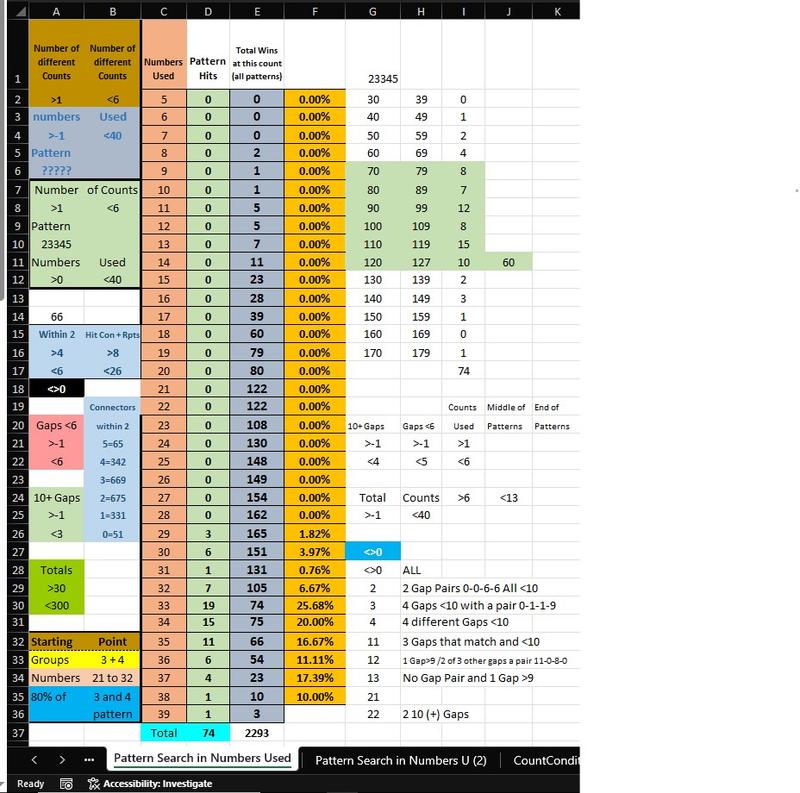
Here's the top pattern that hits in the rolling cash five. The pattern is 23345 and it's hit 74 times in 2293 draws. The best time to play it is when those four counts add up to 33 or 34 total numbers used. It hits 25 and 20% of the time. 60 of those patterns were a sum total of 70 to 127. There are many other filters I can use to increase the percentages. Gaps...1 Gap of 10 or >, Gaps <6.....Specific counts. For example: if 1 counts are at 6 and the rest aren't filtered. How many hits were there. I'm working on ranks of numbers and number frequencies. How many numbers in todays data are above or below avg. frequency.
GET IT DONE
-
 Stat$talker700 light yrs West of Milky Way Galaxy's Center
United States
Member #200,634
September 1, 2019
5,623 Posts
Offline"that is trying to give them mathematical properties they don't have..."
 Hoold oon..If whuteva filter iz sed to've occurred "X" amount of time ..THAT iz a Mathematical property,which may be tracked, to hit a jackpot
Let'z not git Hypercent$itive heaa ..

-
-
GET IT DONE
-
Dr San doesn't do any workouts or any tracking.
He's not even asking a question,just showing some AI gibberish.
He likes to start threads that he thinks will get responses and that's about it.
He'll reply in AI responses most of the time.
He is a Dr San AI duplicate

and I fear we've lost the original Dr San for good.
He's gone to the dark side of AI.
It's not a big loss I suppose,but it was a bit more interesting
when he at least tried to respond himself in English or Spanish at least
-
-
-
-
-
d|O_ø|b
-
-
-
I Don't Guess Numbers. I Create Smart Filters To Draft My Numbers.