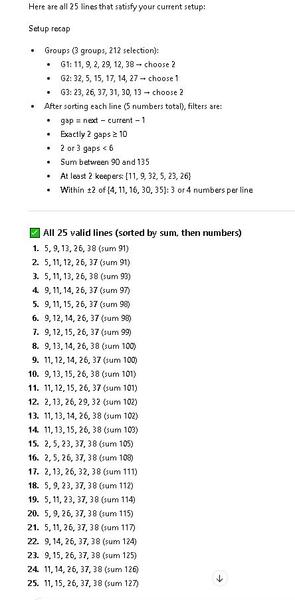
Basic Concept: Frequency of Sums and Patterns The core of the system is that, although individual numbers are drawn randomly, the sum of the numbers drawn in each event may follow a probability distribution. Some sum ranges and certain types of combinations (patterns) are mathematically more likely to occur than others. 🧠 Components of the Analysis System Your system would need to have the following
steps: 1. 💾 Collection of Historical Data (Draw Matrix) You need the data matrix: a list of all past draws of the game in question. Example: If the draw is of 6 numbers from 1 to 60, the matrix is a list with thousands of rows, where each row has 6 numbers.
2. ➕ Calculating the Sum of Each Draw For each historical draw, calculate the total sum of the numbers drawn. Example of Sum: If the numbers drawn were 5, 12, 24, 33, 40, 56, the sum is $5 + 12 + 24 + 33 + 40 + 56 = **170**$.
3. 📊 Frequency Analysis of the Sum Create a frequency table to see how many times each sum occurred in the history. Sum Frequency 20 5 times 170 800 times 340 10 times Result: You would identify the range of most frequent sums (for example, between 150 and 200). This suggests that combinations whose sum is in this range have a higher probability of being drawn.
4. 🧩 Identifying Combination Patterns: Beyond the sum, you can analyze specific patterns in the combinations: Odd/Even Pattern: The frequency of draws with (3 odd and 3 even numbers), (4 odd and 2 even numbers), etc.
Quadrant/Decs Pattern: The frequency of numbers distributed across ranges (e.g., how many numbers came out from 1 to 10, from 11 to 20, etc.).
Consecutive Number Pattern: The frequency of draws that include 2 or 3 consecutive numbers (e.g., 15 and 16). 📈
Conclusion for Creating Combinations: To generate new games with a higher probability, you should prioritize combinations that: Have a SUM that falls within the most frequent range (identified in step 3).
Follow the most frequent Combination Patterns (identified in step 4), such as the most repeated odd/even ratio.
⚠️ Reminder: Draws like lotteries are... By definition, they are random. This type of system helps select games that are within a higher statistical probability range based on historical data and combinatorial mathematics, but it does not guarantee wins.
Powerball Sum Sum Freq Hits O/E 31-40 41-50 51-60 61-69 With-in-5
1. 28-32-36-51-69 216 10 0.78% 2/3 32-36 51 69 28-32-36
2. 10-31-49-51-68 209 10 0.78% 3/2 31 49 51 68 49-51
3. 07-33-50-57-66 213 11 0.86% 3/2 33 50 57 66
4. 06-07-12-47-53 125 6 0.47% 3/2 47 53 06-07
5. 29-39-43-51-65 227 6 0.47% 4 5/0 39 43 51 65 39-43
6. 06-28-44-48-58 184 13 1.01% 3 0/5 44-48 58 44-48
7. 03-53-60-62-68 246 3 0.23% 2 2/3 53-60 62-68 60-62
8. 09-17-29-61-66 182 18 1.40% 1 4/1 61-66
9. 03-32-40-43-57 175 14 1.09% 3/2 32-40 43 57 40-43
10. 02-26-43-44-62 177 7 0.54% 6 1/4 43-44 62
11. 04-24-49-60-65 202 10 0.78% 5 2/3 49 60 65
12. 17-39-43-51-66 216 10 0.78% 4 4/1 43 51 66 39-43
13. 02-12-22-39-67 142 5 0.39% 3 2/3 39 67
14. 18-37-52-54-60 221 5 0.39% 2 1/4 37 52-54-60 52-54
15. 32-38-66-67-69 272 1 0.08% 1 2/3 32-38 66-67-69 66-67-69
16. 03-11-27-40-58 139 6 0.47% 3/2 40 58
17. 10-13-28-34-47 132 10 0.78% 4 2/3 34 47 10-13
18. 13-14-32-52-64 175 14 1.09% 3 1/4 32 52 64 13-14
19. 13-16-18-20-27 94 1 0.08% 2 2/3 13-16-18-20
20. 08-10-44-48-54 164 15 1.17% 1 0/5 44-48 54 08-10 44-48