LiLSpeedy's Blog

A Hit Dog will Holla

Exodus 20:16

King James Version (KJV)                                                                                                                                                                             16  Thou shalt not bear false witness against thy neighbour.

Every time the head bigot opens his alcoholic drunken mouth, he spew out vile lies about Christians. He is a hater of Blacks and all minorities. He drinks to excess, No doubt that is when he feels the spirit. He is a pathological liar and enjoys making up stories about people he has never met or will ever meet. It is people like you that is destroying the Republican Party. No one wants to be part of a political party that is sanctimonious and hypocritical. If God held everyone guilty by association, no one will be worthy of Heaven. JESUS says it best in II CORINTHIANS 5: 10, For we must all appear before the judgment seat of Christ; that every one may receive the things [done] in [his] body, according to that he hath done, whether [it be] good or bad.”

Head Bigot you don’t have the power or authority to pass judgment on NO ONE. No one is listening to your drunken rants. There is no heaven or hell you can send someone to. You better hope that Jesus does not say to you what is written in Luke.

Luke 13:27

But he shall say, I tell you, I know you not whence ye are; depart from me, all ye workers of iniquity.


Read and study your Bible sometime. It is food for your soul.

Entry #326

The real J. Edgar Hoover

J. Edgar Hoover’s war on Black America

Frost Illustrated Staff | February 24, 2014
Lee A. Daniels

Lee A. Daniels

By Lee A. Daniels NNPA Columnist

By the early 1970s, Black Americans could reasonably say they had emerged victorious from their long struggle with America’s internal evil empire: the regime of legalized segregation in the South.

The Civil Rights Act of 1964 and the Voting Rights Act of 1965 had given blacks in both the South and the North the tools—the power of the federal government at their backs and the ballot in their hands—to, at long last, make America a democracy in fact, not just rhetoric.

It was then they got proof that America’s racist power structure had long had a secret ally at the very top of the national government. It was J. Edgar Hoover, the director of the Federal Bureau of Investigation, the man who for nearly half a century had in some ways been, except for the president, the single most powerful government official in the country.

J. Edgar Hoover

J. Edgar Hoover

That’s one of the many powerful truths underscored by Betty Medsger’s new book, “The Burglary: The Discovery of J. Edgar Hoover’s Secret FBI.” The book explores how the burglary in early 1971 of the agency’s field office in Media, Pa., near Philadelphia, by eight antiwar activists led to the unraveling of the Hoover’s decades-long “secret war” against American democracy.

Hoover died in mid-1972, when news reports about the few files that had become public had already begun to destroy his reputation as an honorable public servant. But, it wasn’t until congressional hearings in the mid-1970s that the public would learn Hoover’s monstrous behavior included wholesale spying on hundreds of thousands of citizens by both FBI agents and their army of, literally, thousands and thousands of informants; the planting of rumors and false information to destroy the reputations of individuals and organizations; and deliberate criminal acts, from burglaries, to trying to provoke violent clashes between black militant groups, to aiding and abetting murder. Hoover would let no law stand in his way of trying to establish a state police-like structure beneath America’s ostensibly democratic form of government.

(The Central Intelligence Agency, whom the power-mad Hoover always distrusted, also had its own secret domestic-spying program. Beginning in the early 1970s, that, too, would be exposed.)

That was especially true regarding black Americans. The details here of Hoover’s COINTELPRO campaign against the established civil rights groups, black militant organizations, black students on college campuses, and ordinary citizens living in black ghettos are stunning even to this writer, who’s long known of the program’s existence.

Those details show that the FBI, driven by Hoover’s “savage” racism—and especially his hatred of Dr. Martin Luther King Jr.—surrounded black Americans (and all Americans), whether “militant” or not, with a secret-police-like structure that rivaled those of the states of the Soviet Union.

Several authors have powerfully explored this terrain over the years. But, Medsger’s gripping narrative provides new and shocking details in part because in 1971 she was one of the very small group of journalists the “Media Burglars” anonymously began distributing the stolen FBI files to. They had remained anonymous all these years until she, with their permission, in this book reveals the identities of most (but not all) of them.

Another ironic facet of the story of the “Media Burglary” is that the FBI, which boasted of being the greatest law-enforcement agency in the world, never did identify, much less arrest these otherwise, law-abiding citizens, even though most of them for years continued to live in the Greater Philadelphia area.

Despite the most far-reaching and vicious efforts of the hydra-headed white racist power structure, black Americans and their allies among other Americans nonetheless broke the regime of legalized and de facto apartheid J. Edgar Hoover through his “secret FBI” helped maintain.

In other words, they were, as preceding generations had been, true to the spirit of the words penned by the 20th century writer and poet Sterling Brown:

“The strong men … coming on/ The strong men gittin’ stronger./Strong men …/Stronger …”

Lee A. Daniels is a longtime journalist based in New York City. His latest book is “Last Chance: The Political Threat to Black America.”


About the Author (Author Profile)

Frost Illustrated is Fort Wayne's oldest weekly newspaper. Your Independent Voice in the Community, featuring news & views of African Americans since 1968.


Entry #325

Today In American History

Born on March 12, 1932, in New Orleans, Louisiana, Andrew Young Jr. became active in the Civil Rights Movement, working with Dr. Martin Luther King Jr. in the Southern Christian Leadership Conference. Entering politics, Young served in Congress, was the first African-American ambassador to the United Nations and became mayor of Atlanta. In 1981, he was awarded the Presidential Medal of Freedom.

Quick Facts

Entry #324

Today In American History

Henry Washington  was a one time African-American slave of the first president of the United States, George Washington. His history and linked documents can be found on-line. Transported as a slave to America, he was bought by George Washington in 1763 to work on a project for draining the Great Dismal Swamp. He was living and working in the stable at Mount Vernon, caring for George Washington’s horses.

Early life

He was a saltwater slave from Africa purchased from a deceased estate in 1763 to be part of Washington's workforce in the Great Dismal Swamp. He later went to work at one of the farms at Mt Vernon. Henry Washington from Mount Vernon had taken refuge in New York in 1771. In 1776, Henry Washington fled again to join royal Virginia governor Lord Dunmore’s Ethiopian Regiment of freed slaves.

American War of Independence

Moving into New York in the late 1776, Washington served as corporal in a corps of Black Pioneers attached to a British artillery unit, a British forces under the Governor of VirginiaLord Dunmore's fleet. Harry Washington was a Black Loyalist and one of the 3,000 Black Americans who were evacuated to Nova Scotia at the end of the American War of Independence and part of the first group of immigrants to what eventually became Sierra Leone. Once Sir Guy Carleton's officials put him on the list for evacuation in the "Register of Negroes," he started his age as forty-three and said that he had fled Mount Vernon in 1776, much earlier than 1781 with the slaves on the Savage. Under General Sir Guy Carleton's policy, Henry Washington took a British ship to Nova Scotia (as did two other former Mount Vernon slaves, a man and a woman) and from there continued to Sierra Leone, where he planned to begin a farm making use of the scientific farming techniques he learned at Mount Vernon. In 1800 Washington was among several hundred settlers who rose up in a brief rebellion against white rule there. The precipitating issue was one familiar from the American Revolution: taxes. The settlers were required by the Sierra Leone Company, which ran the colony for the British government, to pay taxes, or quitrents, for the use of their land; the land itself remained the property of the company. The settles formed a provisional government and wrote up a set of laws, which they nailed to the office door of a company administrator. The company responded by sending a corps of recently arrived Jamaican blacks against the rebels. In the trails that followed the defeat of the rebellion, Henry Washington was among the rebels sentenced to banishment to another location in Sierra Leone, where he became one of the two leaders of a new settlement He is listed as leaving New York the Book of Negroes, where he is incorrectly listed with the name Henry. He is called Harry in all other documents.

Later life

After spending a number of years in Birchtown (the largest free African-American city in North America), where he married Jenny, Washington and his wife joined the 1,192 black colonists who migrated to Sierra Leone. Washington was one of those involved in a rebellion against the colonial authorities in Sierra Leone in 1800 and was exiled to the Bullom Shore where he subsequently died. His descendants and those of other African Americans make up a portion of the Sierra Leone Creole people.

Entry #323

Mistaken Identity? Yeah Right!

Police Fooled by Lifelike Mask in Ohio Robberies

(AP Photo)                                   


Police Fooled By Lifelike Mask In Ohio Robberies

Surveillance Video of Robber in Lifelike Mask (AP Photo)

CINCINNATI (CBS/AP) A white man who pleaded guilty to six robberies in Ohio used a black man's mask so lifelike that police initially arrested a black man for one of the crimes, authorities said Tuesday.

The mother of the wrongly accused black man even thought a photo of the robbery suspect she saw on television was her son, the Hamilton County prosecutor's office and the attorney for the white defendant both said.

Conrad Zdzierak, 30, pleaded guilty Monday in a Hamilton County court to one count of aggravated robbery and five counts of robbery.  In exchange, prosecutors dismissed 12 charges and decided not to seek indictments for other crimes, prosecutor's spokeswoman Julie Wilson said Tuesday.

"Conrad apologizes to everyone, is sorry for any harm he has caused and accepts responsibility for his actions," his lawyer Christopher McDowell said.

Zdzierak stole about $15,000 in the robberies of four banks, a credit union and a pharmacy that occurred in March and April - crimes in which witnesses reported that the robber was black and surveillance video appeared to show a black man.

Zdzierak's resemblance to the black man who was initially arrested was so similar that some witnesses even identified a photo of the black man as the one who robbed them, McDowell said.

The prosecutor's office would not release the name of the wrongly accused man.

Zdzierak was arrested at a hotel in suburban Springdale after his girlfriend called police after seeing reports of the robberies and finding two masks and money stained by dye that is used to track robbers, The Cincinnati Enquirer reported.

McDowell said his client purchased the masks from SPFXmasks, based in Van Nuys, Calif. The silicone masks "look and behave like real flesh and muscle," the company's website says.

Owner Rusty Slusser said Tuesday his company's masks are normally bought for movies, Halloween, haunted houses and stage shows, but the Ohio case was not the first time they have been used for criminal purposes.

"We do not condone any illegal activity with our masks," Slusser said.

The unmasked robber faces up to 35 years in prison at his Jan. 7 sentencing.

Entry #322

Today In American History

File:John lewis official biopic.jpg

John Robert Lewis (born February 21, 1940) is an American politician and civil rights leader. He is the U.S. Representative for Georgia's 5th congressional district, serving since 1987, and is the dean of the Georgia congressional delegation. The district includes the northern three-quarters of Atlanta.

Lewis is the only living "Big Six" leader of the American Civil Rights Movement, having been the chairman of the Student Nonviolent Coordinating Committee (SNCC), playing a key role in the struggle to end legalized racial discrimination and segregation. A member of the Democratic Party, Lewis is a member of the Democratic leadership of the House of Representatives and has served in the Whip organization since shortly after his first election to the U.S. Congress.

He is Senior Chief Deputy Whip, leading an organization of chief deputy whips and serves as the primary assistant to the Democratic Whip. He has held this position since 1991.

US Flag

Entry #321

Today In American History

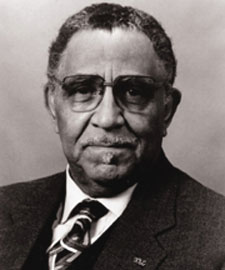
Joseph Lowery

Joseph Lowery

AKA Joseph Echols Lowery

Born:6-Oct-1921 Birthplace: Huntsville, AL

Gender: Male Religion:Methodist Race or Ethnicity: Black  Occupation: Activist

Nationality: United States  Executive summary: Co-Founder of the SCLC

Pastor of Warren Street United Methodist Church, Mobile (1952-61). After Rosa Parks' arrest in 1955 he helped lead the Montgomery bus boycott. His property was seized in 1959 along with that of other civil rights leaders (including Ralph Abernathy) by the state of Alabama as part of a libel suit. The US Supreme Court ordered the suit reversed. At the request of Martin Luther King, Lowery led the Selma-to-Montgomery march in 1965. Lowery served as pastor of Cascade United Methodist Church in Atlanta from (1986-92). He is now retired.


Father: LeRoy Lowery (small businessman)Mother: Dora (teacher)Wife: Evelyn Gibson Lowery (activist)

University: Knoxville College     Theological: Payne College and Theological Seminary     Theological: Chicago Ecumenical Institute

Southern Christian Leadership Conference Co-Founder, President (1977-98)     Black Leadership Forum President (former)     Campaign for America's Future     Citizens for a Moratorium on Federal Executions     NAACP     Sharpton 2004     Presidential Medal of Freedom 12-Aug-2009

Entry #320

Today In American History

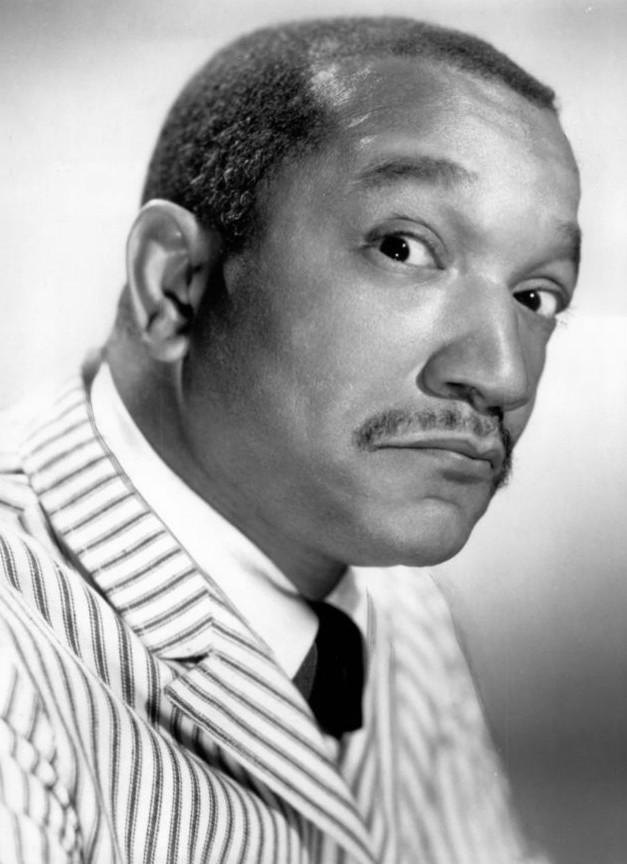
John Elroy Sanford (December 9, 1922 – October 11, 1991), known professionally as Redd Foxx, was an American comedian and actor, best remembered for his explicit comedy records and his starring role on the 1970s sitcom Sanford and Son.

Foxx gained notoriety with his raunchy nightclub acts during the 1950s and 1960s. Known as the "King of the Party Records", he performed on more than 50 records in his lifetime. He also starred in Sanford, The Redd Foxx Show and The Royal Family. His film roles included All the Fine Young Cannibals (1960) and Harlem Nights (1989).

With three failed marriages and various financial problems, Foxx reportedly owed more than $3.6 million in taxes at the time of his death.

In 2004, Comedy Central Presents: 100 Greatest Stand-ups of All Time ranked Foxx as the 24th best stand-up comedian. Foxx not only influenced many comedians, but was often portrayed in popular culture as well, mainly as a result of his famous catchphrases, body language and facial expressions exhibited on Sanford and Son.

Entry #319

Today In American History

Lewis Latimer (1848–1928) invented an important part of the light bulb — the carbon filament.

Fast Fact: Latimer worked in the laboratories of both Thomas Edison and Alexander Graham Bell.

US Flag

Entry #318

Today In American History

Desegregating Little Rock Central High School, 1957

Main article: Little Rock Nine
Troops from the 327th Regiment, 101st Airborne escorting the Little Rock Nine African-American students up the steps of Central High.

Little Rock, Arkansas, was in a relatively progressive Southern state. A crisis erupted, however, when Governor of Arkansas Orval Faubus called out the National Guard on September 4 to prevent entry to the nine African-American students who had sued for the right to attend an integrated school, Little Rock Central High School.The nine students had been chosen to attend Central High because of their excellent grades.

On the first day of school, only one of the nine students showed up because she did not receive the phone call about the danger of going to school. She was harassed by white protesters outside the school, and the police had to take her away in a patrol car to protect her. Afterward, the nine students had to carpool to school and be escorted by military personnel in jeeps.

Faubus was not a proclaimed segregationist. The Arkansas Democratic Party, which then controlled politics in the state, put significant pressure on Faubus after he had indicated he would investigate bringing Arkansas into compliance with the Brown decision. Faubus then took his stand against integration and against the Federal court ruling.

Faubus' resistance received the attention of President Dwight D. Eisenhower, who was determined to enforce the orders of the Federal courts. Critics had charged he was lukewarm, at best, on the goal of desegregation of public schools. But, Eisenhower federalized the National Guard in Arkansas and ordered them to return to their barracks. Eisenhower deployed elements of the 101st Airborne Division to Little Rock to protect the students.

The students attended high school under harsh conditions. They had to pass through a gauntlet of spitting, jeering whites to arrive at school on their first day, and to put up with harassment from fellow students for the rest of the year. Although federal troops escorted the students between classes, the students were teased and even attacked by white students when the soldiers were not around. One of the Little Rock Nine, Minnijean Brown, was suspended for spilling a bowl of chili on the head of a white student who was harassing her in the school lunch line. Later, she was expelled for verbally abusing a white female student.

Only Ernest Green of the Little Rock Nine graduated from Central High School. After the 1957–58 school year was over, Little Rock closed its public school system completely rather than continue to integrate. Other school systems across the South followed suit.

Entry #317

Today In American History

Bessie Coleman

Bessie Coleman

Known for: pioneer in aviation; first African American woman with a pilot's license, first African American woman to fly a plane; first American with an international pilot's license.
Occupation: aviator: stunt pilot
Dates: January 26, 1892 (some sources give 1893) - April 30, 1926
Also known as: Queen Bess, Brave Bessie


Bessie Coleman was born in Atlanta, Texas, in 1892. The family soon moved to a farm near Dallas. Her father, George Coleman, moved to Indian Territory, Oklahoma, in 1901, where he had rights, based on having three Indian grandparents. His wife, Susan, with five of their children still at home, refused to go with him. She supported the children by picking cotton and taking in laundry and ironing.


Susan, Bessie Coleman's mother, encouraged her daughter's education, though she was herself illiterate, and though Bessie had to miss school often to help in the cotton fields or to watch her younger siblings. After Bessie graduated from eighth grade with high marks, she was able to pay, with her own savings and some from her mother, for a semester's tuition at an industrial college in Oklahoma.


When she dropped out of school after a semester, she returned home, working as a laundress. In 1915 she moved to Chicago to stay with her two brothers who had already moved there. She went to beauty school, and became a manicurist, where she met many of the "black elite" of Chicago.


Learning to Fly


Bessie Coleman had read about the new field of aviation, and her interest was heightened when her brothers regaled her with tales of French women flying planes in World War I. She tried to enroll in aviation school, but was turned down. It was the same story with other schools where she applied.


One of her contacts through her job as a manicurist was Robert S. Abbott, publisher of the Chicago Defender. He encouraged her to go to France to study flying there. She got a new position managing a chili restaurant while studying French at the Berlitz school. She followed Abbott's advice, and, with funds from several sponsors including Abbott, left for France in 1920.


In France, Bessie Coleman was accepted in a flying school, and received her pilot's license -- the first African American woman to do so. After two more months of study with a French pilot, she returned to New York in September, 1921. There, she was celebrated in the black press and was ignored by the mainstream press.


Wanting to make her living as a pilot, Bessie Coleman returned to Europe for advanced training in acrobatic flying -- stunt flying. She found that training in France, in the Netherlands, and in Germany. She returned to the United States in 1922.


Bessie Coleman, Barnstorming Pilot


That Labor Day weekend, Bessie Coleman flew in an air show on Long Island in New York, with Abbott and the Chicago Defender as sponsors. The event was held in honor of black veterans of World War I. She was billed as "the world's greatest woman flyer."


Weeks later, she flew in a second show, this one in Chicago, where crowds lauded her stunt flying. From there she became a popular pilot at air shows around the United States.


She announced her intent to start a flying school for African Americans, and began recruiting students for that future venture. She started a beauty shop in Florida to help raise funds. She also regularly lectured at schools and churches.


Bessie Coleman landed a movie role, but walked away when she realized that the depiction of her as a black woman would be as a stereotypical "Uncle Tom." Those of her backers who were in the entertainment industry in turn walked away from supporting her career.


In 1923, Bessie Coleman bought her own plane, a World War I surplus Army training plane. She crashed in the plane days later, on February 4, when the plane nose-dived. After a long recuperation from broken bones, and a longer struggle to find new backers, she finally was able to get some new bookings for her stunt flying.


On Juneteenth(June 19) in 1924 , she flew in a Texas air show. She bought another plane -- this one also an older model, one that was low-priced enough that she could afford it.


May Day in Jacksonville


In April, 1926, Bessie Coleman was in Jacksonville, Florida, to prepare for a May Day Celebration sponsored by the local Negro Welfare League. On April 30, she and her mechanic went for a test flight, with the mechanic piloting the plane and Bessie in the other seat, with her seat belt unbuckled so that she could lean out and get a better view of the ground as she planned the next day's stunts.


A loose wrench got wedged in the open gear box, and the controls jammed. Bessie Coleman was thrown from the plane at 1,000 feet, and she died in the fall to the ground. The mechanic could not regain control, and the plane crashed and burned, killing the mechanic.


After a well-attended memorial service in Jacksonville on May 2, Bessie Coleman was buried in Chicago. Another memorial service there drew crowds as well.


Every April 30, African American aviators -- men and women -- fly in formation over Lincoln Cemetery in southwest Chicago (Blue Island) and drop flowers on Bessie Coleman's grave.


Legacy of Bessie Coleman


Black flyers founded the Bessie Coleman Aero Clubs, right after her death. the Bessie Aviators organization was founded by black women pilots in 1975, open to women pilots of all races.


In 1990, Chicago renamed a road near O'Hare International Airport for Bessie Coleman. That same year, Lambert - St. Louis International Airport unveiled a mural honoring "Black Americans in Flight," including Bessie Coleman. In 1995, the U.S. Postal Service honored Bessie Coleman with a commemorative stamp.


In October, 2002, Bessie Coleman was inducted into the National Women's Hall of Fame in New York.


 

 US Flag

Entry #316

George Zimmerman says he's homeless and suffering from PTSD

Well boo hoo, life is not going so well for you. Everything you are going through and will continue to go through is because you took it upon yourself to take a life. If you had left well enough alone you would not be in fear of your pathetic existence. You took it upon yourself to follow and provoke an unarmed teenager that was minding his own business. After provoking a confrontation, things went horribly wrong for you, in that, you bite off more than you could chew and got an old fashioned AZZ whipping by a teenager half your size. Now that you are free and clear of murdering someone’s son, you want your life to turn back to normal. It will never be normal for Trayvon’s parents, why should anyone give a RAT'S AZZ about your sorry pathetic AZZ. You reap what you sew. You had your fifthteen minutes of fame, now it is reaping time CHUMP.

Entry #315

Today In American History

Shirley Franklin


Former two-term Mayor of Atlanta Shirley Franklin joined the LBJ School of Public Affairs as the Barbara Jordan Visiting Professor of Ethics and Political Values in 2013.

Franklin served as Mayor of the City of Atlanta from 2002 to 2010.  She was the first female to hold the post and became the first African-American woman to be elected mayor of any major Southern city.

Her public service career began in 1978 when she served as the Commissioner of Cultural Affairs under Atlanta Mayor Maynard Jackson. She was later appointed as the nation's first woman Chief Administrative Officer or City Manager, where she was responsible for the daily operations of a city with nearly 8,000 employees. She was charged with guiding the development of Hartsfield International Airport, a new city hall, a new municipal court building and 14,000 net housing units.

In 1991, Franklin joined the Atlanta Committee for the Olympic Games (ACOG) as the top ranking female executive, serving as senior vice-president for external relations. In this position she was instrumental in the development of the Centennial Olympic Park and served as ACOG’s primary liaison with labor unions, civil rights groups, neighborhood and community organizations, and environmentalists.

Franklin was named Governing magazine’s 2004 Public Official of the Year. In 2005, TIME magazine named her one of the top five mayors in the country and U.S. News and World Report named her one of “America’s Best Leaders”. Esquire Magazine named her one of the best and brightest and American City and County Magazine named her Municipal Leader of the Year. In 2005, Franklin received the prestigious John F. Kennedy Profile in Courage Award. In 2006, she was honored with the Southern Institute for Business and Professional Ethics’ Ethics Advocate Award. In 2007, Newsweek Magazine named her one of the women to watch in their Women & Power issue.

Franklin also serves as the Chairman of the Board and Chief Executive Officer of Purpose Built Communities and as a member of the Board of Directors of the National Center for Civil and Human Rights.

The Barbara Jordan Visiting Professorship is funded through the Barbara Jordan Chair in Ethics and Political Values, an endowment created in 1997 intended to promote training in ethics and values-based decision-making.

Barbara Jordan’s legislative career began with her election to the Texas Legislature in 1966. Jordan’s victory made her the first African-American woman to serve in the Texas Senate and the first African-American elected to that body since 1883. From 1979 until her death in 1996, Jordan served as a distinguished professor at the LBJ School of Public Affairs, holding the Lyndon B. Johnson Centennial Chair in National Policy.


US Flag

Entry #314

Today In American History

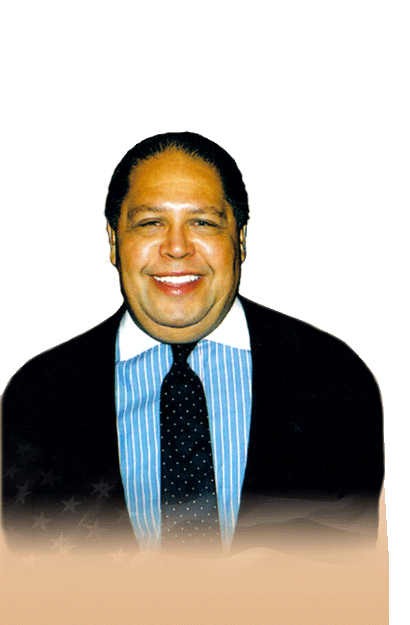
International Civil Rights: Walk of Fame         

Maynard Jackson   


Maynard Holbrook Jackson, Jr.
1938 - 2003

Maynard Jackson was Atlanta's first African American mayor; he serve two consecutive terms (1974-1978; 1978-1982) and was elected for a third term in 1990.  Jackson is best known for improving opportunities for African Americans to do business with the City of Atlanta, especially in the expansion of Hartsfield Airport-which has been renamed Hartsfield-Jackson Airport.   Under his leadership African American contracts witih the City of Atlanta increased to thirty-five percent from a low of less than one percent.  Jackson also reformed the City of Atlanta Police Department, changing it's reputation as a public agency that mistreated African Americans and limited opportunity for African American policemen.    The death of Martin Luther King Jr. in 1968 prompted Jackson to enter politics for the first time. He ran against popular white supremacist Herman Tallmadge for a seat in the United States Senate.  Although Jackson did not win (he received approximately one-third of votes cast), he described his campaign as successful because he wanted to energize Georgia's African American electorate to take advantage of the provisions of the Voting Rights Act passed in 1965.   Jackson was actively involved in the National Democratic Party.  He founded the African American Voters League (2001) and during the same year he strongly suppported the election of Shirley Franklin, Atlanta's first female mayor.  At the time of his death in 2003, Jackson had been appointed to a top position in the National Democratic Party.         

Maynard Jackson, Jr.'s father was the pastor of Friendship Baptist Church in Atlanta; his mother, Irene Dobbs Jackson, was a professor of French at Spelman College.  Jackson's maternal grandfather, activist John Wesley Dobbs (1882-1961) provided a framework for Maynard's political life.   Dobbs was known as the unofficial mayor of Auburn Avenue, an important street and symbol of African American progress and pride in Atlanta.  Maynard Jackson was a child prodigy who graduated from high school at fourteen, and earned a degree from Morehouse College at the age of eighteen.  He earned a law degree from North Carolina Central University (1964).       

In 1990, Mr. Jackson founded the Maynard Jackson Youth Foundation, Inc. (a multi-focused leadership program teaching disadvantaged 11th grade students in Atlanta) where he actively served as Chairman and Principal Teacher. In 1994, Jackson returned to the private sector as Chairman of Jackson Securities headquartered in Atlanta.  The firm was named one of the top five black investment companies by Black Enterprise magazine in 1996. At the time of his death, Mr. Jackson and his daughter, Brook, ran Jackson Securities, Inc.


US Flag


Entry #313

Today In American History

Richard Allen was one of the greatest Black religious leaders in American history. His leadership and organizational skills were phenomenal. Born of slave parents in 1760 in Philadelphia, Allen taught himself to read and write after having been sold to another master in Dover, Delaware. There, with the permission of his master, he joined the Methodist Society and was soon heading the Society’s meetings. His owner’s offer to allow Allen to purchase his freedom spurred Allen to work as a day laborer, brick maker, and teamster. He worked until he had earned the 2000 Continental dollars it took to make good the offer. Allen served as a wagon driver during the Revolutionary War and in 1786, after serving as an itinerate preacher, he returned to Philadelphia to begin his ministry.

When Allen and Rev. Absalom Jones went to Philadelphia’s St. George Methodist Episcopal Church on a Sunday in November 1786, a new chapter in Black history unfolded. Allen had been organizing Black prayer meetings and encouraging greater Black attendance at St. George’s. As he told it: “when the colored people began to get numerous in attending the church, they moved us from the seats we usually sat on, ... and told us to go in the gallery. [The] meeting had begun and . . . just as we got to the seats, the elder said, ‘Let us pray.’ We had not been long upon our knees before I heard considerable scuffling and low talking. I raised my head up and saw one of the trustees ... having hold of the Rev. Absalom Jones, pulling him up off his knees, and saying, ‘You must get up - - you must not kneel here.’” Mr. Jones replied, “Wait until the prayer is over.’” The trustee would not wait. Before the service ended, every Black man, woman, and child, led by Allen, walked out of the church. It was the first mass demonstration staged by Blacks in America! As news of the demonstration spread, Blacks in Boston, New York, and other northern cities walked out of segregated White institutions and created their own. Five months later, in April 1787, AlIen and Jones responded by creating the Free African Society. The Society’s varied features were those of a mutual aid society, a church, a political structure, and an insurance company.

Five years afterwards, its membership decided to build a church. This decision was not immediately acted upon, because a severe yellow fever epidemic in 1793 interrupted the plan. As others fled the city, Allen focused the Free American Society on the dreary business of recruiting Blacks to serve as nurses and undertakers. After the epidemic had run its course, the church building plan was resumed and on July 17, 1794, the Bethel Church, which later became the first African Methodist Episcopal (AME) congregation, was established. Under Allen’s organization and leadership, by 1816, the AME church boasted a national membership, with Allen ordained as bishop - - the first Black bishop in America.

Allen was a staunch supporter of the Anti-Slavery societies, president of the first Negro Convention, and a contributing correspondent to the first Black newspaper, Freedom’s Journal. Writing for the Journal, he eloquently opposed the American Colonization Society on the basis that “its philosophy of removal of Afro-Americans from the United States was based on racial prejudice rather than benevolence:” Yet another of Allen’s major accomplishments was the organizing of the Society of Free People of Color for Promoting Instruction and School Education of Children of African Descent.

Bishop Richard Allen died on March 26, 1831. Throughout his life, Allen continued to press vigorously for the abolition of slavery. He established himself as one of the giants of Black history and, indeed, of American history. The African Methodist Episcopal Church, which he founded, is today the oldest and largest Black formal institution in America.

  US Flag

Entry #312