konane's Blog

"Daily Disciplines for Effortless Success

Back to feel good stuff, great article.  Many inspirational articles posted have very similar messages.  Have found each writer comes from a slightly different perspective and hope each has a crumb of information which helps make your day better.  Hope you enjoy.

Thank you very much for reading and commenting!!!

______


"Daily Disciplines for Effortless Success

By Jack Canfield March 30th, 2009
Source Dream Manifesto

"Hand’s down, one of the most popular questions I’m asked by students is this… “Jack, what are your most important daily actions that you correlate with your success.”

In fact, Oprah Winfrey asked me a similar question just days before appearing on her show. She asked me to come up with some easy-to-apply steps for her viewers to start applying The Law of Attraction in their lives.

One of the basic first steps is to determine, write down and talk about what you do want, not what you don’t want. Be as specific as possible. Once you have clarified what you want, do the following each and every day.

1. Morning Intention, Visualization and Releasing
As soon as you wake up in the morning, take about 5 minutes to focus your mind on your desires, goals and intentions. Start by sitting in a comfortable position, closing your eyes and visualizing your desires and goals as already being fulfilled. Spend 30 seconds to a minute on each of your core desires and goals. You can also take a few moments to visualize your day going exactly as you would like it to.

When you do this, you will often find negative limiting beliefs that are the result of negative programming from your childhood will come up. You may hear thoughts like “I could never afford that,”“there’s no way I’ll ever get that,” or “who am I kidding?” coming up. If you do, use one of the many releasing techniques that are available (see the list below) to release the negative thought. Don’t fight or argue with the thought; just release it.

Remember to also spend several moments feeling the feelings you would feel if you had already manifested your desire in your life. The intensity of the feeling is what fuels the intensity of the attraction.

If you’re interested in learning a powerful releasing technique, check out the new documentary movie about the emotional freedom technique (EFT) I use, Try it On Everything; I highly recommend it.

2. Use External Images to Keep you Focused on Your Desires and Goals
Keep yourself focused on what you want to manifest by surrounding yourself with visual images of the things and experiences you want to create in your life. There are many tools you can use for this, including creating a Vision Book from our Dream Big Collection.

Cut out pictures of the things you wish to own (like your ideal car or home) and pictures that represent the experiences you want to have (like the perfect relationship, your ideal job,perfect health, being at your ideal weight, more joy, inner peace or balance in your life) to remind yourself of how you want it to be. Put them somewhere where you will see them every day - on the mirror, the refrigerator, or in your Vision Book.

For even greater impact, combine your pictures with words that reflect your desired outcome, such as abundance, romance, fun, vitality, etc. I think you get the picture.

When you look at any of these pictures, do what Bob Doyle, who is featured in The Secret teaches - think the thought, “THIS IS MINE NOW! THIS IS WHO I AM!”

3. Think a Better Feeling Thought
Start paying attention to the many times during the day that you have emotional responses(to other people, experiences, or your own thoughts) that are not in alignment with having or producing your desires. Pay special attention to when you feel disappointment, resentment, frustration or anger about your experiences and circumstances.

Remember, it’s your feelings (which are created by your thoughts, opinions, and beliefs) that are creating your current circumstances. You must make a shift by changing your thoughts to ones that make you feel better (i.e., raise your vibration). Remember that you must become a vibrational match for the things and experiences that you want to attract into your life.

It is especially important to focus your thoughts and behaviors on things that cause you to feel joy. Focus your thoughts on thoughts that bring you joy (your lover, your best friend, your grandchildren, your favorite vacation spot) and your actions on doing the things you love to do (pet your cat, work in your garden, listen to your favorite music).

4. Have an Attitude of Gratitude
It is critical to take time each and every day to focus on what you are grateful for!Some people do this in the morning before or after they visualize their desires; others prefer to do it in the evening. Focus on all of the things in your life (most of which you take for granted) that you are grateful for - your health, your children, your job, the nice weather, electricity, running water, a nice stereo system, your flower garden, your pets, your friends).

No matter what your situation, there are always things to be grateful for. The more you focus on what you are grateful for, the more things and experiences you will attract to be grateful for. You may wish to carry a “gratitude rock” like the one Lee Brower talks about in “The Secret”, or log your findings in a Gratitude Journal.

5. Take Action
There are two kinds of actions you can take. Obvious actions are things like, if you want a better car, going to test drive all of the models you are interested in and choosing the exact car you want to have, and saving 10% of your income in a “car account.” If you want to be a doctor, apply to medical school.

There is also what I call “inspired actions.” Once you begin to do the things described above, the universe will start responding by sending people, resources and opportunities you need to manifest your desired result. You are going to find that you have inspired ideas; you must act on them. You must follow those gentle proddings from the universe.

Often these intuitive impulses will have no seeming connection to achieving your goal, but if you follow them, they will lead you down a path of wonderful fulfillment.
Here’s a quick way to know if the actions you’re taking are taking you closer to the fulfillment of your dreams and desires.

If you are feeling joy while you are doing them, then you are on the right path. Remember, joy is your internal guidance system, just like the GPS system in a car, telling you are taking the right actions. Follow your joy.

6. Acknowledge That it’s Working
If you start to see something change for the better, acknowledge that it is happening. Appreciate it. When you find the perfect parking space, acknowledge it. When you get the table you want in the restaurant, acknowledge it. When you receive unexpected income, acknowledge it. When you meet someone who can help you achieve your goal, acknowledge that Law of Attraction is working. The more you acknowledge that it’s working, the more it will work. It’s that simple.

If you are attracting things into your life that you don’t want, remember that the Law of Attraction is still working. Instead of thinking or saying, “It’s not working,” ask your self, “What am I focusing on, thinking about, talking about, feeling or doing that is bringing this into my life?”

If you want to know what you are thinking about, notice the results you are producing in your life. To change those results, you will first have to change your vibration by changing your thoughts and feelings.
When you make a commitment to take these actions each day, you’ll start to move forward, with confidence, in the direction of your dreams. Believe that they are not only possible, but that they are already in progress.

I’ll be back in two weeks with another edition of Success Strategies. Until then, see if you can discover ways to immediately implement what you discovered from today’s message into your life."

http://www.dreammanifesto.com/daily-disciplines-effortless-success.html
________

Abraham-Hicks Daily Quote

" An activated thought means a thought that when I think it, I have a feeling response. If you're not having a feeling response to something, a feeling that feels good or a feeling that feels bad -- the thought is not that powerful, and it is probably not a big player in your vibrational mix."

" There is no right or wrong way to tell your improved story. It can be about your past, present, or future experiences. The only criterion that is important is that you be conscious of your intent to tell a better-feeling, improved version of your story. Telling many good-feeling short stories throughout your day will change your point of attraction. Just remember that the story you tell is the basis of your life. So tell it the way you want it to be."

" Always, when you know what you don't want, that's when the rocket of desire is born of what you do want. That is the fruit of your experience. Now pluck it and savor it and enjoy it. Visualize it, and find the feeling place of it. And live happily ever after, once you get the hang of this."

Entry #1,089

"PETA Killed 95 Percent of Adoptable Pets in its Care During 2008

Last significant thing I heard from PETA they were calling fish "SEA KITTENS" railing against the fishing industry.  "Sea Kittens" .......  still laughing!!!!!  ROFL

__________

Posted On March 25, 2009
Source The Center For Consumer Freedom

"PETA Killed 95 Percent of Adoptable Pets in its Care During 2008

"Hypocritical Animal Rights Group’s 2008 Disclosures Bring Pet Death Toll To 21,339

WASHINGTON DC – Today the nonprofit Center for Consumer Freedom (CCF) published documents online showing that People for the Ethical Treatment of Animals (PETA) killed 95 percent of the adoptable pets in its care during 2008. Despite years of public outrage over its euthanasia program, the animal rights group kills an average of 5.8 pets every day at its Norfolk, VA headquarters.

According to public records from the Virginia Department of Agriculture and Consumer Services, PETA killed 2,124 pets last year and placed only seven in adoptive homes. Since 1998, a total of 21,339 dogs and cats have died at the hands of PETA workers.

Despite having a $32 million budget, PETA does not operate an adoption shelter. PETA employees make no discernible effort to find homes for the thousands of pets they kill every year. Last year, the Center for Consumer Freedom petitioned Virginia’s State Veterinarian to reclassify PETA as a slaughterhouse.

CCF Research Director David Martosko said: “PETA hasn’t slowed down its hypocritical killing machine one bit, but it keeps browbeating the rest of society with a phony ‘animal rights’ message. What about the rights of the thousands of dogs, cats, puppies, and kittens that die in PETA’s headquarters building?”

Martosko added: “Since killing pets is A-OK with PETA, why should anyone listen to their demands about eating meat, using lab rats for medical research, or taking children to the circus?”

CCF obtained PETA’s “Animal Record” filings since 1998 from the Virginia Department of Agriculture and Consumer Services. Members of the public can see these documents at PetaKillsAnimals.com.  http://petakillsanimals.com/ 

In addition to exposing PETA’s hypocritical record of killing defenseless animals, the Center for Consumer Freedom has publicized the animal rights group’s ties to violent activists, and shed light on its aggressive message-marketing to children.

The Center for Consumer Freedom is a nonprofit coalition supported by restaurants, food companies, and consumers, working together to promote personal responsibility and protect consumer choices. "

http://www.consumerfreedom.com/pressRelease_detail.cfm/release/258

________

"PETA kills animals. Because it has other financial priorities.

PETA rakes in nearly $30 million each year in income, much of it raised from pet owners who think their donations actually help animals. Instead, the group spends huge sums on programs equating people who eat chicken with Nazis, scaring young children away from drinking milk, recruiting children into the radical animal-rights lifestyle, and intimidating businessmen and their families in their own neighborhoods. PETA has also spent tens of thousands of dollars defending arsonists and other violent extremists.

PETA claims it engages in outrageous media-seeking stunts "for the animals." But which animals? Carping about the value of future two-piece dinners while administering lethal injections to puppies and kittens isn't ethical. It's hypocritical -- with a death toll that PETA would protest if it weren't their own doing.

PETA kills animals. And its leaders dare lecture the rest of us?"

http://petakillsanimals.com/petasdirtysecret.cfm

Entry #1,088

"U.N. 'Climate Change' Plan Would Likely Shift Trillions to Form New World Economy

Follow the money trail.

_____

"U.N. 'Climate Change' Plan Would Likely Shift Trillions to Form New World Economy

Friday, March 27, 2009

By George Russell
Source FoxNews.com

"A United Nations document on "climate change" that will be distributed to a major environmental conclave next week envisions a huge reordering of the world economy, likely involving trillions of dollars in wealth transfer, millions of job losses and gains, new taxes, industrial relocations, new tariffs and subsidies, and complicated payments for greenhouse gas abatement schemes and carbon taxes — all under the supervision of the world body.

Those and other results are blandly discussed in a discretely worded United Nations "information note" on potential consequences of the measures that industrialized countries will likely have to take to implement the Copenhagen Accord, the successor to the Kyoto Treaty, after it is negotiated and signed by December 2009. The Obama administration has said it supports the treaty process if, in the words of a U.S. State Department spokesman, it can come up with an "effective framework" for dealing with global warming.

The 16-page note, obtained by FOX News, will be distributed to participants at a mammoth negotiating session that starts on March 29 in Bonn, Germany, the first of three sessions intended to hammer out the actual commitments involved in the new deal.

In the stultifying language that is normal for important U.N. conclaves, the negotiators are known as the "Ad Hoc Working Group On Further Commitments For Annex I Parties Under the Kyoto Protocol." Yet the consequences of their negotiations, if enacted, would be nothing short of world-changing. 

Getting that deal done has become the United Nations' highest priority, and the Bonn meeting is seen as a critical step along the path to what the U.N. calls an "ambitious and effective international response to climate change," which is intended to culminate at the later gathering in Copenhagen.

Just how ambitious the U.N.'s goals are can be seen, but only dimly, in the note obtained by FOX News, which offers in sparse detail both positive and negative consequences of the tools that industrial nations will most likely use to enforce the greenhouse gas reduction targets.

The paper makes no effort to calculate the magnitude of the costs and disruption involved, but despite the discreet presentation, makes clear that they will reverberate across the entire global economic system.

• Click here for the information note.

Among the tools that are considered are the cap-and-trade system for controlling carbon emissions that has been espoused by the Obama administration; "carbon taxes" on imported fuels and energy-intensive goods and industries, including airline transportation; and lower subsidies for those same goods, as well as new or higher subsidies for goods that are considered "environmentally sound."

Other tools are referred to only vaguely, including "energy policy reform," which the report indicates could affect "large-scale transportation infrastructure such as roads, rail and airports." When it comes to the results of such reform, the note says only that it could have "positive consequences for alternative transportation providers and producers of alternative fuels."

In the same bland manner, the note informs negotiators without going into details that cap-and-trade schemes "may induce some industrial relocation" to "less regulated host countries." Cap-and-trade functions by creating decreasing numbers of pollution-emission permits to be traded by industrial users, and thus pay more for each unit of carbon-based pollution, a market-driven system that aims to drive manufacturers toward less polluting technologies.

The note adds only that industrial relocation "would involve negative consequences for the implementing country, which loses employment and investment." But at the same time it "would involve indeterminate consequences for the countries that would host the relocated industries."

There are also entirely new kinds of tariffs and trade protectionist barriers such as those termed in the note as "border carbon adjustment"— which, the note says, can impose "a levy on imported goods equal to that which would have been imposed had they been produced domestically" under more strict environmental regimes.

Another form of "adjustment" would require exporters to "buy [carbon] offsets at the border equal to that which the producer would have been forced to purchase had the good been produced domestically."

The impact of both schemes, the note says, "would be functionally equivalent to an increased tariff: decreased market share for covered foreign producers." (There is no definition in the report of who, exactly, is "foreign.") The note adds that "If they were implemented fairly, such schemes would leave trade and investment patterns unchanged." Nothing is said about the consequences if such fairness was not achieved.

Indeed, only rarely does the "information note" attempt to inform readers in dollar terms of the impact of "spillover effects" from the potential policy changes it discusses. In a brief mention of consumer subsidies for fossil fuels, the note remarks that such subsidies in advanced economies exceed $60 billion a year, while they exceed $90 billion a year in developing economies."

But calculations of the impact of tariffs, offsets, or other subsidies is rare. In a reference to the impact of declining oil exports, the report says that Saudi Arabia has determined the loss to its economy at between $100 billion and $200 billion by 2030, but said nothing about other oil exporters.

One reason for the lack of detail, the note indicates, is that impact would vary widely depending on the nature and scope of the policies adopted (and, although the note does not mention it, on the severity of the greenhouse reduction targets).

But even when it does hazard a guess at specific impacts, the report seems curiously hazy. A "climate change levy on aviation" for example, is described as having undetermined "negative impacts on exporters of goods that rely on air transport, such as cut flowers and premium perishable produce," as well as "tourism services." But no mention is made in the note of the impact on the aerospace industry, an industry that had revenues in 2008 of $208 billion in the U.S. alone, or the losses the levy would impose on airlines for ordinary passenger transportation. (Global commercial airline revenues in 2008 were about $530 billion, and were already forecast to drop to an estimated $467 billion this year.)

In other cases, as when discussing the "increased costs of traditional exports" under a new environmental regime, the report confines itself to terse description. Changes in standards and labeling for exported goods, for example, "may demand costly changes to the production process." If subsidies and tariffs affect exports, the note says, the "economic and social consequences of dampening their viability may, for some countries and sectors, be significant."

Much depends, of course, on the extent to which harsher or more lenient greenhouse gas reduction targets demand more or less drastic policies for their achievement.

And, precisely because the Bonn meeting is a stage for negotiating those targets, the note is silent. Instead it suggests that more bureaucratic work is needed "to deepen the understanding of the full nature and scale of such impacts."

But outside the Bonn process, other experts have been much more blunt about the draconian nature of the measures they deem necessary to make "effective" greenhouse gas reductions.

In an influential but highly controversial paper called "Key Elements of a Global Deal on Climate Change," British economist Nicholas Lord Stern, formerly a high British Treasury official, has declared that industrial economies would need to cut their per capita carbon dioxide emissions by "at least 80% by 2050," while the biggest economies, like the U.S.'s, would have to make cuts of 90 percent.

Stern also calls for "immediate and binding" reduction targets for developed nations of 20 percent to 40 percent by 2020.

To meet Stern's 2050 goals, he says, among other things, "most of the world's electricity production will need to have been decarbonized."

Click here for Stern's paper.

By way of comparison, according to the U.S. Department Of Energy, roughly 72 percent of U.S. electrical power generation in 2007 was derived from burning fossil fuels, with just 6 percent coming from hydro-power and less than 3 percent from non-nuclear renewable and "other" sources. And even then, those "other" non-fossil sources included wood and biomass — which, when burned, are major emitters of carbon.

Click here to see the Department of Energy report."

http://www.foxnews.com/story/0,2933,510937,00.html

Entry #1,087

"Bachmann Demands Truth: Will Obama Administration Abandon Dollar for a Multi-National Currency?

The US is being systematically gutted, sold out before our eyes, our Constitution used as toilet paper.  One person is standing up to the cadre doing it. Oh yeah, character assassination videos about her on youtube, pretty sure unfavorable discussion about her on liberal watering hole sites.  Happens when someone is vocally in the face of those whose legislation(s) set the whole free fall into motion.

______

"Bachmann Demands Truth: Will Obama Administration Abandon Dollar for a Multi-National Currency? 
 
Washington, D.C., Mar 25 - In response to suggestions by China, Russia, and other countries around the world calling on the International Monetary Fund to explore a multi-national currency, U.S. Representative Michele Bachmann (MN-6) has introduced a resolution that would bar the dollar from being replaced by any foreign currency.

“Yesterday, during a Financial Services Committee hearing, I asked Secretary Geithner if he would denounce efforts to move towards a global currency and he answered unequivocally that he would," said Bachmann. "And President Obama gave the nation the same assurances. But just a day later, Secretary Geithner has left the option on the table. I want to know which it is. The American people deserve to know."

Asked today about a currency proposal from China at a Council on Foreign Relations event, Secretary Geithner stated he was open to supporting it. Despite attempts to clarify his remarks later in the day, the unguarded initial response calls into question his true intentions.

Although Title 31, Sec. 5103 USC prohibits foreign currency from being recognized in the U.S., the President has the power to engage foreign governments in treaties, and the President is principally responsible for the interpretations and implementation of those treaties according to the Constitution. As a result, legislation prohibiting the President and Treasury from issuing or agreeing that the U.S. will adopt an international currency would need to come in the form of a Constitutional Amendment differentiating a treaty used to implement an international currency in the U.S. from other types of treaty agreements."

http://bachmann.house.gov/News/DocumentSingle.aspx?DocumentID=116036

Entry #1,086

"Multisensory Perception

Back to metaphysics, extrasensory perception or as the article defines it as Multisensory Perception. Great article, hope you enjoy!!

________

"Soul Stories

By: Gary Zukav
Published: March 2009
Source Aquarius-Atlanta.com

"Multisensory Perception
It was a gray winter afternoon. The black, sleek car was traveling fifty miles an hour when it hit the ice. Like a graceful dancer, it began a slow, horizontal pirouette as it slid toward a steep embankment and then disappeared over it. Inside, a young woman screamed as the car rolled again and again like a ball careening downward and spinning at the same time. That woman was my sister.

One hundred miles away, an older woman with gray hair suddenly rose out of her chair. "Something has happened to Gail!" she gasped. The telephone rang forty minutes later. "Your daughter has been in an accident. She is not hurt badly, but her car was destroyed."

How could this have happened? The woman who rose in alarm, my mother, could not see her daughter struggling for her life as the car crashed again and again against the frozen ground and, at last, into a barren tree. She could not smell the crushed bushes beneath the battered car, or the gasoline from the ruptured tank. She could not hear the bending of metal and the shattering of glass, feel the impact of the car as it tumbled, or taste the blood in her daughter's mouth.

She did not have to. She used multi-sensory perception. Multi-sensory perception is a direct link with information that the five senses cannot provide. It eliminates the distance between the one who knows and what she knows. It eliminates the time between them. My mother did not need to wait for the police to tell her that her daughter's life had been in danger. She knew it as clearly as if she had watched, heard, smelled, felt, and tasted the experience herself. She engaged another way of knowing.

The businessman was late for his plane. He waited impatiently for his ticket, and then drove quickly into the huge airport garage. The first level was full. So was the second. Up and up he spiraled, one narrow ramp after the other, becoming more worried each moment. Level three was full, and so was level four. As he approached the ramp to the last level, desperate now, he suddenly stopped. A large sedan came speeding around the curve, going the wrong way. Neither would have seen the other before the crash.

How did he know that car was coming? He could not see it, hear it, or smell it. His ability to taste and touch could not help him. This is also an example of multi-sensory perception. Multi means more than one. Taste, touch, smell, hearing, and sight are different ways of sensing, but they are all part of a single system. That system is designed to detect one thing -- the world that appears to be outside of you. If you only have five senses to navigate, you are limited to this system.

When the brochure first came in the mail, the woman did not give it much attention. It was about a conference that was too far away, too expensive, and not about the things that were most interesting to her. The next day, she felt an impulse to read it again, and the next day, too. She could not put it out of her mind, nor the curious feeling that she should attend. Without knowing why, she registered and booked a flight. The first day there she met a man who was struggling with cancer. She had a passionate interest in the healing process. With her assistance, his cancer disappeared, and they co-authored a book on healing.

Where did her impulse come from? She had two systems to provide her with information. The first -- her five senses -- didn't give her information about what might happen at the conference. Another system did. That second system is multi-sensory perception.

My friend Jeffrey had come to a dead end. He wanted to study "deviant personalities" from a positive point of view -- what makes some people more fulfilled and happy than others. His graduate program in criminology only studied them from a negative point of view -- what makes some people more violent than others. One night he dreamed that he visited the house of two friends (whom he actually knew). They were not home, so he let himself in. On a table in the living room he found a magazine called Eye. It told him exactly what he needed to know.

The next morning, he hurried to tell his friends about this dream. They weren't home. He knew where they kept the key, so he let himself in, although he had never done that before. On a table in the living room he found a magazine called Focus, which included a schedule of programs on a national public television station. As he looked through it, he suddenly realized that he could study positive "deviant personalities" by interviewing them on television! He did just that. He called his program "Thinking Allowed."

Jeffrey's dream told him how to find what he needed. So did the woman's impulse to go to the conference. The businessman's hunch told him what he needed to avoid. These are examples of multi-sensory perception. Jeffrey, the woman, and the businessman listened to their multi-sensory perception. That is why Jeffrey has his television program, the woman is the co-author of a book, and the businessman stayed out of the hospital.

 Having multi-sensory perception and using it to help you are different things. This is important to realize because we are all becoming multi-sensory. If you understand that, you will be looking for ways to use this ability. Actually, this ability is not new. What is new is that everyone is now getting it. ........."

http://www.aquarius-atlanta.com/currentissueview.php?issueid=275

Entry #1,085

"U.S. to blame for much of Mexico violence: Clinton

Happy the US has friends in such high places. "Our insatiable demand for illegal drugs fuels the drug trade. Our inability to prevent weapons from being illegally smuggled across the border to arm these criminals causes the death of police officers, soldiers and civilians"

Isn't Clinton a proponent issuing illegals driver's licenses, granting amnesty?

Understand from a very reliable source illegals know through the grapevine where to buy SS #'s. This has enabled illegals to go to South Carolina (used to be Tennessee) where a SS # and utility bill shown as proof of residency enable them to obtain a South Carolina drivers license. That driver's license is then be transferred to other states.

Gun shows do standard background checks the same as gun stores for anyone wishing to purchase a gun. Social Security number which is the benchmark used for background checks is plugged into the system and if it comes back clean anyone including an illegal can purchase a gun.

Simple mechanism and the buck stops in Washington, but liberals find it much easier to direct attention away from their own blatent inaction.  Confiscate Second Amendment rights from law abiding legal US citizens and everything will be fine in liberal land. 
__________

"U.S. to blame for much of Mexico violence: Clinton

Wed Mar 25, 2009 7:54pm EDT
Source Reuters 
By Arshad Mohammed

"MEXICO CITY (Reuters) - An "insatiable" appetite in the United States for illegal drugs is to blame for much of the violence ripping through Mexico, U.S. Secretary of State Hillary Clinton said on Wednesday.

Clinton acknowledged the U.S. role in Mexico's vicious drug war as she arrived in Mexico for a two-day visit where she discussed U.S. plans to ramp up security on the border with President Felipe Calderon.

A surge in drug gang killings to 6,300 last year and fears the violence could seep over the border has put Mexico's drug war high on President Barack Obama's agenda, after years of Mexico feeling that Washington was neglecting a joint problem.

"Our insatiable demand for illegal drugs fuels the drug trade. Our inability to prevent weapons from being illegally smuggled across the border to arm these criminals causes the death of police officers, soldiers and civilians," Clinton told reporters during her flight to Mexico City.

"I feel very strongly we have a co-responsibility."

Clinton said the Obama administration strongly backed Mexico in its fight with the drug cartels and vowed the United States would try to speed up the transfer of drug-fighting equipment promised under a 2007 agreement.

"We will stand shoulder-to-shoulder with you ... Our relationship is far greater than any threat," Clinton said at a news conference in Mexico City.

Crushing the drug cartels, who arm themselves with smuggled U.S. weapons and leave slain rivals, sometimes beheaded, in public streets, has become the biggest test of Calderon's presidency as the bloodshed rattles investors and tourists.

Washington plans to ramp up border security with a $184 million program to add 360 security agents to border posts and step up searches for smuggled drugs, guns and cash.

The Obama administration will spend $725 million to modernize border crossings and provide about $80 million to help Mexico purchase Black Hawk helicopters, Clinton said.

It was unclear whether this would be new money from the United States or whether the Obama administration had already requested the funds from Congress.

In Washington, Senator Joseph Lieberman said Obama's plans were not enough and he would seek $385 million more from Congress to pay for 1,600 more Customs and Border Patrol agents and bolster law enforcement centers in border areas.

"The danger here is clear and present. It threatens to get worse," Lieberman said.

CHALLENGES

Clinton will use her visit to address a trucking dispute with Mexico and long-running trade and immigration issues.

She said the trading partners were making headway on a spat which saw Mexico slam high tariffs on an estimated $2.4 billion worth of U.S. goods after the U.S. Congress ended a pilot program to let Mexican trucks operate in the United States.

"On the trucking dispute, we are working to try to resolve it. We are making progress," she said, adding that she expects Congress will be receptive to the administration's ideas.

Clinton, whose includes a stop in the northern business city of Monterrey on Thursday, said the thorny issues on the table did not mean that U.S.-Mexico relations were in trouble.

"I don't see it that way," she said. "I think that we have some specific challenges ... but every relationship has challenges in it."

Mexico has felt slighted by a delay in the arrival of drug-fighting equipment pledged by former President George W. Bush, as U.S. officials have sought assurances that the aid would not end up in the hands of corrupt officials or police.

The U.S. Congress this month trimmed the amount of drug aid money it will set aside this fiscal year to $300 million from $400 million last year, under a pledge of $1.4 billion to Mexico and Central America over three years.

Since taking office in December 2006, Calderon has spent more than $6.4 billion on his drug war and sent 45,000 troops and federal police to trouble spots around the country.

Mexico has repeatedly said, however, that its efforts will come to nothing if the United States does not clamp down on the smuggling of U.S. guns used in 90 percent of drug crimes south of the border.

Clinton described the violence Mexico is grappling with as "horrendous" and said cartels were alarmingly well equipped.

"It's not only guns. It's night vision goggles. It's body armor. These criminals are outgunning the law enforcement officials," she said. "When you go into a gun fight, where you are trying to round up bad guys and they have ... military style equipment that is much better than yours, you start out at a disadvantage."

(Additional reporting by Catherine Bremer; Editing by Kieran Murray)

© Thomson Reuters 2009 All rights reserved"

http://www.reuters.com/article/topNews/idUSTRE52O5RF20090325?feedType=RSS&feedName=topNews&rpc=22&sp=true

Entry #1,084

Youtube "Congresswoman Bachmann Questions Geithner & Bernanke About A Global Currency

This video came to my attention tonight via Granny Miller blog email.  Worth time to watch, this lady is courageous and unrelenting.  These doofuses can't answer her simple question "Where in the Constitution ......

Oh by the way before someone chimes in there ARE unfavorable videos on youtube about Congresswoman Bachmann.  Go watch them and make yourself happy.   

Character assassinations are popular for anyone exposing economic sedition.

_____

"Congresswoman Bachmann Questions Geithner & Bernanke About A Global Currency

http://www.youtube.com/watch?v=E9DgMG-_6Ls

Entry #1,083

"The Amazing Holographic Universe

Fascinating well written article, hope you enjoy!!!

________


"The Amazing Holographic Universe

By Michael Talbot March 24th, 2009  
Source Dream Manifesto

"In 1982 a remarkable event took place. At the University of Paris a research team led by physicist Alain Aspect performed what may turn out to be one of the most important experiments of the 20th century. You did not hear about it on the evening news. In fact, unless you are in the habit of reading scientific journals you probably have never even heard Aspect’s name, though there are some who believe his discovery may change the face of science.

Aspect and his team discovered that under certain circumstances subatomic particles such as electrons are able to instantaneously communicate with each other regardless of the distance separating them. It doesn’t matter whether they are 10 feet or 10 billion miles apart.

Somehow each particle always seems to know what the other is doing. The problem with this feat is that it violates Einstein’s long-held tenet that no communication can travel faster than the speed of light. Since traveling faster than the speed of light is tantamount to breaking the time barrier, this daunting prospect has caused some physicists to try to come up with elaborate ways to explain away Aspect’s findings. But it has inspired others to offer even more radical explanations.

University of London physicist David Bohm, for example, believes Aspect’s findings imply that objective reality does not exist, that despite its apparent solidity the universe is at heart a phantasm, a gigantic and splendidly detailed hologram.

Understanding the Hologram
To understand why Bohm makes this startling assertion, one must first understand a little about holograms. A hologram is a three- dimensional photograph made with the aid of a laser.

To make a hologram, the object to be photographed is first bathed in the light of a laser beam. Then a second laser beam is bounced off the reflected light of the first and the resulting interference pattern (the area where the two laser beams commingle) is captured on film.

When the film is developed, it looks like a meaningless swirl of light and dark lines. But as soon as the developed film is illuminated by another laser beam, a three-dimensional image of the original object appears.

The three-dimensionality of such images is not the only remarkable characteristic of holograms. If a hologram of a rose is cut in half and then illuminated by a laser, each half will still be found to contain the entire image of the rose.

Indeed, even if the halves are divided again, each snippet of film will always be found to contain a smaller but intact version of the original image. Unlike normal photographs, every part of a hologram contains all the information possessed by the whole.

The “whole in every part” nature of a hologram provides us with an entirely new way of understanding organization and order. For most of its history, Western science has labored under the bias that the best way to understand a physical phenomenon, whether a frog or an atom, is to dissect it and study its respective parts.

A hologram teaches us that some things in the universe may not lend themselves to this approach. If we try to take apart something constructed holographically, we will not get the pieces of which it is made, we will only get smaller wholes.

This insight suggested to Bohm another way of understanding Aspect’s discovery. Bohm believes the reason subatomic particles are able to remain in contact with one another regardless of the distance separating them is not because they are sending some sort of mysterious signal back and forth, but because their separateness is an illusion. He argues that at some deeper level of reality such particles are not individual entities, but are actually extensions of the same fundamental something.

To enable people to better visualize what he means, Bohm offers the following illustration:

The Aquarium Analogy
Imagine an aquarium containing a fish. Imagine also that you are unable to see the aquarium directly and your knowledge about it and what it contains comes from two television cameras, one directed at the aquarium’s front and the other directed at its side.

As you stare at the two television monitors, you might assume that the fish on each of the screens are separate entities. After all, because the cameras are set at different angles, each of the images will be slightly different. But as you continue to watch the two fish, you will eventually become aware that there is a certain relationship between them.

When one turns, the other also makes a slightly different but corresponding turn; when one faces the front, the other always faces toward the side. If you remain unaware of the full scope of the situation, you might even conclude that the fish must be instantaneously communicating with one another, but this is clearly not the case.

This, says Bohm, is precisely what is going on between the subatomic particles in Aspect’s experiment.

According to Bohm, the apparent faster-than-light connection between subatomic particles is really telling us that there is a deeper level of reality we are not privy to, a more complex dimension beyond our own that is analogous to the aquarium. And, he adds, we view objects such as subatomic particles as separate from one another because we are seeing only a portion of their reality.

Such particles are not separate “parts”, but facets of a deeper and more underlying unity that is ultimately as holographic and indivisible as the previously mentioned rose. And since everything in physical reality is comprised of these “eidolons”, the universe is itself a projection, a hologram.

In addition to its phantomlike nature, such a universe would possess other rather startling features. If the apparent separateness of subatomic particles is illusory, it means that at a deeper level of reality all things in the universe are infinitely interconnected.

The electrons in a carbon atom in the human brain are connected to the subatomic particles that comprise every salmon that swims, every heart that beats, and every star that shimmers in the sky.

Everything interpenetrates everything, and although human nature may seek to categorize and pigeonhole and subdivide, the various phenomena of the universe, all apportionments are of necessity artificial and all of nature is ultimately a seamless web.

Time And Space Disappear
In a holographic universe, even time and space could no longer be viewed as fundamentals. Because concepts such as location break down in a universe in which nothing is truly separate from anything else, time and three-dimensional space, like the images of the fish on the TV monitors, would also have to be viewed as projections of this deeper order.

At its deeper level reality is a sort of superhologram in which the past, present, and future all exist simultaneously. This suggests that given the proper tools it might even be possible to someday reach into the superholographic level of reality and pluck out scenes from the long-forgotten past.

What else the superhologram contains is an open-ended question. Allowing, for the sake of argument, that the superhologram is the matrix that has given birth to everything in our universe, at the very least it contains every subatomic particle that has been or will be - every configuration of matter and energy that is possible, from snowflakes to quasars, from bluü whales to gamma rays. It must be seen as a sort of cosmic storehouse of “All That Is.”

Although Bohm concedes that we have no way of knowing what else might lie hidden in the superhologram, he does venture to say that we have no reason to assume it does not contain more. Or as he puts it, perhaps the superholographic level of reality is a “mere stage” beyond which lies “an infinity of further development”.

Bohm is not the only researcher who has found evidence that the universe is a hologram. Working independently in the field of brain research, Standford neurophysiologist Karl Pribram has also become persuaded of the holographic nature of reality.

Pribram was drawn to the holographic model by the puzzle of how and where memories are stored in the brain. For decades numerous studies have shown that rather than being confined to a specific location, memories are dispersed throughout the brain.

In a series of landmark experiments in the 1920s, brain scientist Karl Lashley found that no matter what portion of a rat’s brain he removed he was unable to eradicate its memory of how to perform complex tasks it had learned prior to surgery. The only problem was that no one was able to come up with a mechanism that might explain this curious “whole in every part” nature of memory storage.

Then in the 1960s Pribram encountered the concept of holography and realized he had found the explanation brain scientists had been looking for. Pribram believes memories are encoded not in neurons, or small groupings of neurons, but in patterns of nerve impulses that crisscross the entire brain in the same way that patterns of laser light interference crisscross the entire area of a piece of film containing a holographic image. In other words, Pribram believes the brain is itself a hologram.

Pribram’s theory also explains how the human brain can store so many memories in so little space. It has been estimated that the human brain has the capacity to memorize something on the order of 10 billion bits of information during the average human lifetime (or roughly the same amount of information contained in five sets of the Encyclopaedia Britannica).

The Hologram As Information Storage
Similarly, it has been discovered that in addition to their other capabilities, holograms possess an astounding capacity for information storage - simply by changing the angle at which the two lasers strike a piece of photographic film, it is possible to record many different images on the same surface. It has been demonstrated that one cubic centimeter of film can hold as many as 10 billion bits of information.

Our uncanny ability to quickly retrieve whatever information we need from the enormous store of our memories becomes more understandable if the brain functions according to holographic principles. If a friend asks you to tell him what comes to mind when he says the word “zebra”, you do not have to clumsily sort back through ome gigantic and cerebral alphabetic file to arrive at an answer. Instead, associations like “striped”, “horselike”, and “animal native to Africa” all pop into your head instantly.

Indeed, one of the most amazing things about the human thinking process is that every piece of information seems instantly cross- correlated with every other piece of information–another feature intrinsic to the hologram. Because every portion of a hologram is infinitely interconnected with evey other portion, it is perhaps nature’s supreme example of a cross-correlated system.

The storage of memory is not the only neurophysiological puzzle that becomes more tractable in light of Pribram’s holographic model of the brain. Another is how the brain is able to translate the avalanche of frequencies it receives via the senses (light frequencies, sound frequencies, and so on) into the concrete world of our perceptions. Encoding and decoding frequencies is precisely what a hologram does best.

Just as a hologram functions as a sort of lens, a translating device able to convert an apparently meaningless blur of frequencies into a coherent image, Pribram believes the brain also comprises a lens and uses holographic principles to mathematically convert the frequencies it receives through the senses into the inner world of our perceptions.

Is The Brain A Holographic Storage?
An impressive body of evidence suggests that the brain uses holographic principles to perform its operations. Pribram’s theory, in fact, has gained increasing support among neurophysiologists.

Argentinian-Italian researcher Hugo Zucarelli recently extended the holographic model into the world of acoustic phenomena. Puzzled by the fact that humans can locate the source of sounds without moving their heads, even if they only possess hearing in one ear, Zucarelli discovered that holographic principles can explain this ability.

Zucarelli has also developed the technology of holophonic sound, a recording technique able to reproduce acoustic situations with an almost uncanny realism.

Pribram’s belief that our brains mathematically construct “hard” reality by relying on input from a frequency domain has also received a good deal of experimental support.

It has been found that each of our senses is sensitive to a much broader range of frequencies than was previously suspected.

Researchers have discovered, for instance, that our visual systems are sensitive to sound frequencies, that our sense of smell is in part dependent on what are now called “osmic frequencies”, and that even the cells in our bodies are sensitive to a broad range of frequencies. Such findings suggest that it is only in the holographic domain of consciousness that such frequencies are sorted out and divided up into conventional perceptions.

But the most mind-boggling aspect of Pribram’s holographic model of the brain is what happens when it is put together with Bohm’s theory. For if the concreteness of the world is but a secondary reality and what is “there” is actually a holographic blur of frequencies, and if the brain is also a hologram and only selects some of the frequencies out of this blur and mathematically transforms them into sensory perceptions, what becomes of objective reality?

Put quite simply, it ceases to exist. As the religions of the East have long upheld, the material world is Maya, an illusion, and although we may think we are physical beings moving through a physical world, this too is an illusion.

We are really “receivers” floating through a kaleidoscopic sea of frequency, and what we extract from this sea and transmogrify into physical reality is but one channel from many extracted out of the superhologram.

This striking new picture of reality, the synthesis of Bohm and Pribram’s views, has come to be called the holographic paradigm, and although many scientists have greeted it with skepticism, it has galvanized others. A small but growing group of researchers believe it may be the most accurate model of reality science has arrived at thus far. More than that, some believe it may solve some mysteries that have never before been explainable by science and even establish the paranormal as a part of nature.

Explaining Para-Psychological Phenomena
Numerous researchers, including Bohm and Pribram, have noted that many para-psychological phenomena become much more understandable in terms of the holographic paradigm.

In a universe in which individual brains are actually indivisible portions of the greater hologram and everything is infinitely interconnected, telepathy may merely be the accessing of the holographic level.

It is obviously much easier to understand how information can travel from the mind of individual ‘A’ to that of individual ‘B’ at a far distance point and helps to understand a number of unsolved puzzles in psychology. In particular, Grof feels the holographic paradigm offers a model for understanding many of the baffling phenomena experienced by individuals during altered states of consciousness.

LSD Experiments
In the 1950s, while conducting research into the beliefs of LSD as a psychotherapeutic tool, Grof had one female patient who suddenly became convinced she had assumed the identity of a female of a species of prehistoric reptile. During the course of her hallucination, she not only gave a richly detailed description of what it felt like to be encapsuled in such a form, but noted that the portion of the male of the species’s anatomy was a patch of colored scales on the side of its head.

What was startling to Grof was that although the woman had no prior knowledge about such things, a conversation with a zoologist later confirmed that in certain species of reptiles colored areas on the head do indeed play an important role as triggers of sexual arousal.

The woman’s experience was not unique. During the course of his research, Grof encountered examples of patients regressing and identifying with virtually every species on the evolutionary tree (research findings which helped influence the man-into-ape scene in the movie Altered States). Moreover, he found that such experiences frequently contained obscure zoological details which turned out to be accurate.

Regressions into the animal kingdom were not the only puzzling psychological phenomena Grof encountered. He also had patients who appeared to tap into some sort of collective or racial unconscious. Individuals with little or no education suddenly gave detailed descriptions of Zoroastrian funerary practices and scenes from Hindu mythology. In other categories of experience, individuals gave persuasive accounts of out-of-body journeys, of precognitive glimpses of the future, of regressions into apparent past-life incarnations.

In later research, Grof found the same range of phenomena manifested in therapy sessions which did not involve the use of drugs. Because the common element in such experiences appeared to be the transcending of an individual’s consciousness beyond the usual boundaries of ego and/or limitations of space and time, Grof called such manifestations “transpersonal experiences”, and in the late ’60s he helped found a branch of psychology called “transpersonal psychology” devoted entirely to their study.

Although Grof’s newly founded Association of Transpersonal Psychology garnered a rapidly growing group of like-minded professionals and has become a respected branch of psychology, for years neither Grof or any of his colleagues were able to offer a mechanism for explaining the bizarre psychological phenomena they were witnessing. But that has changed with the advent of the holographic paradigm.

Transpersonal Experiences
As Grof recently noted, if the mind is actually part of a continuum, a labyrinth that is connected not only to every other mind that exists or has existed, but to every atom, organism, and region in the vastness of space and time itself, the fact that it is able to occasionally make forays into the labyrinth and have transpersonal experiences no longer seems so strange.

The holographic prardigm also has implications for so-called hard sciences like biology. Keith Floyd, a psychologist at Virginia Intermont College, has pointed out that if the concreteness of reality is but a holographic illusion, it would no longer be true to say the brain produces consciousness. Rather, it is consciousness that creates the appearance of the brain — as well as the body and everything else around us we interpret as physical.

Such a turnabout in the way we view biological structures has caused researchers to point out that medicine and our understanding of the healing process could also be transformed by the holographic paradigm. If the apparent physical structure of the body is but a holographic projection of consciousness, it becomes clear that each of us is much more responsible for our health than current medical wisdom allows. What we now view as miraculous remissions of disease may actually be due to changes in consciousness which in turn effect changes in the hologram of the body.

Similarly, controversial new healing techniques such as visualization may work so well because in the holographic domain of thought images are ultimately as real as “reality”.

Even visions and experiences involving “non-ordinary” reality become explainable under the holographic paradigm. In his book “Gifts of Unknown Things,” biologist Lyall Watson discribes his encounter with an Indonesian shaman woman who, by performing a ritual dance, was able to make an entire grove of trees instantly vanish into thin air. Watson relates that as he and another astonished onlooker continued to watch the woman, she caused the trees to reappear, then “click” off again and on again several times in succession.

Although current scientific understanding is incapable of explaining such events, experiences like this become more tenable if “hard” reality is only a holographic projection.

Perhaps we agree on what is “there” or “not there” because what we call consensus reality is formulated and ratified at the level of the human unconscious at which all minds are infinitely interconnected.

If this is true, it is the most profound implication of the holographic paradigm of all, for it means that experiences such as Watson’s are not commonplace only because we have not programmed our minds with the beliefs that would make them so. In a holographic universe there are no limits to the extent to which we can alter the fabric of reality.

What we perceive as reality is only a canvas waiting for us to draw upon it any picture we want. Anything is possible, from bending spoons with the power of the mind to the phantasmagoric events experienced by Castaneda during his encounters with the Yaqui brujo don Juan, for magic is our birthright, no more or less miraculous than our ability to compute the reality we want when we are in our dreams.

Indeed, even our most fundamental notions about reality become suspect, for in a holographic universe, as Pribram has pointed out, even random events would have to be seen as based on holographic principles and therefore determined. Synchronicities or meaningful coincidences suddenly makes sense, and everything in reality would have to be seen as a metaphor, for even the most haphazard events would express some underlying symmetry.

Whether Bohm and Pribram’s holographic paradigm becomes accepted in science or dies an ignoble death remains to be seen, but it is safe to say that it has already had an influence on the thinking of many scientists. And even if it is found that the holographic model does not provide the best explanation for the instantaneous communications that seem to be passing back and forth between subatomic particles, at the very least, as noted by Basil Hiley, a physicist at Birbeck College in London, Aspect’s findings “indicate that we must be prepared to consider radically new views of reality”. "

http://www.dreammanifesto.com/amazing-holographic-universe.html
___________

Abraham-Hicks Daily Quote

" You have been oriented that you must pay a price in order to get somewhere, and in the process, you’ve come to believe that getting there must be really important, therefore, it must be your purpose. And we say, but if you’re not getting to joy, then you’ve gotten nowhere. Joy is really where you’re going."

" You are blessed beings, who deserve Well-being, and Well-being is making its way to you at all times. If you will relax and find a way to allow it -- it will be your experience."

" It does not matter what path you take, but it does matter if the path you are taking is something that you are believing is appropriate. Nothing is more damaging to you than to do something that you believe is wrong."

Entry #1,082

"Fed Planning 15-Fold Increase In US Monetary Base

Have included live links written within article for reference.

________

Friday, March 20, 2009

"*****Fed Planning 15-Fold Increase In US Monetary Base*****

by Eric deCarbonnel   Source Market Skeptics

"The fed is planning moves that would more than double its balance-sheet assets by September to $4.5 trillion from $1.9 trillion. Whether expressing approval or concern over the fed’s intentions, most commentators fail to understand the real magnitude of the projected expansion of the US monetary base because they don’t take into account the amount of dollars circulating abroad.

At least 70 percent of all US currency is held outside the country, and this means the US monetary base is considerably smaller than the fed’s overall balance sheet. Take, for example, the true US domestic money supply at the beginning of September 2008, before the fed started its quantitative easing. From the Federal Reserve’s website, we know that currency in circulation was 833 Billion. This translates as 583 Billion dollars circulating abroad (70 percent), and 250 Billion dollars circulating domestically (30 percent). Since the bank reserve balances held with Federal Reserve Banks were 12 billion, that gives us a 262 Billion domestic monetary base as of September 2008. Now compare that to the projected US domestic monetary base for September 2009 which is 3,818 billion (4,500 billion – 583 billion (dollars circulating abroad) – 99 billion (other fed liabilities not part of the money supply)). The fed’s planned balance sheet expansion results in a 15-fold increase in the base money supply.


262 Billion = US monetary base as of September 2008 (minus dollars held abroad)
3,818 Billion = projected US monetary base in September 2009 (minus dollars held abroad)

3,818 Billion / 262 Billion = 15-Fold Increase
in US monetary base


This is a staggering devaluation of the US currency! It means that for every dollar in America in September 2008, the fed is going to create fourteen more of them! Below is a rough sketch of what this increase in US monetary base would look like:
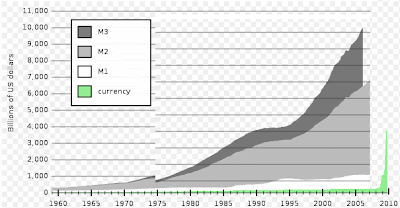


This 15-Fold Increase will be impossible to reverse

Next September, when the fed realizes it has gone too far and tries to reverse its balance sheet expansion, it will be unable to do so. The realities which will hinder the fed’s control of the money supply are:

1) The toxic assets filling its balance sheet

Expanding the money supply is easy. All the fed has to do is print dollars and then use them to buy assets. There is no effective limit to how much the fed can print and spend.

Shrinking the money is much trickier. To shrink the base money supply, the fed sell assets and takes the dollars it receives for them out of circulation. The amount the fed can shrink the money supply is therefore effectively limited by the market value of assets on its balance sheets. Since the fed is in the process of loading up on toxic securities while trying to restore health to the financial sector, it is now sitting billions of unrealized losses. These unrealized losses means the fed has little ammunition available to bring the money supply under control.

Once September rolls around, If the fed wants to reverse the expansion of its balance sheet and shrink the monetary base back down from 3,818 billion to 262 billion, then it will need to sell 3,556 billion worth of assets. However, the market value of its assets will only be worth a fraction of that.

2) Political constrains on fed's actions

Even if the fed does try to shrink the money, it is likely to run into political constrains on its actions:

A) Selling toxic assets at a loss could become a crippling source of major embarrassment for the fed, undermining its authority. For example, last year when the fed took 29 billion toxic assets to help JPMorgan’s takeover of Bear Stearns, it assured Americans that by holding those securities till maturity, the cost to taxpayers would be minimal. If the fed sells those toxic Bearn Stearns assets at a catastrophic loss, it would cause fury and outrage from voters and lawmakers.

B) Selling assets at below book value will quickly cause the fed’s equity to turn negative. The Federal Reserve would then need to be recapitalized by new debt from the treasury, which would increase the national debt.

3) The benefits from of its balance sheet expansion would be lost if the fed starts selling assets

The fed is accumulating toxic mortgage backed securities, long term treasuries, and other assets to unfreeze the credit markets and spur economic growth. Turning around and selling those assets would result in the collapse of the credit markets and the financial system, which the fed has been desperately trying to prevent.

Upwards pressure on interest rates

On top of all the issues above, the fed’s woes are going to be compounded by upwards pressure on the yields of treasuries and other US debt. This upwards pressure will likely force the fed to monetize far more treasuries than the planned $300 billion purchases it has already announced, and will greatly complicate any efforts by the fed to control the money supply.

Below are the nine factors which will cause yields to move higher.


1) Massive supply of treasuries in the pipeline

The biggest force pressuring treasury yield upward is without a doubt the trillions of debt the treasury has to sell to finance the enormous 2009 budget deficit. There is nowhere near enough buyers to absorb this supply. The graph below demonstrates the challenge facing the treasury in funding this year’s budget.
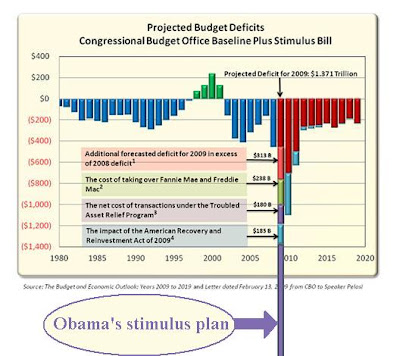


2) As a reserve asset, treasury bonds will face enormous selling pressure in 2009

There is the mistaken belief that the role of treasuries as a safe haven is bullish for treasury bonds. It is not. This logic ignores the reality that reserve assets, such as treasuries, are accumulate in good times and sold in bad times:

Federal and state agencies will be selling treasury reserves. For example, the Deposit Insurance Fund (a.k.a. FDIC) will be selling treasuries to pay back depositors of failed banks, and the Unemployment Trust Fund will be selling treasuries to make payments to the unemployed.

State and local governments will be selling treasury reserves. As an example, states have already begun drawing down reserves as their budget troubles worsen. The bulk of those reserve remain, and they will be sold over the course of this year.

Banks and insurers will be selling off their treasury loan-loss reserves. Financial institutions have been building their treasury loan-loss reserve for the last year in anticipation of growing defaults. In 2009, this process will reverse as loans go bad and insurers make good on claims.

Foreign central banks will be selling off their treasury foreign reserves. Saudi Arabia, for example, is projecting a 2009 Budget Deficit, which it intends to finance by selling off its US holdings. Russia, meanwhile, has already sold over 20% of its $598.1 billion reserves, and India's central bank has been forced to sell off its US holdings to curb its currency's decline, and its total reserves have decreased by $62.2 billion. Japan, which is now running a record current account deficit, can also be expected to sell treasuries.

Even China could become a seller of treasuries as it mobilizes its dollar reserves. The Chinese government has sent clear signals that it is shifting from passive to active management of its reserve and is exploring more efficient ways to use its reserves to boost its domestic economy.


3) Retirement inflows into treasuries are over

The steady accumulation of treasuries by government retirement funds has helped absorb the supply of treasury bonds for over three decades. This accumulation of government debt to secure the retirement of baby boomers helped drive down treasury yields and fund deficit spending. As of September 2008, the four biggest of these funds held 3.3 trillion treasuries:

2150 billion (Federal old-age and survivors insurance trust fund)
615 billion (Federal employees retirement fund)
318 billion (federal hospital insurance trust fund)
217 billion (federal disability insurance trust fund) (for more on these four funds, see where social security tax amounts are deposited)

3300 billion total

Today, the accumulation of treasuries by government retirement funds is over. Baby boomers are beginning to retire, increasing outflows, and unemployment is rising, cutting inflows. More importantly, the 3.3 trillion already accumulated in these funds provides an enormous political incentive to prevent treasury prices from collapsing. Faced with a run on treasuries, politicians, rather than explaining to baby boomers that their retirement savings are gone, will instruct the fed to monetize treasury bonds. This alone will prevent the fed from reversing its current balance sheet expansion.


4) Deleveraging in credit-default swap market will drive up risk premiums

If you have been following the credit crisis in any detail, you might have heard that the 53 trillion credit-default swap market threatening the solvency of the financial system. What you might not have heard is the other dire threat posed by the CDS market: drastically higher risk premiums on all forms of debt.

These higher risk premiums are the result of reversing the process by which credit-default swaps were leveraged up and packaged into investment vehicles. Some examples of these horrors are:

Synthetic CDOs
As opposed to regular CDOs (which contain actual bonds), synthetic CDOs provide income to investors by selling credit-default swaps on hundreds bonds from companies and governments.
To juice returns, these synthetic CDOs disproportionally insured the riskiest AAA rated debt, such as Lehman’s bonds. Synthetic CDOs are estimated to have sold insurance on between $1.25 trillion to $6 trillion worth of bonds.

Constant-Proportion Debt Obligations
CPDOs are specialized funds which work exactly like synthetic CDOs but with one major difference: they used leverage to boost returns. These CPDO
funds typically borrowed about $15 for every dollar invested with them. They also contain safety triggers that force the liquidation of their investments if losses reach a predetermined level, and most CPDO funds have begun to hit these triggers. For example, Three CPDO funds launched in 2006 by Dutch bank ABN Amro Holding NV have already been forced to liquidate as credit insurance costs spiked and their credit ratings were downgraded.

Credit Derivative Product Companies
CDPPs are another group of specialized funds which work exactly like synthetic CDOs and CPDO funds, except for one key difference: they used an insane amount of leverage, as much as $80 for every dollar invested. CDPP funds together with subprime CDOs squared are finalists for the title of “most idiotic financial instrument ever created”.


Since these leveraged investment vehicles sold an enormous amount of insurance, the premiums for CDS insurance dropped sharply, making corporate debt seem safer and lowering interest rates. In effect, the process of building up the 53 trillion CDS market created an era of artificially low risk premiums on all forms of debt. Unfortunately, the pendulum is now swinging in the other direction, and the pain has just begun.

As investors attempt to get out of synthetic CDOs and CPDO/CDPP funds try to deleverage, they push up the cost of default insurance. In turn, that raises the risk premium on all forms of debt since most investors use the cost of default insurance as a guide when deciding at what interest rate they will buy bonds.
Many banks are also tying corporate loan rates to credit-default swaps, raising borrowing costs and exposing companies to an overleveraged derivative market which is largely responsible for crippling the financial system.

The graph below shows how the cost of insuring the debt of EU nations is being driven up.
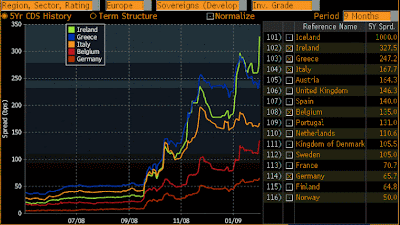


The rising cost of insuring debt is impacting treasuries too.
The cost to hedge against losses on $10 million of Treasuries is now about $100,000 annually for 10 years, up from $1,000 in the first half of 2007. These rising insurance costs have helped push up treasury yields in the last few months. Worse still, the rising costs of insuring against government defaults will undermine faith in dollar. After all, the CDS market is telling us that 10-year treasury notes have become 100 times riskier in the last two years.


5) Unwinding the Gold carry trade

The massive expansion in the US money supply will undoubtedly drive gold prices several times higher and force the unwinding of the gold carry trade. To see the threat which unwinding the gold carry trade poses, it is necessary to understand how US and UK financial institutions got themselves stuck in an enormous short position in gold from which they have no hope of ever escaping. For that purpose, I have outlined below the five steps Wall Street seems to repeat endlessly on its path to ruin.


Step 1: Wall Street embraces a false paradigm

“Housing prices never fall”

-----

“gold is a relic” or “gold is in a permanent downtrend”

Step 2: Wall Street makes billions embracing this false paradigm…

US/UK Financial institutions made billion in fees from making mortgage loans and securitizing them.

-----

US/UK Financial institutions made billions via gold carry trade. Here is an ultra quick explanation how it works from zealllc.com

So, if you can find a cheap enough cost of capital, a safe enough destination, and you have the credit to borrow large amounts of money, you too could make enormous profits in carry trades. The notorious gold carry trade is based on the exact same idea. Elite money-center bullion banks were given sweetheart opportunities to borrow central bank physical gold at 1%, sell it in the open market, and immediately invest the proceeds in higher yielding “safe” investments and reap vast profits.

As Moneyweek further explains:

It seemed like a no-brainer. The central banks got to squeeze a yield from their gold. The borrowers got to sell the gold on, and use the proceeds to fund more exciting investments like 10-year US Treasuries yielding 4% per year or so. Yes, these 'carry trade' returns were tiny. But the cost of borrowing gold was tinier still.

Step 3: …and creates a catastrophic mess in the process

Enormous housing bubble
Subprime CDOs squared
Off balance sheet SIVs
Etc…

-----

Commercial banks and speculators are left inescapably short gold. These ridiculous short positions are best captured by John Hathaway in his 1999 article,
The Golden Pyramid.

The recipe for a shortage has been carefully followed. A few finishing touches may be required before a market epiphany. There is no known reconciliation between paper and physical positions, and none will be attempted until after the squeeze. The weakness of credit analysis and supervisory oversight, as well as the many ambiguities in the linkage between paper gold and physical can flourish only if there is supreme confidence in gold's permanent downtrend. The trust and confidence essential to balance the gold derivatives pyramid depends on three critical errors: that mine reserves = physical gold; that gold receivables = gold on hand; and that financial markets will enjoy smooth sailing indefinitely. Trust is nothing more than a state of mind. When this levitation is finally exposed and its illusions shattered, it is ludicrous to think the imbalances can be corrected by a small rise in the price and within a comfortable time frame. Expect the resolution to be swift, furious, and uncomfortable for those caught short.

Step 4: Something goes horribly wrong

Subprime borrowers start defaulting
Housing prices plummet

-----

Gold prices shoot up after the 1999 Washington Agreement on Gold (EU central banks agreed to limits on gold sales/leasing).

This gold bear trap is best described by Reginald H. Howe in his report about central banks at the abyss.

The first Washington Agreement on Gold, announced in September 1999 at the close of the annual meetings of the International Monetary Fund and World Bank in Washington, D.C., placed limits for the next five years on the official gold sales of the signatories as well as on their gold lending and use of futures and options. Put together at the instigation of major Euro Area central banks in response to the decline in gold prices caused by the series of U.K. gold auctions announced in May of the same year,WAG I caused gold prices to shoot sharply higher.

Within days, as gold shorts rushed to cover, the price jumped from around $265 to almost $330/oz. and gold lease rates spiked to over 9%.
The rally caught the major bullion banks completely wrong-footed, resulting in the panic later described by Edward A.J. George, then Governor of the Bank of England (Complaint, 55):

We looked into the abyss if the gold price rose further. A further rise would have taken down one or several trading houses, which might have taken down all the rest in their wake. Therefore at any price, at any cost, the central banks had to quell the gold price, manage it. It was very difficult to get the gold price under control but we have now succeeded. The U.S. Fed was very active in getting the gold price down. So was the U.K.

Despite managing to “get the gold price under control”, US/UK bullion banks (JPMorgan, HSBC, etc…) have been stuck on the short side of gold ever since.

Step 5: The US fed and UK do everything in their power to “save the financial system”

Royal Bank of Scotland bailout
Bear Stearns bailout
Freddie/Fannie bailout
AIG bailout
US/UK Quantitative easing
Etc…

-----

Leasing out all US/UK gold to bullion banks
Gold swaps with foreign central banks (then leasing out the gold)
Convincing allies to sell gold
Writing naked call options on gold
Britain’s 1999 gold sales
Pre-emptive gold sales
Allowing JPMorgan’s and HSBC’s manipulation of COMEX futures
Etc


Make no mistake, gold prices have suppressed, but calling this process a “conspiracy” would be inaccurate. Gold suppression by the US and UK is better characterized as a desperate cover-up. Furthermore, while a side affect of the gold carry trade and gold suppression was to drive down interest rates, that was never their intended effect. A desire to hold interest rates would not have been enough to push the fed or the Bank of England to manipulate gold prices. It was only the threat of the total collapse of US/UK financial system which prompted the suppression of gold. The unwinding of the gold carry trade would have (and will) dragged down the some of the biggest US/UK banks under (JPMorgan, HSBC, etc…) and that was what had to be prevented at any cost.

Stay away from any form of paper gold: GLD (HSBC is custodian), gold pools and unallocated gold accounts, gold futures, etc… Paper gold investments are guaranteed to default before this crisis ends.


Besides leaving the financial system inescapably short gold, the gold carry trade also drove down yields on treasuries and other US debt, as commercial banks invested the proceeds from the sale of borrowed central bank gold and other naked short positions. Unwinding the gold carry trade involves the purchase of physical gold, but also the sale of the investments linked to the gold short positions. As the fed begins 15-fold expansion of the monetary base (which logically should eventually send gold prices up at least ten times where they are now), the unwinding and fallout of the gold carry trade seems imminent.


6) The return of the 580 billion dollars circulating abroad

Over the last thirty years, the steady outflow of 580 billion dollars has helped drive down interest rates. For example, If 10 billion dollars leaked out of the US and began circulating abroad, the fed would print 10 billion and buy treasuries in order to replenish the domestic money supply. So the 580 billion dollars held abroad resulted in the purchase of roughly 580 billion treasury bonds by the fed, thereby increasing demand for US debt.

While the accumulation of oversea dollars has been beneficial in the past, today the large pools of dollars circulating in foreign hands pose a threat. With many dollar alternatives becoming available, US oversea currency looks increasingly likely to start flowing back home. The main currencies with the potential to displace dollars are:

A) The Chinese yuan which is becoming an international currency
B) The Khaleeji, a new currency being launched by Gulf states which will be possibly backed by gold.
C) The Euro with its partial gold backing
D) Gold

Furthermore, now that the fed has begun creating money at an accelerating rate, the extensive foreign holdings of US currency might exacerbate the effects of inflation fears. As foreign dollar holders’ confidence in the dollar is eroded, they will trade their dollars for alternate stores of value (yuan, euro, gold, etc…), potentially sending a flood of currency back to the US. If the Fed failed to reduce the supply of currency to counteract dollars being unloaded from abroad, the inflationary consequences would be made worse as the mass reversal of currency flows from foreigners to the US becomes overwhelming.

7) Interest rate derivates nightmare

The threat posed by interest rate derivates is perhaps the greatest out of all the ones outlined so far. It is also the one hardest to understand. The first thing to note about interest rate swaps is the size of the market, as explained by the Wikipedia:

The Bank for International Settlements reports that interest rate swaps are the largest component of the global OTC derivative market. The notional amount outstanding as of December 2006 in OTC interest rate swaps was $229.8 trillion, up $60.7 trillion (35.9%) from December 2005. These contracts account for 55.4% of the entire $415 trillion OTC derivative market. As of Dec 2007 the number rose to 309,6 trillion according to the same source.

The growth in interest rate swaps creates demand for bonds because many of these interest derivatives require the purchase of bonds as a hedge. Rob Kirby on 321gold.com explains this in his article, the real ponzi scheme - "unreal interest rates".

Interest Rate Swaps create demand for bonds because bond trades are implicitly embedded in these transactions. Without end user demand for the product - trading for "trading sake" creates ARTIFICIAL demand for bonds. This manipulates rates lower than they otherwise would be.
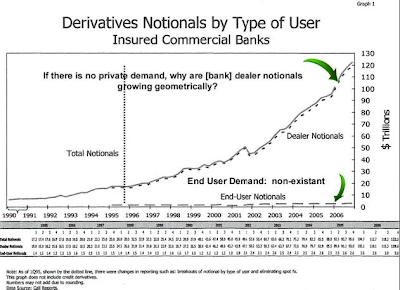


Interest rate swaps were originally developed to [1] allow parties to exchange streams of interest payments for another party's stream of cash flows; [2] manage fixed or floating assets and liabilities and [3] to speculate - replicating unfunded bond exposures to profit from changes in interest rates. Growth in the first two of these activities are dependent on their being increased end-user-demand for these products - graph 1 above indicated that this is not the case:

In the case of J.P. Morgan in particular[forgetting about the lesser obscenities at Citi and B of A]; their interest rate swap book is so big that there are not enough U.S. Government bonds being issued or in existence for them to adequately hedge their positions.

This means that
the obscene, explosive growth in interest rate derivatives was all about overwhelming the long end of the interest rate complexto ensure that every and any U.S. Government bond ever issued had a buyer on attractive terms for the issuer. Concurrent with the neutering of usury, the price of gold was also "capped" largely through Fed appointed banks "shorting gold futures" as well as brokering gold leases [sales in drag] sourcing vaulted Sovereign Central Bank gold bullion. The gold price had to be rigged concurrently because historically, according to observations outlined in Gibson's Paradox - lowering interest rates leads to a higher gold price. Gold price strength is historically synonymous with U.S. Dollar weakness which leads to higher financing costs or the possibility of capital flight.

Same as with the gold carry trade, while the explosive growth in interest rate derivatives did reduce interest rates by creating demand for bonds, I am not sure about the conspiracy element. From everything I have seen and read during the credit crisis, the wizards of Wall Street (ie: the creators of the subprime CDO squared and other horrors) and the Federal Reserve seem more like children playing with dynamite rather than masterminds capable of pulling off vast conspiracies.

The greater threat posed by interest rate swaps

Besides creating artificial demand for bonds, the interest rate swap market poses a systematic risk exceeding that of the credit-default swap market because of its enormous size and the fact that each interest rate swap contract offers the potential for unlimited losses. The graph below should help show this danger.
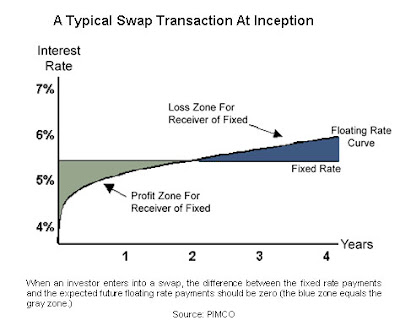


In a currency collapse (which is where we are headed with Bernanke’s 15-fold increase in the money supply), interest rates follow inflation to astronomical heights. Loans for 24 hour periods and interest rates in the five or six digits are common in hyperinflation, and, should they occur here in the States, anyone “short the swap” (the floating-rate payers in interest rate swaps) will be crushed into oblivion. At least with credit default swaps, there is a limit to how much investors can lose.


8) The liquidation of the 8 Trillion dollar holdings of overleveraged European banks

European banks increased their dollar assets sharply in the last decade which helped drive down US interest rates
and absorbed a large portion of America's growing debt. Their combined long dollar positions grew to more than $800 billion by mid-2007. This $800 billion was then leveraged into $8 trillion in US assets. The low capital ratios of these dollar positions were acceptable to regulators because European banks are allowed to apply a lot more leverage as long as they are buying exclusively AAA rated securities.

Unfortunately, as we have learned over the past 18 months, AAA is not always AAA. While much of the AAA rated securities bought by European banks were treasuries and agencies, some of these AAA rated securities were senior securitized loans that are still marked close to par on the balance sheet of European banks despite the fact they trade around 70 cents on the dollar in the markets. The enormous unrealized losses on their US holdings are only one of the problems facing European banks.

The other is the loss of their dollar funding. The enormous leverage employed by European banks to purchase toxic AAA rated assets was funded in great part by loans from US money market funds. After Lehman's default led to massive withdrawals from those money market funds, European banks lost access to billions in dollar funding.

If European banks are forced to sell their 8 trillion US assets, it will crash the credit markets, and they will have to recognize enormous losses. Since the fed is desperate to prevent the collapse of the US financial system, it lent those European banks 600 billion dollars so that they wouldn't be forced to sell. Meanwhile, European banks accepted this 600 billion because they don't want to recognize losses on their toxic US securities.


What is going to happen next with these overleveraged European banks?

Well, if history is any guide, the outlook isn’t good for the US financial system:

“When the American economy fell into depression, US banks recalled their loans, causing the German banking system to collapse”

The same thing will happen in 2009, except the roles will be reversed. It will be European banks that will recall their loans and sell off dollar assets, causing the US banking system to collapse.

What could convince European banks sell off their US assets at firesale prices?

The answer is simple: fear of a dollar collapse. With the fed increasing the monetary base 15-fold, the strategy of waiting for impaired assets to recover becomes meaningless: with the dollar likely to lose nine tenths of its value in the next year, waiting for assets trading 70 cents on the dollar to recover is a senseless venture.

9) Inflation expectations

The US’s experience during the Great Depression has left America dominated by Keynesian thinking and prone to deflation fears. As a result, inflation expectations are about nonexistent right now despite the current financial crisis. However, the fed’s latest plan to expand the monetary base 15-fold should give pause to even the most hardened deflationist. Indeed someone must be worried, because the fed’s Wednesday announcement has caused a dramatic collapse of the dollar:



The sheer size the fed’s monetary expansion and the dollar’s fall will soon increase both inflation and inflation expectations. This in turn will put upwards pressure on treasury yields.


Conclusion

During the last three decades, long-term interests rates have fallen steadily in US, as demonstrated by the chart below
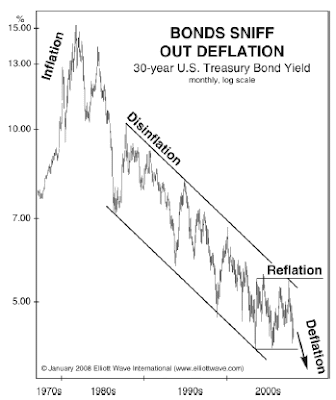


Logically speaking, the chart above makes no sense. The fundamentals underlying the US economy have grown steadily worse over the last thirty years. For example, in 2006, the US’s current account deficit nearly hit 9 percent of our gdp, and economists usually consider 4 percent to be unsustainable. There are also the US’s chronic budget deficits and the massive projected social security shortfalls. Even more incomprehensible, over the last six months the yield on long-term treasuries has fallen in the face of a disintegrating economy and massive expansion in the supply of treasuries. This is NOT how the world works: as the financial health of borrowers decrease, their interest rates are supposed to go up. The only rational explanation is that some combination of forces has been unnaturally driving rates lower. These forces, (outlined above) which have been driving interest rates down, are today threats and issues which need to be resolved before the financial crisis can end:

The US budget deficit
The crisis in entitlement spending
The trade deficit and large holdings of treasury reserves
The credit-default swap market
The gold carry trade
The 580 billion dollar circulating overseas
The 8 trillion dollar assets accumulated by European banks
The interest rate swaps market
The Keynesian thinking dominating US economic and fiscal policy "


http://www.marketskeptics.com/2009/03/fed-is-planning-15-fold-increase-in-us.html

Entry #1,081

"China calls for new reserve currency (replacing US dollar)

"U.N. panel says world should ditch dollar | U.S. | Reuters

http://www.reuters.com/article/newsOne/idUSTRE52H2CY20090318

_____

 
"China calls for new reserve currency
By Jamil Anderlini in Beijing

Source The Financial Times 

Published: March 23 2009 12:16 | Last updated: March 24 2009 00:06

"China’s central bank on Monday proposed replacing the US dollar as the international reserve currency with a new global system controlled by the International Monetary Fund.

In an essay posted on the People’s Bank of China’s website, Zhou Xiaochuan, the central bank’s governor, said the goal would be to create a reserve currency “that is disconnected from individual nations and is able to remain stable in the long run, thus removing the inherent deficiencies caused by using credit-based national currencies”.

Analysts said the proposal was an indication of Beijing’s fears that actions being taken to save the domestic US economy would have a negative impact on China.

“This is a clear sign that China, as the largest holder of US dollar financial assets, is concerned about the potential inflationary risk of the US Federal Reserve printing money,” said Qu Hongbin, chief China economist for HSBC.

Although Mr Zhou did not mention the US dollar, the essay gave a pointed critique of the current dollar-dominated monetary system.

“The outbreak of the [current] crisis and its spillover to the entire world reflected the inherent vulnerabilities and systemic risks in the existing international monetary system,” Mr Zhou wrote.

China has little choice but to hold the bulk of its $2,000bn of foreign exchange reserves in US dollars, and this is unlikely to change in the near future.

To replace the current system, Mr Zhou suggested expanding the role of special drawing rights, which were introduced by the IMF in 1969 to support the Bretton Woods fixed exchange rate regime but became less relevant once that collapsed in the 1970s.

Today, the value of SDRs is based on a basket of four currencies – the US dollar, yen, euro and sterling – and they are used largely as a unit of account by the IMF and some other international organisations.

China’s proposal would expand the basket of currencies forming the basis of SDR valuation to all major economies and set up a settlement system between SDRs and other currencies so they could be used in international trade and financial transactions.

Countries would entrust a portion of their SDR reserves to the IMF to manage collectively on their behalf and SDRs would gradually replace existing reserve currencies.

Mr Zhou said the proposal would require “extraordinary political vision and courage” and acknowledged a debt to John Maynard Keynes, who made a similar suggestion in the 1940s. 

Copyright The Financial Times Limited 2009 "

http://www.ft.com/cms/s/0/7851925a-17a2-11de-8c9d-0000779fd2ac.html

Entry #1,080

"What You Pay Attention To Creates Your Life III

"What You Pay Attention To Creates Your Life III

By Bill Harris November 24th, 2007 
Source Dream Manifesto

"Mastering your Internal Map of Reality This may all seem incredibly complex, and in a sense, it is. (In fact, we’ve just scratched the surface of your Internal Map of Reality, looking at just a few aspects of it.) You are fluent in your native language, however, and even the simplest language is complex. Mastering your Internal Map of Reality is like anything else - you start where you are, you practice, and you make progress.

Since this process is one of discovering yourself, and how you create your experience of life, it’s a fascinating undertaking, with profoundly positive rewards. Mastering your Internal Map of Reality is much the same process a jazz musician uses to learn to improvise. The musician practices chords, scales, and other pieces of musical vocabulary. He consciously thinks of these things and how to arrange them while he practices.

At some point, however, his ability to play no longer requires conscious thought. He relaxes his linear mind and turns his playing over to that part of his mind I mentioned a moment ago, a part that knows how to utilize the skills he has practiced. This other part of his mind can see all the possible choices for what to play in each next moment, evaluate them, choose the best one, and then play it - all in a fraction of a moment, and without conscious thought.

The musician must play this way. The music happens much too quickly to allow him to think his way through it with his linear mind. So, he plays with little or no linear thought, in the same way you talk to others without considering grammar, syntax, or even giving much thought to the content of what you say.

Okay, so you aren’t a jazz musician. But you probably do know how to drive a car.

When you first learned to drive you had to think your way through each move. “Time to stop. Where is the brake? When, exactly, do I step on it, and how hard - in order to stop at the right place and the right moment?” “Okay. Time to change lanes. I’ve got to look over my shoulder, judge how much room I need, decide how fast to go, and when to go, and then use the right amount of gas, breaking, and steering, all at the exact right time.”

It was a lot of work because you had to do it all with your conscious, linear mind. Now, though, you drive with little if any conscious thought. To be a little bit Zen about it, when you drive you’re one with the car. How did you get that way? By practicing, by driving until you developed the ability to evaluate all the possibilities in each moment, choose the right one, and then do it - all without consciously thinking about it. Just like the jazz musician, you began by being unconsciously incompetent (you didn’t know how, and you didn’t even know what you didn’t know).

Then, with a little bit of practice, you became consciously incompetent (you began to realize what you didn’t know, and what you needed to work on). Next, you became consciously competent (you could do it, but you had to think your way through it). Finally, you became unconsciously competent (you turned it over to a part of your unconscious mind that can evaluate an infinite number of variable, instantly, decide what to do, and then do it).

The ability to move through these various stages, by the way, is connected to the amount of neural real estate devoted to whatever it is you are learning. Once you have practiced enough, the part of your brain responsible for driving, or playing music - or consciously and intentionally operating your Internal Map of Reality - takes over and does its job.

So you can learn to take charge of your Internal Map of Reality. First, you learn the basics of how it works. Next, you notice how you’ve been using it and what results your way of using it has been creating. Then you play with each part and find out what it does, and notice all the other choices you haven’t been exercising. You play with those and find out what they do. Eventually, the same mechanism that allows you to drive a car while you eat, talk on the phone, change the radio station, put on your makeup, and talk to your passengers, will take over.

You’ll be just like the jazz musician who, after practicing for many years, effortlessly generates beautiful music. The fact that you may not know anyone with this kind of control over his or her mind shouldn’t keep you from believing that you can learn to do this.

It can be done (I’ve done it, and I have taught many others to do it). All that’s required is the desire to do so, and the persistence to practice. The process is fascinating, and the rewards are huge. What would you do if you really could be in charge of what you feel, how you behave, and what people and situations you attract into your life?

We each have a choice. We can continue to automatically create whatever our Internal Map of Reality has been pre-programmed to create, or we can develop the awareness, and the flexibility, to intentionally and fluidly change our Map of Reality, moment - by - moment, as needed, in order to create whatever we want.

You may not have realized, up to now, that this choice existed, but it’s a real choice. You can take the reins of your mind, and in mastering your mind, you can master your life."

http://www.dreammanifesto.com/part-3.html

Entry #1,079

"What You Pay Attention To Creates Your Life II

"What You Pay Attention To Creates Your Life II

By Bill Harris November 22nd, 2007 
Source Dream Manifesto

"Metaprograms are content-free (unlike beliefs or values, each of which has content) in the sense that they can be applied to any content. Let’s look at a couple of the more important metaprograms.

The Direction Filter determines whether, when you look at a given situation, you move toward what you want, or away from what you don’t want. If someone asks you why having a good job is important to you (assuming that it is), you might say that having a good job creates a good living and allows you to exercise your creativity.

In this case, you’ve described what you want to move toward - a good living, and exercising your creativity. You might, though, use this filter in the opposite way and say that without a good job you would struggle to make ends meet, and you would feel bad spending forty hours a week doing something you find uninteresting. In this case, you’ve described what you want to move away from - not being able to make ends meet, and spending your time on something that does not interest you. In both cases, your intention might be the same, to have what you want. In the first case you want to get it by moving toward it, while in the second you want to get it by moving away from the opposite.

These two ways of focusing your mind, however, will create very different outcomes. To move toward what you want, you have to focus on it. In most cases this means picturing it internally or talking to yourself about it. As with all focusing, this will create certain feelings and behaviors, and it will cause you to attract or be attracted to the people or situations that will help you make what you’ve focused on happen in reality.

As always, your mind figures out how to create what you focus on. When you move away from what you don’t want, something very similar happens, but with an interesting twist. To move away from something you don’t want, you also have to focus on it. Unfortunately, your mind takes what you focus on very literally. It assumes that you want whatever you focus on. It doesn’t register the negative and, as before, it gets busy attracting or creating what you’ve focused on - even though you don’t want it.

If, for instance, you are afraid that people don’t like you, you will find ways to attract people who don’t like you. You might become attracted to people who don’t like anyone. You might act in such a way that people don’t like you. You might interpret what people say and do in a way that makes it seem that they don’t like you, even if they do. You can see that automatically focusing on what you don’t want is not resourceful, yet many people do it.

To be in charge of what you create, you need to use this filter consciously. You cannot allow it to operate unconsciously.

A second metaprogram filter, The Reason Filter, determines why you do whatever it is you are doing. Do you do it because it’s possible, or because you have to? Many people unconsciously and automatically follow a set of rules or “supposed-to’s” they learned while growing up. These rules create pre-programmed focusing and pre-programmed behavior.

There are certain benefits to this - rules act like shortcuts, allowing us to act in ways that have worked in the past). However, no set of rules can cover all possibilities, and what do you do when you can’t find a rule that works? And, many of the rules we carry with us from childhood are nothing more than hand-me-down limitation from our parents.

Rules and “have-to’s” filter out other possibilities, and if you filter out the possibilities, you don’t see them. If you don’t see them, they don’t exist. If you focus on the possibilities in any given situation, you may still end up with the same action the rules would have generated, but you’ll be doing it for a different reason, and you’ll have considered many possibilities that might generate a much more resourceful outcome.

But what about the shortcut advantage?

Won’t you need to consider all the possibilities - which could be infinite - in every situation? Relax. There is a part of you that can consider them all, evaluate them, and choose the most resourceful, and do it in an instant. It isn’t your linear mind, though, which does everything one step at a time, but rather another part of you that can handle an unlimited number of variables all at once. (More about that in a moment.) These (and about twenty more) metaprogram filters determine what you pay attention to.

You can either use them unconsciously, as you probably are now, or you can master them and use them consciously and intentionally. When these filters operate unconsciously and automatically, you will create your life in a certain pre-set way. If you operate them consciously and intentionally, you can create whatever you want. It’s that simple."

http://www.dreammanifesto.com/centerpointe-part-2.html

Entry #1,078

"What You Pay Attention To Creates Your Life Part 1

Awesome information, hope you enjoy!!

____

"What You Pay Attention To Creates Your Life  Part 1

By Bill Harris November 20th, 2007
Source Dream Manifesto

"Your Internal Map of Reality is really just a way of taking what comes in through your senses and turning it into what you feel, how you behave, and the people and situations you attract or become attracted to. There are several steps in this process. In the simplest sense, you begin by deciding what to pay attention to. Then, you decide how to pay attention to it, in other words, how to represent to yourself internally whatever you are paying attention to (i.e., how to think about it).

These two simple steps involve a number of rather complex sub-steps. Deciding what to pay attention to involves choosing what you allow in through your senses - a simple example being whether to watch television, read a book, or watch the sunset. Next, of all the millions of bits of information touching your senses in each moment, you have to decide which to notice and which to delete and therefore not notice. This is no minor decision (and, right now, if you’re like most people, you’re making it unconsciously and automatically). The amount of information coming in through your senses in each moment is enormous.

You can pay attention, in any moment, to only a tiny fraction of it, which means that you must delete most of it. And because this onslaught of sensory information keeps coming and coming and coming, you must make this decision over and over, in every moment. To make this easier, your internal map of reality consists of certain automatic, pre-set ways of deciding what to let in and what to delete.

This method, as handy as it is, has certain drawbacks. You decided how to decide what to pay attention to when you were very young, before you had any real criteria for deciding how to do it. To be truly effective as a human being, you’re going to have to take this process off of autopilot and learn to do it consciously and intentionally. In each moment, and depending on the outcome you have in mind, what is most resourceful to pay attention to changes.

Consciously deciding what to pay attention to and what to delete has huge advantages. One automatic method of deciding what to pay attention to is your beliefs. Beliefs are crystallized, pre-set ways of focusing attention, and as such become self-fulfilling prophecies, in the sense that we find ways to make whatever we believe come true in reality (or at least seem to be true, which usually amounts to the same thing). When you believe something, you delete whatever does not support the belief, and keep the rest.

Beliefs also strongly affect your ability to attract or become attracted to people and situations that help confirm that what you believe is, indeed, true. A wit once said, “If I hadn’t believed it, I wouldn’t have seen it.”  This bon mot actually describes how it works. For instance, if you believe that in relationships men will be untrustworthy and unreliable, you will notice, attract,and become attracted to men who are, indeed, unreliable.

In a crowded room, your attention will be automatically drawn to such men. At the same time, you’ll fail to notice, or fail to become attracted to, men who don’t fit this profile (another example of how we use unconscious cues to attract certain people and situations). If you do encounter men who are reliable in relationships, you won’t be attracted to them, or you’ll interpret what they do as evidence of unreliability, even if that isn’t really true.

If you believe it’s difficult to make money, you’ll focus your attention in such a way that you’ll attract or become attracted to situations where it is, indeed, difficult to make money. You’ll also fail to notice situations where it might be easier to make money. If you do notice a moneymaking opportunity, you’ll discount it, or act in a way that leads to failure anyway - again, confirming the “truth” of what you belief.

Different beliefs cause us to attract different people and situations, to behave in different ways, and to create different outcomes - outcomes that demonstrate the truth of what you already believe. Your goal, of course, is to operate your internal map of reality consciously and intentionally, adjusting how you use it on the fly to fit each situation and the outcome you want to create. This means choosing what to believe based on the outcome you want.

Since you will find a way to make anything you believe either come true or seem to be true, choosing what to believe becomes a method for creating what you want.

Most people choose what to believe because “it’s true.” In other words, they believe it because they have “evidence.” Once you have evidence and, based on that evidence, believe something to be true, you will find ways to create more evidence - which is why psychologists call it a self-fulfilling prophecy. This means that you shouldn’t decide what to believe based on past evidence. Instead, you should decide what to believe based on the outcome you have in mind.

Now how do you do that? Doesn’t that mean you have to disregard “the evidence” - to pretend that what the evidence tells you is true isn’t true? Yes, you do, in a sense. How, then, do you go against the evidence you currently have for what you believe now, assuming that you want to change what you believe? First, you understand that beliefs generate evidence, and evidence also generates beliefs. If you decide to believe something that is more resourceful, you will generate evidence that this new belief is true. In fact, ALL beliefs are “true,” in the sense that all beliefs generate their own evidence.

Next, you look around and realize that someone else, somewhere, believes what you would like to believe. If so, it is possible to believe it. So, borrow that other person’s evidence until you have your own. Believe “as if” the belief is true. If you do think “as if” the belief is true, and act as if it is true, you will generate the ideas, the motivation, the internal qualities, and the behavior, which will make it come true.

You can choose what to believe, based on what you want to create. When you change what you believe, you change what you pay attention to and what you delete, and in doing so, you change how you feel and behave, and what and whom you attract.

A second key aspect of your Internal Map of Reality is your values. Values are simply what you think is important. When you think something is important, you pay attention to it, and you spend time on it.

Values, then, are another filter that determines what you pay attention to (and, therefore, what results you create). Values also have an additional and more specialized role: they are the source of motivation.

If something is important to you, you pay attention to it, and you are motivated by it. As with beliefs, you can choose what is important to you. Most people make this choice when they are too small to have any criteria for choosing. How do they choose, then? They choose based on pressures applied by their parents. Parents have an agenda, sometimes positive and sometimes not, for what should be important, and this becomes another unconscious, automatic part of your Internal Map of Reality.

You can, however, choose what to value, and in doing so, take charge of your life. In addition to beliefs and values, there is another collection of filters we use to decide what to pay attention to and what to delete, called metaprograms....."

http://www.dreammanifesto.com/pay-attention-creates-life.html

Entry #1,077

"Radio Lab: Into the Brain of a Liar

My take ..... Washington's must be a sea of "white matter".

____________


"Radio Lab: Into the Brain of a Liar
by Robert Krulwich and Jad Abumrad

Jake Rofman for NPR

"Morning Edition, March 6, 2008 · We all lie — once a day or so, according to most studies. But usually we tell little lies, like "your new haircut looks great!" And most of us can control when we lie or what we lie about. But some people lie repeatedly and compulsively, about things both big and small.

In 2005, a study published in The British Journal of Psychiatry provided the first evidence of structural differences in the brains of people with a history of persistent lying. The study was led by Yaling Yang, a doctoral student in psychology at the University of Southern California, and Adrian Raine, an expert on antisocial disorders who is now at University of Pennsylvania.

They expected to see some kind of deficit in the brains of these liars, Yang says. But surprisingly, the liars in their study actually had a surplus — specifically, they had more connections in the part of their brains responsible for complex thinking.

Finding Liars

The label "pathological liar" gets used in a variety of ways, and there's no standard psychological definition or test to measure if someone is a pathological liar. So Yang and her team chose to focus their study on people who have a history of repeated lying and seem not to be able to control their lying (hereafter called simply, "liars"). The researchers began by gathering volunteers from temporary employment agencies in the Los Angeles area. The idea was that liars would be over-represented at these agencies; a history of repeated lying would likely make it hard to keep a steady job.

Then they ran 108 volunteers through extensive interviews and a battery of tests that measure patterns of deception. In the end, the team found 12 people who showed strong evidence of repeated and compulsive lying. For control groups, they identified 16 people who had antisocial tendencies but no history of lying and 21 people with no history of either lying or antisocial behavior.

Into the Scanner

Yang and her colleagues put all 49 people, both the liars and the non-liars, into a magnetic resonance imaging scanner and took pictures of their prefrontal cortex. They chose to focus on this area of the brain because previous studies had shown that the prefrontal cortex plays a role in both lying and in antisocial behaviors.

If you could look into this part of the brain, which sits right behind your forehead, you would see two kinds of matter: gray and white. Gray matter is the groups of brain cells that process information. Most neuroscience studies focus on gray matter. But nearly half the brain is composed of connective tissues that carry electrical signals from one group of neurons to another. This is white matter. Roughly, gray matter is where the processing happens, and white matter connects different parts of the brain, helping us to bring different ideas together.

The liars in Yang's study had on average 22 percent to 26 percent more white matter in their prefrontal cortex than both the normal and antisocial controls.

More Connections

Yang speculates that the increase in white matter means that people who lie repeatedly and compulsively are better at making connections between thoughts that aren't connected in reality — like, say, "me" and "fighter pilot." Consequently, while some of us struggle to come up with reasons why we were late for work, or can't go out with someone we don't really like, Yang's liars impulsively serve up a heaping helping of excuses and stories, and fast.

"By having more connections," Yang says, "you can jump from one idea to another and you can come up with more random stories and ideas."

Admittedly, this study is just a first step. It doesn't show that more white matter in the prefrontal cortex accounts for all lying or that it's the only part of the brain involved. And the study does not establish whether the brain differences lead to lying or whether repeated lying somehow "exercises" connections in the brain. While the study was carefully designed to exclude differences that could be due to age, ethnicity, IQ, brain injury or substance abuse, the small sample size means the results need to be replicated. More research is needed to define what behaviors count as pathological lying and to establish the mechanism behind those behaviors.

A Promising Beginning

Still, the study provides a promising starting point for exploring the relationship between lying and white matter in the brain. For example, brain scans of autistic people, who have difficulty telling lies, show the exact opposite profile of Yang's liars: They have less white matter than other people. In autistic children, white matter doesn't develop at a normal rate.

"For normal people, from age 2 to age 10 there is a big jump in their white matter," says Yang, "and actually that's the same age that they develop the skill to lie."

Yang has good reason to be thinking about the development of young brains: She's a new mom. She's on maternity leave keeping a close eye on her daughter, Zoe.

"Every step, every little noise she makes, it makes me wonder what's going on in her brain," Yang says. And because she's a scientist, as well as a mother, she does more than just wonder. "It's too early to scan her brain," Yang says, "but eventually I will do it."

Soren Wheeler contributed to this report."

http://www.npr.org/templates/story/story.php?storyId=87922568

Entry #1,076

Tax "$750 billion "green" investment could revive economy: U.N.

Add a tea bag to the latest global elitist slush fund.  

________


$750 billion "green" investment could revive economy: U.N.
Thu Mar 19, 2009 4:24am EDT

Source Reuters

OSLO (Reuters) - Investments of $750 billion could create a "Green New Deal" to revive the world economy and protect the environment, perhaps aided by a tax on oil, the head of the U.N. environment agency said on Thursday.

Achim Steiner said spending should focus on five environmental sectors including improved energy efficiency for buildings and solar or wind power to create jobs, curb poverty and fight climate change.

"The opportunity must not be lost," Steiner, head of the U.N. Environment Program (UNEP), told Reuters of a UNEP study that will be put to world leaders meeting in London on April 2 to work out how to spur the ailing economy.

The UNEP report said investments of one percent of global gross domestic product, or about $750 billion, could bankroll a "Global Green New Deal" inspired by the "New Deal" of U.S. President Franklin D. Roosevelt that helped end the depression of the 1930s.

Investments should be split between more energy efficient buildings, renewable energies, better transport, improved agriculture and measures to safeguard nature -- such as fresh water, forests or coral reefs, it said.

Thursday's study adds details of spending after UNEP called for a Green New Deal late last year.

Steiner also said that the world urgently needed funds to jump start a U.N. deal to fight global warming, due to be agreed in Copenhagen in December to succeed the U.N.'s Kyoto Protocol beyond 2012.

He floated the possibility of taxing oil in rich nations of the Organization for Economic Cooperation and Development (OECD) to help a new pact become the cornerstone of a greener economy.

"If, for argument's sake, you were to put a five-year levy in OECD countries of $5 a barrel, you would generate $100 billion per annum. It translates into roughly 3 cents per liter," he said.

UNNOTICED

"It would be almost, if not totally, unnoticed by the consumer," he said, especially since oil prices have fallen from more than $140 a barrel at mid-2008 peaks to about $40.


A barrel of oil contains 158 liters and OECD consumption is about 20 billion barrels a year, he said. "This is just one example, there may be many others," of funding, he said.

"I am concerned about the prospect of a meaningful deal in Copenhagen if there is not a significant financial package on the table," he said. Cash would encourage poor nations to step up actions to curb rising greenhouse gas emissions.

"The argument that we cannot afford this does not, on any serious analysis, hold much water -- especially given the cost to the global economy of failure to act on climate change," he said.

Carbon markets, which could also be a source of funds to help fight climate change, were unlikely to contribute enough cash in early years of a new climate deal, he said.

Steiner said there were promising signs that economic stimulus packages by many nations, ranging from the United States to China, were being tailored to help a shift toward greener growth and away from dependence on fossil fuels.

The U.N. Climate Panel says that greenhouse gases from burning fossil fuels are a prime cause of warming that will cause more heatwaves, droughts, rising sea levels and more powerful storms."

http://www.reuters.com/article/environmentNews/idUSTRE52I09T20090319?sp=true

Entry #1,075